
Why do 55% of CRM implementations fail to meet their business goals? It isn’t usually a software glitch. Most service providers treat a CRM like a digital filing cabinet rather than the structural blueprint of their conversion machinery. If you’re managing lead data across sticky notes, emails, and scattered spreadsheets, you’re leaking profit every hour. Successful CRM implementation for service businesses requires more than just a software login. It demands a systematic approach to how your team handles every inquiry from the first click to the final invoice.
You know the frustration of watching a qualified lead go cold because a follow-up took two days instead of five minutes. It’s exhausting to spend money on marketing without knowing exactly which efforts drive real profit. This article will show you how to transform your fragmented operation into a high-performance growth engine. We’ll explore how to build a unified system that automates lead routing, captures missed calls, and provides total visibility into your sales pipeline. You’ll learn how to turn your CRM into a scalable asset that powers predictable revenue growth through 2026 and beyond.
Key Takeaways
- Stop treating software as a standalone solution and learn how to align your sales and operations through a structured operational blueprint.
- Discover why successful CRM implementation for service businesses focuses on lead routing as the mechanical heart of your entire sales process.
- Build a “Review Loop” that automatically triggers reputation management requests the moment a job is marked complete in your system.
- Bridge the gap between your marketing efforts and real profit by integrating your Visibility Engine directly into a central nervous system.
- Transition from managing fragmented tools to partnering with an architect who builds reliable systems for long-term stability and revenue growth.
Why Most CRM Implementations Fail for Service Businesses
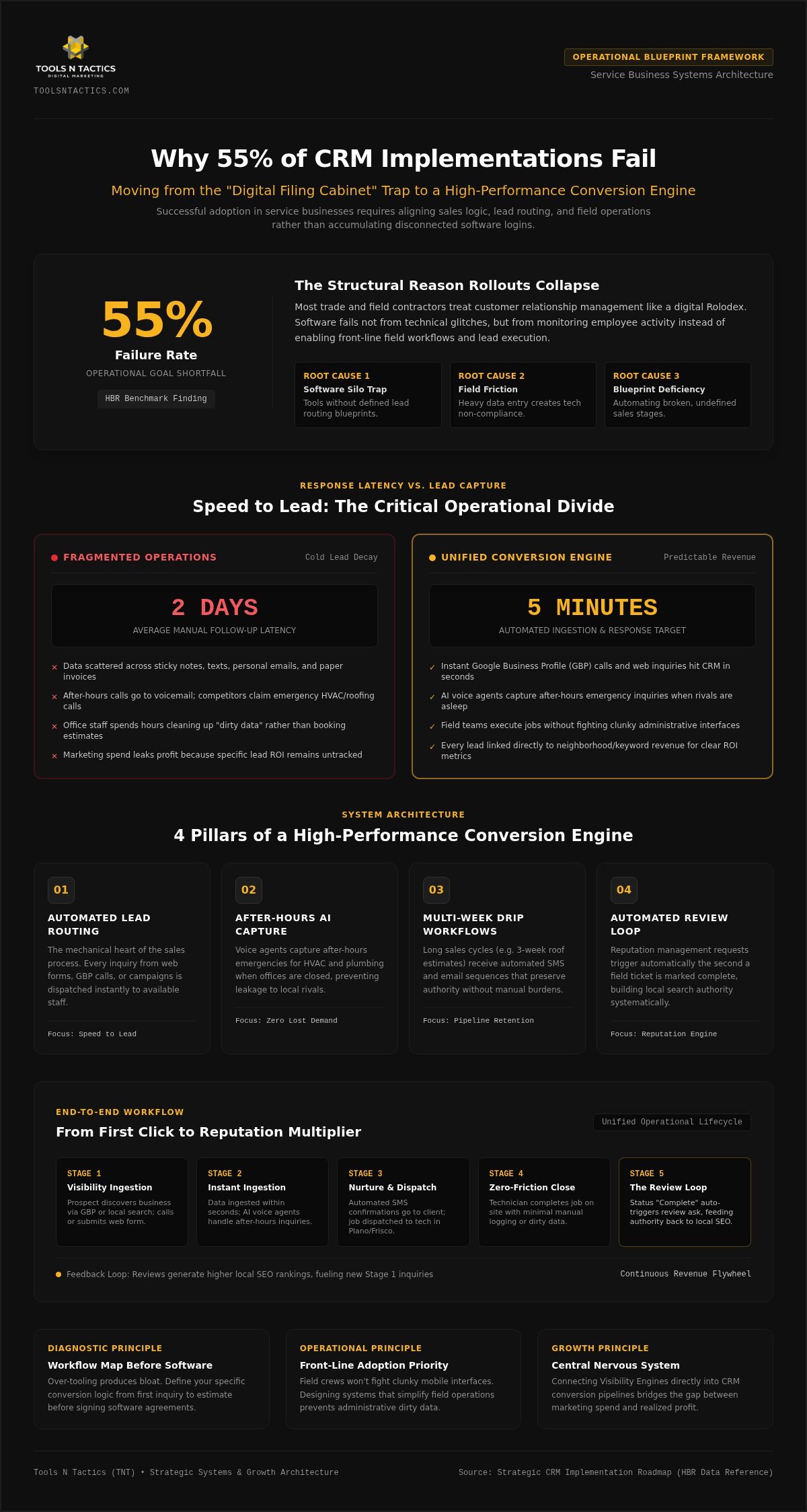
Most service business owners treat a CRM like a digital filing cabinet. They pay for a subscription, hand out logins, and wonder why their revenue hasn’t moved. This “digital Rolodex” mindset is why 55% of CRM rollouts fail to meet operational goals. True customer relationship management isn’t about the software; it’s about the structural alignment of your sales and operations.
When you fall into the “Software Silo” trap, you buy tools without a blueprint for lead routing. This leads to fragmented data scattered across emails, texts, and paper invoices. The cost is high. You lose leads to slow follow-ups and waste marketing spend on efforts you can’t track. Instead of a silo, your business needs a high-performance Conversion Engine that connects your marketing efforts to your bottom line.
The Friction Between Field Work and Data Entry
Manual data entry is the enemy of adoption. For HVAC and roofing crews in Plano, every minute spent fighting a clunky mobile app is a minute they aren’t on a roof or fixing a unit. If your system requires constant manual input, your team won’t use it. This creates administrative bloat where office staff spend hours cleaning up “dirty data” instead of booking estimates. In high-competition North Texas markets, this friction causes lead leakage. If a lead isn’t captured and routed instantly, your rivals will take the job before your tech even opens their phone. A system that works must reduce friction, not add to it.
The Blueprint Deficiency
Many contractors over-tool. They pay for advanced features that don’t drive job site efficiency or improve the customer experience. You need a workflow map before you select a platform. Without a map, you’re just automating a broken process. CRM implementation for service businesses is the process of digitizing your unique business logic. By defining your conversion stages from the first inquiry to the final estimate, you ensure the system serves the business. Strategic CRM implementation for service businesses transforms a fragmented operation into a unified, scalable growth engine. It moves you from merely existing in the market to dominating it with structural integrity.
The Components of a High-Performance Conversion Engine
A CRM isn’t just a database; it’s the engine room of your entire operation. If your Visibility Engine is generating interest but your CRM isn’t capturing it, you’re essentially building a house without a foundation. Successful CRM implementation for service businesses requires a shift in perspective. You must stop seeing it as a tool for your office staff and start seeing it as the mechanical heart of your sales process. When properly integrated, it acts as the central repository for your business authority and reputation management.
Research from Harvard Business Review highlights why CRM projects fail so frequently. It’s often because companies focus on monitoring employee activity rather than enabling front-line processes. To avoid this, your Conversion Engine must be built to handle leads with surgical precision. This is where the Automation Engine becomes vital. It maintains the “speed to lead” necessary to win jobs in a competitive landscape where homeowners expect instant responses.
Lead Routing and Automated Distribution
In high-demand markets like Plano and Frisco, every second counts. Your system must ensure that every Google Business Profile (GBP) call or website inquiry hits the CRM in seconds. This isn’t just about convenience; it’s about survival. For emergency services like HVAC or plumbing, AI voice agents can capture after-hours leads when your competitors are asleep. By linking each lead source directly to CRM data, you can measure your marketing ROI with absolute clarity. You’ll know exactly which neighborhood or search term is driving your most profitable jobs. If you want to see how your current systems stack up, we can help you audit your existing lead workflows.
SMS and Email Follow-Up Workflows
Service businesses often deal with long sales cycles. A homeowner might inquire about a new roof today but not sign the contract for three weeks. Automated follow-up is the only way to stay top-of-mind without burying your team in manual tasks. You can build “drip” sequences that maintain your authority through educational content and proof points. These workflows ensure that no prospect falls through the cracks. For specific sequence strategies, refer to our guide on automated lead follow up for service businesses. This systematic approach turns a cold inquiry into a warm, trusting customer by the time your technician arrives on-site.
CRM as the Central Nervous System for Local SEO
A CRM is more than just a place to store phone numbers. It is the central nervous system that feeds your local search visibility. Most agencies treat SEO and sales as separate departments. This is a mistake. When you integrate your CRM with your marketing, you create a feedback loop that strengthens your brand’s authority in real-time. This integration ensures that your operational success becomes visible to search engines and potential customers alike.
By using CRM data to power reputation management, you ensure your business stays at the top of the Google Map Pack. Search engines reward businesses that show consistent, recent activity. Your CRM knows exactly when a job is done. Automating the “Review Loop” turns every successful service call into a signal of trust. This data also helps you refine your Visibility Engine by showing exactly where your most profitable customers live in Frisco and Dallas.
Automating Customer Trust
Trust isn’t something you wait for; it’s something you build through reliable systems. The mechanics are simple. When a technician closes a ticket in the field, the CRM triggers an SMS review request immediately. This timing is critical. If you wait 24 hours, your response rate drops. Consistent reviews build the Authority Engine required to dominate Plano search results.
You must avoid “review gating,” which is the common mistake of only asking happy customers for feedback. Google penalizes this practice because it manipulates the score. A proper CRM implementation for service businesses automates the request for every customer. This ensures your profile remains authentic and compliant while maintaining a steady stream of fresh social proof.
Data-Driven Local Visibility
Your CRM is a goldmine of geographical data. You can map customer density in Frisco or Celina to see where you are actually winning. If you have a high concentration of jobs in a specific zip code, you should adjust your Google Business Profile service areas to match. This turns your CRM into a strategic tool for local SEO targeting rather than just a passive database.
Many owners guess which keywords drive revenue. A CRM tells you the truth. By connecting lead sources to closed jobs, you see which search terms are high-value and which are just noise. If you aren’t sure where your visibility stands, connecting your CRM data to a free SEO audit can reveal hidden gaps in your local strategy. Effective CRM implementation for service businesses ensures your marketing budget is spent where it actually produces a return. This level of insight is the difference between a business that survives and one that scales.
A Strategic Roadmap for CRM Implementation in 2026
Building a high-performance system requires more than just picking a software vendor. It requires a blueprint. Successful CRM implementation for service businesses is a five-step process that builds structural integrity into your daily operations. You don’t just “install” a CRM; you architect a conversion machine. This process ensures your technology serves your business goals rather than creating new administrative headaches.
- Step 1: The Visibility Audit. You must track exactly where your leads originate before you can optimize how they are handled.
- Step 2: Define Conversion Engine Stages. Map the path from the initial inquiry to the estimate and finally to the closed job.
- Step 3: Lead Routing Automation. Integrate AI voice agents and automated routing to ensure no call in Plano or Frisco ever goes to voicemail.
- Step 4: Mobile-First Field Training. Ensure your HVAC or roofing crews can capture data on-site without administrative friction.
- Step 5: The Strategic Feedback Loop. Use closed-job data to tell your marketing team which service areas are actually driving profit.
Mapping the Service Lifecycle
You need to visualize the entire path a customer takes. It often begins with a “marketing agency near me” search or a Google Business Profile click. Many service businesses have bottlenecks right after the first contact. Leads fall through the cracks because the hand-off from the dispatcher to the field tech is broken. You can use custom fields to fix this. Track job-specific data like equipment types or warranty dates. This ensures your team has the right parts and information before they even pull into the driveway. If you want to stop losing leads during the hand-off, contact us to audit your workflow.
The Implementation Sprint vs. Long-Term Growth
A one-off setup is a recipe for failure. You might get the software running, but without an ongoing growth partner, the system will eventually decay. You must set benchmarks for lead response times and conversion rates. Measuring these metrics requires a professional analytics and tracking setup to ensure your data is clean and actionable. This long-term approach moves you away from firefighting and toward a predictable revenue model. CRM implementation for service businesses is not a project with an end date. It’s the ongoing process of refining your business’s structural integrity to handle higher volumes without breaking.
Partnering for Scalable Growth in North Texas
Software vendors sell you a tool and walk away. They provide the hammer but no blueprint for the house. Tools N Tactics | Local SEO & Digital Marketing Solutions’s Growth Partner Program operates on a different level. We act as the architect of your business’s structural integrity. CRM implementation for service businesses is only effective when it fits into a larger strategic framework. You need a partner who understands that a login is not a solution. We move your operation from the chaos of fragmented efforts to the security of consistent, scalable results.
A CRM must function as part of an integrated whole. Your Visibility, Conversion, and Authority Engines must work in unison to drive revenue. For service firms in Plano and the wider Dallas-Fort Worth area, the competition is too intense for disconnected systems. You need a local partner who knows the regional market pressures. When these engines are aligned, your business transforms from a collection of tasks into a high-performance conversion machine. This systematic approach ensures your long-term stability in a crowded digital landscape.
Beyond the CRM: The Integrated Growth Engine
Strategic CRM implementation for service businesses is a core component of a high-level seo company plano tx strategy. You have to stop managing a pile of disconnected tools. Instead, you must manage a unified growth system. Tools N Tactics | Local SEO & Digital Marketing Solutions doesn’t just provide a CRM, but implements a revenue-generating machine. This machine connects your search visibility directly to your sales pipeline. It ensures that every lead generated by your local SEO efforts is captured, tracked, and nurtured until the job is closed and the review is posted. This creates a repeatable cycle of growth that builds real business value.
Next Steps for North Texas Service Leaders
Delaying your implementation is a choice to lose market share. Your rivals in Plano are already automating their follow-ups and securing their lead pipelines. Every hour you spend manually entering data is an hour you aren’t scaling your revenue. The first step is securing a GBP audit to see exactly what your system will be processing. This audit identifies the visibility gaps that your CRM will eventually help close. We invite you to stop fighting your software and start building a systematic blueprint for your long-term stability. Let’s build a growth engine that works as hard as your crews do.
Secure Your Business Infrastructure for 2026
A CRM is not a software purchase; it’s the structural blueprint of your business’s conversion machinery. You’ve seen how fragmented data and slow response times leak profit every single day. By treating your CRM as the central nervous system of your operation, you connect marketing visibility directly to your bottom line. Successful CRM implementation for service businesses requires more than a login. It demands industrial-strength systems that automate lead routing and capture customer trust through integrated AI and automation.
Don’t let your business settle for mere existence while rivals in Plano and Frisco scale their revenue. Our local North Texas implementation experts are ready to help you move from operational friction to a repeatable, high-performance growth engine. It’s time to stop fighting clunky tools and start architecting a reliable future for your crews and your community. You have the hard work; we provide the systems to make it scale.
Build Your Growth Engine Blueprint Today
Frequently Asked Questions
How long does a typical CRM implementation take for a service business?
A typical CRM implementation for service businesses takes four to eight weeks to reach full operational capacity. This timeframe covers the strategic audit, workflow mapping, and crew training. Rushing this process often results in a “Software Silo” where tools exist but don’t communicate. We focus on establishing a stable foundation during this sprint to ensure your systems can handle high lead volumes across North Texas without failing.
Do I need a separate CRM if I already use field service management software?
You often need both to maintain a high-performance conversion engine. Field service tools excel at dispatch and invoicing, but they frequently lack robust lead nurturing or automated follow-up capabilities. A dedicated CRM acts as the central nervous system that captures inquiries from your website and routes them into your operational software. This integration prevents lead leakage and ensures your marketing efforts connect directly to your bottom line.
What is the most important feature for a contractor’s CRM?
Automated lead routing and instant distribution are the most critical features for any contractor’s CRM. If a potential client isn’t contacted within five minutes, your chance of winning the job drops significantly. Your system must include instant SMS text-back and automated routing to your active technicians. This “speed to lead” is what separates top-performing firms in Plano from those who lose jobs to faster competitors.
How can a CRM help me get more Google reviews in Plano?
A CRM automates the “Review Loop” by sending SMS requests the moment a technician completes a job in the field. This timing is vital for building the Authority Engine needed to rank high in Plano search results. By sending a direct link while the service is fresh, you increase review velocity and recency. This consistent social proof tells Google your business is active and trusted throughout North Texas.
Can a CRM automate my lead follow-up without sounding like a bot?
Yes, you can maintain a human touch by using custom fields to insert specific job details into your automated sequences. Instead of generic messages, your CRM can reference the exact service provided or the specific neighborhood in Frisco where your team worked. This personalization builds customer trust by making the interaction feel relevant. Our Automation Engine uses these blueprints to keep your brand top-of-mind without requiring constant manual input.
What happens if my team refuses to use the new CRM system?
Low adoption usually happens when systems create administrative bloat or have clunky mobile interfaces. We solve this by focusing on mobile-first data capture that minimizes work for your field crews. Training should highlight how the system simplifies their day, such as providing quick access to customer history and equipment specs. If a system is built for job site efficiency, your team will treat it as a valuable tool.
Is CRM implementation worth the investment for a small service business?
CRM implementation for service businesses is a high-value investment because it transforms a fragmented operation into a scalable growth engine. Small firms often suffer most from inconsistent follow-ups and lost leads. A properly architected system ensures every marketing dollar spent has a clear path to conversion. It moves your business away from manual tracking and toward predictable revenue growth in a competitive North Texas market.
How does a CRM integrate with my local SEO efforts?
Your CRM provides the geographic data needed to refine your local visibility strategy. By mapping where your most profitable jobs are located in Celina or Melissa, you can adjust your Google Business Profile service areas with data-driven precision. This insight reveals which keywords are driving actual revenue rather than just empty search volume. It ensures your local SEO strategy is fueled by real-world sales performance.