
Paid advertising is rented real estate, and the landlord raises your rent every single month. The second you pause your daily ad budget, your lead flow evaporates, leaving your crews idle and trucks parked. You already know that burning hard-earned operating profit on skyrocketing click costs isn’t a sustainable way to scale. Mastering marketing for service business without paid ads is how you break free from this cycle, take control of your pipeline, and build lasting equity in your local market.
You shouldn’t have to keep bidding against rival contractors just to speak with serious homeowners who value quality work. In this guide, you’ll discover how to construct a self-sustaining marketing engine that delivers steady, qualified inbound inquiries without paying for clicks. We will examine the operational blueprint to turn your Google Business Profile, localized service pages, and automated intake workflows into permanent assets that command higher job prices and compound in value over time.
Key Takeaways
- Why relying on pay-per-click auctions drains operating margins, and how marketing for service business without paid ads creates permanent digital assets that compound over time.
- The exact local search signals required to lock down Google Local 3-Pack placement and capture high-intent homeowners through dedicated service landing pages.
- How to fix common mobile conversion leaks and transform a passive brochure site into an active client acquisition platform that books jobs.
- Why consistent review velocity and specific project feedback generate stronger customer trust and higher pricing power than static review totals.
- The automated speed-to-lead workflow that engages inbound inquiries within five minutes to secure booked appointments before competitors even check their inboxes.
The Paid Advertising Trap: Why Rented Attention Stalls Service Growth
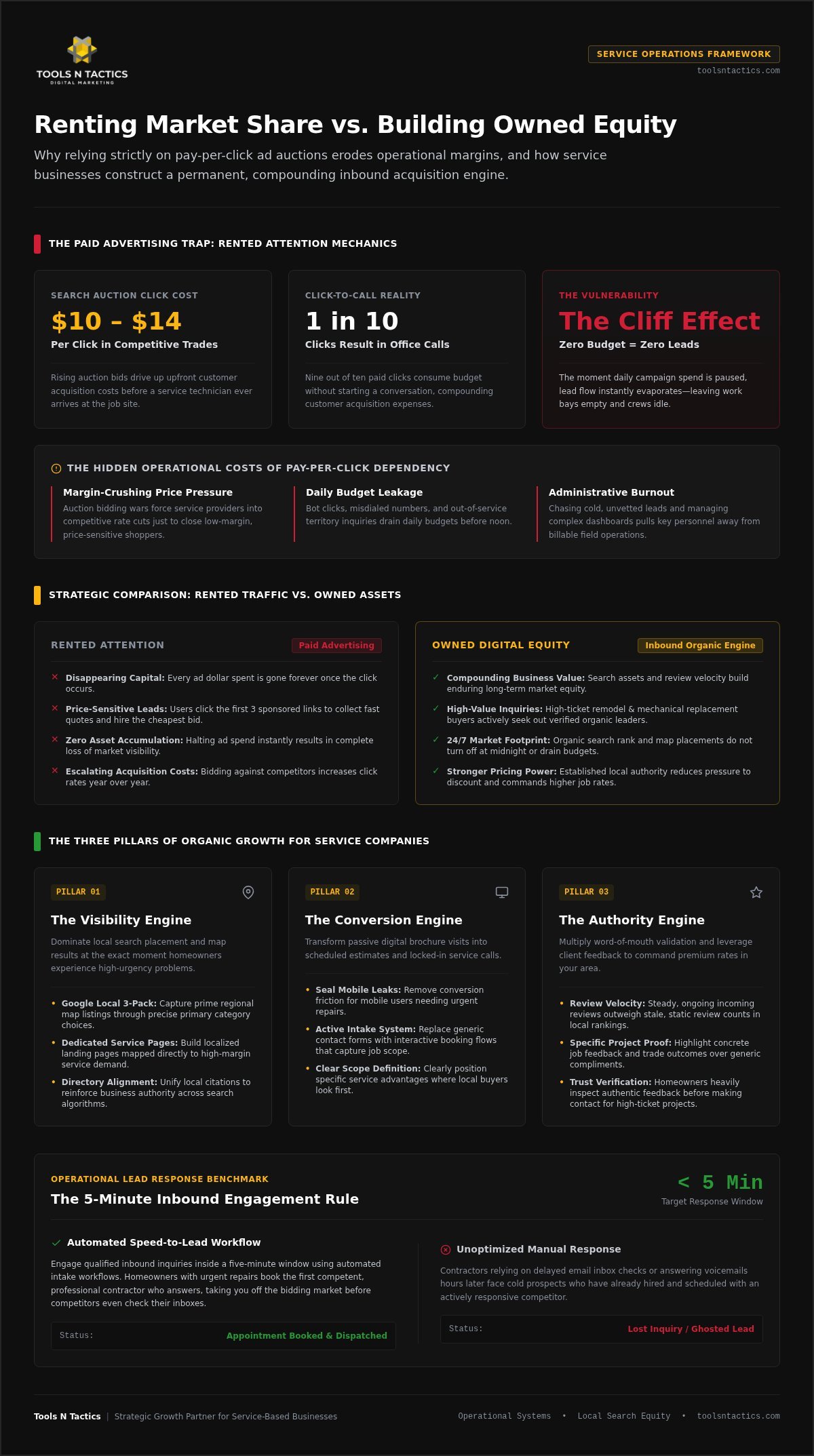
Pay-per-click advertising feels like an easy spigot to turn on when your install bays sit empty. You fund an ad account, set a daily budget, and wait for inbound calls. What ad agencies rarely explain is how auction bidding mechanics erode your margins over time. In competitive home service trades, search ads frequently cost between $10 and $14 per click. If only one in ten clicks calls your office, your customer acquisition cost climbs before a technician ever steps foot on the job site.
Relying exclusively on paid platforms introduces a severe operational vulnerability: the cliff effect. The minute you pause your ad budget, inbound phone calls drop to zero. You haven’t built a business engine; you’ve leased temporary traffic. In contrast, implementing sustainable marketing for service business without paid ads builds owned digital equity that keeps producing qualified inquiries month after month.
Paid ad traffic also attracts higher volumes of price-sensitive shoppers who click the first three sponsored links, collect quick quotes, and hire the cheapest provider. Homeowners seeking high-ticket replacements, major remodels, or complex mechanical repairs behave differently. They skip the sponsored tags, scrutinize organic map rankings, read authentic client feedback, and rely heavily on modernized word-of-mouth marketing across local communities before picking up the phone.
The Hidden Operational Costs of Pay-Per-Click Dependency
Running on the paid ad treadmill drags down your daily operations in ways that never appear on a simple agency performance report:
- Margin-crushing price pressure: Auction bidding wars force contractors into competitive rate cuts just to close low-margin leads.
- Budget leakage: Bot clicks, misdialed numbers, and out-of-service inquiries drain daily budgets before noon.
- Administrative burnout: Managing complex ad dashboards and chasing cold ad leads distracts operational leaders from completing revenue-producing field work.
Renting Versus Owning Your Digital Market Share
Every dollar spent on paid platforms disappears immediately after the click occurs. Paid campaigns require continuous funding just to generate a single new conversation. When you stop feeding the meter, your business vanishes from view.
Transitioning toward marketing for service business without paid ads shifts capital from an ongoing operating expense into an appreciating business asset. When you deploy an integrated Visibility Engine, your search footprint expands organically. High-ranking local profiles and search assets don’t turn off at midnight. They establish unmatched local authority, compound in reach over time, and generate reliable lead volume that paid banners cannot buy.
The Visibility Engine: Dominating Local Search and Google Maps
Claiming prime real estate on Google Maps isn’t an accident. It requires an intentional build. For service businesses, securing a spot in the Google Local 3-Pack puts your company directly in front of homeowners at the exact moment their pipe bursts or roof leaks. Core ranking signals rely on precise category choices, proximity, and review signals, while website architecture provides the necessary backing. Aligning these elements creates a dependable foundation for marketing for service business without paid ads, ensuring you capture demand instead of constantly chasing it.
Building local search equity means treating your digital footprint like real physical infrastructure. As outlined in the Small Business Administration guide to marketing and sales, sustainable market presence comes from clearly defining your service advantages and systematically distributing that message where local buyers look first. When your map listing, core directory citations, and localized site pages reinforce each other, search engines recognize your business as the logical primary recommendation for regional service calls.
Google Business Profile Optimization for High-Intent Calls
Locking down high-intent inquiries through your Google Business Profile requires precision configuration rather than guesswork:
- Select precise primary categories: Align your primary category with the exact service driving your highest margin. Secondary categories should capture complementary trades without diluting your main focus.
- Fill out complete service menus: Build out itemized service cards with plain-language scopes rather than leaving blank tabs or generic bullet lists.
- Audit listing mechanics: Use an external GBP audit tool to diagnose baseline ranking gaps, missing attributes, and profile vulnerabilities.
- Post weekly operational proof: Publish regular project updates featuring unedited photos of completed field work across your actual service territory.
Building Local Search Signals Through Location Pages
A single generic service area page won’t win competitive search queries across multiple suburbs. Search engines prioritize websites that show verified local relevance. Construct dedicated city service landing pages for surrounding municipalities, weaving in specific neighborhood references and job site summaries. Whitespark data shows that dedicated pages for each service represent the top factor for local organic search rank. Run a free SEO audit to identify indexation problems or broken internal links that prevent crawlers from indexing these geographic assets.
Answer Engine Optimization for Modern Local AI Discovery
Homeowners increasingly ask conversational AI engines like ChatGPT and Google Gemini for contractor recommendations. Capturing this organic volume requires structured Answer Engine Optimization (AEO). Write detailed, diagnostic troubleshooting guides answering specific maintenance questions, and apply structured schema markup so AI algorithms can parse your hours, certifications, and service boundaries without friction. If you want help structuring your local visibility architecture across North Texas, you can talk with our team to plan your deployment.
The Conversion Engine: Turning Organic Website Traffic into Booked Jobs
Generating local search impressions solves only half of your customer acquisition problem. An influx of website visitors won’t help your field crews if your digital storefront operates like an outdated paper brochure. Service businesses often lose high-margin jobs because their pages look like static art portfolios rather than functional intake platforms. An integrated Conversion Engine transforms passive web visitors into dispatched technicians and confirmed revenue.
Effective marketing for service business without paid ads requires building a friction-free bridge between discovery and booking. BrightLocal reports that 54% of consumers go directly to a contractor’s website after reading reviews to verify credentials and scope out the process. If your site hides contact options or loads slowly during a water heater breakdown, prospects leave immediately for a competitor who makes scheduling simple.
Eliminating Friction Across Mobile User Experiences
Contractor leads are largely won or lost on smartphone screens. Homeowners managing property repairs need clear, immediate pathways to contact dispatch:
- Persistent click-to-call banners: Keep a fixed phone button visible on mobile screens so prospects never have to scroll backwards to call.
- Streamlined intake forms: Cut out unnecessary questions. Capture only their name, phone number, physical address, and a brief description of the job issue.
- Fast load speeds: Strip heavy uncompressed images that stall page load times on weak cellular connections during emergencies.
Trust Architecture That Pre-Sells Homeowners on Quality
Serious property owners want reassurance before letting crews into their homes. Prominently display verified trade licenses, worker compensation proof, and local insurance bonds above the fold. Authentic job site galleries showing clean company trucks, marked uniforms, and neat work sites establish real credibility. To keep customer feedback compliant and transparent, review official FTC guidance on customer reviews before collecting testimonials. Strategic layout decisions also impact your close rates. Explore foundational design practices in our breakdown of high-converting landing page architecture to tighten page structure.
Converting Inbound Traffic with On-Site Automation
Inbound service requests peak during evenings and weekends when office dispatchers are off the clock. Deploying an intelligent virtual intake system captures qualified homeowner details while your competitors route calls to empty voicemail boxes. For deeper technical execution, look into integrating an AI-driven local business assistant to answer basic customer inquiries and qualify repair needs. When implemented properly, inbound inquiries route straight into your internal scheduling calendar, securing booked appointments around the clock without manual admin delays.
The Authority Engine: Multiplying Inbound Referrals and Reputation Velocity
A static total of two hundred reviews from three years ago won’t convince a cautious homeowner today. BrightLocal research shows that 74% of consumers care primarily about reviews written in the last three months, while 32% evaluate feedback from just the past two weeks. Relying on an outdated reputation leaves your business vulnerable to competitors who capture reviews continuously. Building an active Authority Engine provides the steady stream of social proof needed to close high-margin jobs without bidding wars.
High review velocity does more than satisfy search algorithms. It commands pricing power. When prospective buyers see consistent, glowing feedback highlighting prompt arrivals, clean uniforms, and transparent quotes, their sensitivity to price drops significantly. Establishing this degree of market authority forms a core pillar of marketing for service business without paid ads, insulating your business from market downturns and diluting the impact of an inevitable rogue negative review.
Systematizing Review Collection at the Job Site
Manual review requests fail because technicians forget to ask once the work order is signed. Removing human friction requires an automated operational system:
- Automate post-service text triggers: Connect your field software or CRM so an automated SMS review link dispatches within one to two hours of job completion.
- Technician verbal priming: Train technicians to notify the homeowner before departure that an automated quality check text is on its way.
- Public, keyword-rich replies: Respond to every review. Reference the specific neighborhood and service completed, such as an AC condenser retrofit or roof leak repair.
Review additional operational workflows in our comprehensive breakdown of online reputation management for service businesses to streamline field feedback collection.
Building Strategic Referral Loops with Non-Competing Trades
Satisfied customers are your first referral source, but non-competing trade partners are your most reliable. A roofing company, a seamless gutter installer, and an insulation contractor all serve the same homeowners at different stages of property maintenance. Establishing formal referral pipelines creates a predictable web of qualified inbound opportunities that cost nothing in media spend.
Equip trade partners with direct booking links and simple referral assets so sending prospective clients takes seconds. Combine this with automated seasonal maintenance check-ins for past clients to keep your crews top of mind year-round. This referral flywheel transforms happy homeowners and local trade peers into an active, unpaid sales force. If you are ready to systematize your referral systems and market reputation, schedule a growth strategy session to map out your implementation.
Connecting the Framework: Deploying an Automated Inbound Growth Engine
Connecting visibility, conversion, and authority into one unified mechanism completes your operational pipeline. When a homeowner discovers your business on Google Maps, evaluates your recent reviews, and visits your service page, they are ready to hire. If that inquiry sits in an unmonitored inbox for hours, your hard-earned visibility goes to waste. The final stage of marketing for service business without paid ads is operational speed, converting organic discovery into dispatched crews before competitors even open the ticket.
Automating Inbound Response and Speed-to-Lead
Customer acquisition in field services is won in minutes, not days. Research from Harvard Business Review and MIT shows that contacting an inbound inquiry within five minutes makes you 21 times more likely to qualify that prospect compared to waiting just 30 minutes. In fact, 78% of customers buy from the provider that responds first, yet the average response time across businesses lingers between 42 and 47 hours. Connecting an Automation Engine fixes this operational friction across your business:
- Centralized lead routing: Unify phone calls, quote forms, and map inquiries into a single CRM dispatch queue.
- Instant two-way text engagement: Dispatch an automated SMS response within 60 seconds to open an immediate dialog while homeowner intent is at its peak.
- Automated booking links: Provide direct scheduling links so commercial and residential clients can book evaluation slots without phone tag.
Examine the operational mechanics behind these workflows in our guide to automated lead follow-up for service businesses.
Aligning Your Business for Long-Term Organic Domination
Relying on fragmented software tools, uncoordinated marketing freelancers, and ad auctions drains your operating margins. Pay-per-click click costs continue to rise, forcing contractors into unpredictable bidding wars that eat away gross profit. Building sustainable marketing for service business without paid ads requires treating your digital presence with the same craftsmanship you bring to the job site. When you combine top-tier local map rankings, high-converting service pages, and automated intake workflows, you create a permanent asset that compounds in value each month.
Instead of managing multiple disconnected marketing providers, you can align with an integrated strategic partner through the Growth Partner Program. Take control of your local market and build a sustainable acquisition pipeline by choosing to contact Tools N Tactics today.
Take Control of Your Local Market Equity
Relying on rented advertising space is an expensive habit that drains your operating margins and leaves your schedule vulnerable. True business stability comes from building owned digital infrastructure that produces qualified job inquiries whether you run ads or not. Executing effective marketing for service business without paid ads means pairing prominent local search visibility with friction-free mobile conversion pages and consistent customer review velocity.
When you align the Visibility, Conversion, and Authority Engine framework with automated lead response workflows engineered specifically for trade services, you stop reacting to algorithmic changes and start controlling your pipeline. Partnering with a dedicated team turns your digital presence into an appreciating asset that delivers compounding local market equity year after year.
Your trucks belong in homeowners’ driveways, not parked outside an empty shop. Take the first step toward lasting market leadership and schedule your consultation with Tools N Tactics today.
Frequently Asked Questions
Can a service business survive and scale without spending on paid ads?
Yes. Relying on paid ads rents temporary visibility, whereas marketing for service business without paid ads builds permanent digital assets. By optimizing your Google Business Profile, building localized service pages across North Texas communities like Plano and Frisco, and automating client intake, your company creates compounding organic equity. This eliminates margin-eroding click costs and produces a steady stream of qualified customer inquiries that never vanish when an ad budget stops.
How long does it take to see consistent organic leads from local SEO?
Most service contractors begin seeing measurable movement in local pack rankings within 60 to 90 days. Achieving consistent, market-dominating lead volume typically takes four to six months of systematic effort. The timeline depends on local competition in areas like Dallas or Celina, baseline profile health, and how aggressively you build dedicated service pages and capture authentic customer reviews. Unlike paid ads, organic gains compound and endure over time.
What is the most effective organic marketing channel for home service contractors?
Your Google Business Profile paired with high-converting local landing pages is your most potent organic lead channel. Homeowners facing urgent repairs turn to Google Maps first. When your listing ranks in the local 3-pack and connects to a fast mobile site with clear service scopes, you capture high-intent property owners ready to hire immediately. Organic search generates higher trust and attracts customers who prioritize workmanship over the lowest price quote.
Why is my Google Business Profile not generating customer phone calls?
Your profile likely lacks category precision, geographic signals, or review momentum. Common culprits include choosing the wrong primary category, leaving service menus blank, or listing an unverified physical address. If your website lacks dedicated pages for your trades in target cities like Sherman or Princeton, Google won’t view your profile as authoritative. Fixing these operational gaps transforms an inactive listing into a reliable client acquisition asset.
How many Google reviews does a local service company need to dominate their market?
Total review volume matters less than velocity and recency. Having 200 reviews from two years ago carries little weight with modern algorithms and discerning homeowners. To dominate local competitors across Collin and Denton counties, focus on generating a predictable stream of five to ten fresh reviews each month. Consistent, recent feedback with specific mentions of the services performed signals reliability and active field operations to both Google and prospective buyers.
What is speed-to-lead and why does it dictate organic conversion rates?
Speed-to-lead measures how quickly your team contacts an inbound customer inquiry. Research shows contacting a lead within five minutes makes you 21 times more likely to qualify that prospect than waiting half an hour. Homeowners often reach out to multiple contractors during repairs; 78% buy from whoever responds first. If your organic inquiries sit unanswered in an inbox, you forfeit high-margin jobs to faster competitors regardless of your search rankings.
How do automated follow-up systems recover lost organic inquiries?
Automated follow-up systems immediately engage prospects through instant two-way SMS and missed-call text-back workflows. When a homeowner calls while your technicians are on a job site, an automated system instantly texts them back with scheduling options. Implementing these operational workflows completes your strategy for marketing for service business without paid ads, ensuring no qualified lead slips through the cracks and capturing bookings while your competitors let calls go straight to voicemail.