Why do local homeowners browse your website, inspect your business profile, and then hire your competitor down the street? When a homeowner faces a broken heat pump or a damaged roof, skepticism runs high. They aren’t just purchasing a repair; they’re taking a financial gamble on whether a contractor will show up and deliver quality work. If you’ve wondered how to build trust with local customers online, the reality is straightforward: credibility is engineered through verifiable proof, not empty sales talk.
You already know the frustration of spending money on digital visibility that yields tire-kickers instead of phone calls, only to lose high-value jobs to rivals with active profiles. This guide delivers the step-by-step framework service contractors use to establish undeniable credibility, capture qualified local leads, and turn online searchers into loyal clients. Ahead, we break down the operational blueprint for showcasing real-world proof, systematizing your review pipeline, and turning skeptical searchers into profitable, repeat customers.
Key Takeaways
- Understand why cautious homeowners hesitate to call and how to build trust with local customers online using verifiable operational proof.
- Turn your Google Business Profile into a high-converting digital storefront by aligning critical business details and maintaining active visibility signals.
- Upgrade your website into a conversion engine by swapping generic stock photos for authentic job-site imagery, licensing data, and clear local identifiers.
- Deploy automated review workflows to consistently capture five-star feedback directly from field service completions.
- Implement rapid-response SMS and lead routing systems to engage incoming service requests within minutes before competitors react.
Why Local Customers Hesitate Before Calling Your Service Business
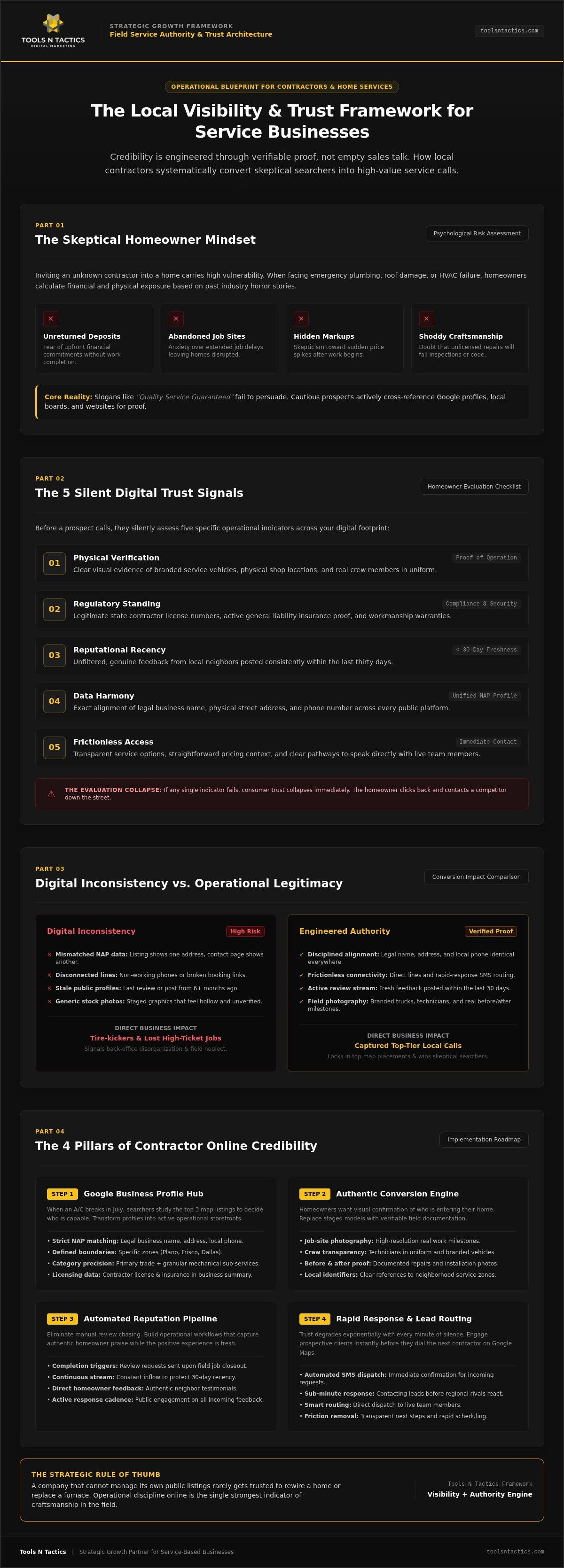
Inviting an unknown contractor into a home carries real vulnerability. When a homeowner searches for an emergency plumber, an HVAC specialist, or a roofing crew, they calculate both financial and physical exposure. Bad past experiences linger. Stories of unreturned deposits, abandoned job sites, hidden markups, and shoddy craftsmanship make every local searcher inherently cautious. Understanding sociological and psychological aspects of trust shows that people require verifiable cues of competence and safety before taking a vulnerability-inducing action.
Before a prospect ever picks up the phone, they silently evaluate five distinct trust signals across your digital presence:
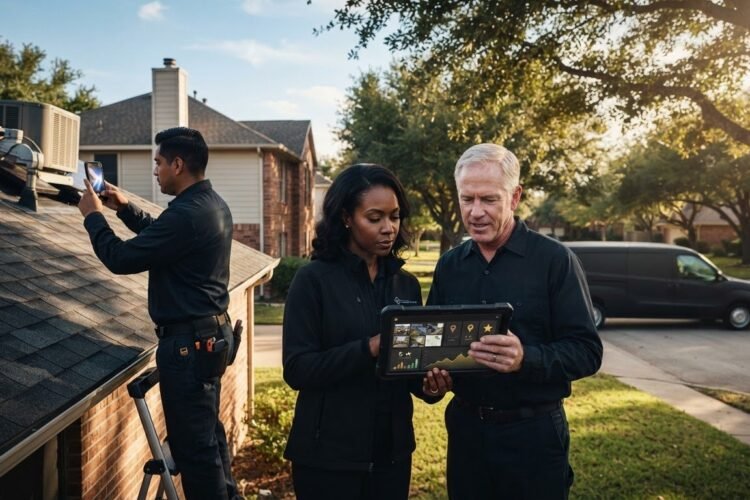
- Physical verification: Clear visual evidence of branded vehicles, physical shop locations, and real crew members.
- Regulatory standing: Legitimate trade license numbers and explicit proof of general liability insurance.
- Reputational recency: Unfiltered feedback from local neighbors posted within the last thirty days.
- Data harmony: Exact alignment of business name, physical address, and phone number across the web.
- Frictionless access: Transparent service options and clear pathways to speak with a live team member.
If any single indicator fails, the evaluation collapses. The homeowner clicks the back button and calls your competitor across town.
The Skeptical Homeowner Mindset
Polished slogans like “Quality Service Guaranteed” do nothing to ease modern skepticism. Consumers understand that anyone can buy a stock photo of a smiling technician. Homeowners now cross-reference your business across multiple channels, checking your Google profile, scanning local discussion boards, and reviewing your website before making contact. Learning how to build trust with local customers online requires proving operational legitimacy upfront. If your presence feels hollow or unverified, prospects assume your field work will match.
The Cost of Digital Inconsistency
Digital discrepancies destroy consumer confidence instantly. When a homeowner spots one address on your business directory listing and a different street name on your contact page, red flags go up immediately. Disconnected phone numbers, broken booking links, and stale profiles suggest operational neglect. A company that cannot manage its own public listings rarely gets trusted to rewire a home or replace a furnace. That hesitation translates directly into lost revenue, leaking high-ticket jobs straight into the hands of regional rivals who maintain a tight Authority Engine to validate their local standing.
Step 1: Build Verifiable Proof with Google Business Profile
Your Google Business Profile serves as your primary digital storefront. When a pipe bursts or an air conditioner fails in July, local homeowners rarely scroll past the top three map listings. They study those profiles to decide who looks legitimate and capable. Mastering how to build trust with local customers online begins with transforming this listing from a static directory entry into an active operational hub. By anchoring your local presence with a dedicated Visibility Engine, you lock down top map placements while delivering verifiable proof to every searcher.
Optimizing Core Profile Data
Operational clarity sets the baseline for credibility. Inconsistent phone numbers or fuzzy service boundaries tell prospective clients that your back office is disorganized. Standardize your core details with extreme discipline:
- Match details exactly: Align your legal business name, street address, and local phone number across every platform.
- Define clear boundaries: Outline your exact service delivery zones across Plano, Frisco, or Dallas instead of claiming unrealistic coverage areas.
- Specify service categories: Select primary categories and specific sub-services that reflect the actual mechanical solutions you deliver.
- Detail licensing credentials: State your state contractor license numbers, active insurance policies, and workmanship warranties in your company summary.
Publishing Authentic Visual Proof
Stock photography repels cautious homeowners. They want to see who will step onto their property. Replace staged graphics with real job-site photography taken directly from the field. Upload high-resolution images of branded service trucks, technicians in uniform, and crisp before-and-after project milestones. Updating your media gallery weekly provides two clear advantages: it gives Google the profile freshness signals it favors, and it shows prospective buyers an active crew solving problems in their immediate neighborhood.
Managing Google Q&A Proactively
Unanswered questions on your public listing create hesitation. Worse, random community members might chime in with inaccurate pricing or outdated policies. Take control of this real estate by pre-populating your profile with critical inquiries regarding emergency response times, written estimates, and warranty coverage. Maintain total compliance with federal consumer protection standards, including the Consumer Review Fairness Act, by prioritizing complete transparency in every public exchange.
If managing profile verifications, weekly photo uploads, and technical local optimization feels overwhelming while running job sites, you can always talk with our team to implement a systematic local visibility framework.
Step 2: Turn Your Website into an Authentic Conversion Engine
Driving traffic to a website accomplishes nothing if visitors leave without booking. When a prospective client clicks through from a search result, your site needs to confirm that your company is established, capable, and accountable. Building an authentic Conversion Engine means removing every barrier between interest and action. It shifts your digital presence from an online brochure into a functional system designed to prove competence and capture qualified leads.
Speed forms the initial test. A sluggish mobile page suggests outdated technology and slow operational response. Once the page opens, visitors demand immediate answers to three unspoken questions: Are you legally certified? Do you operate near me? Have you successfully resolved this specific problem for people I know? Answering these clearly is how to build trust with local customers online without resorting to aggressive sales tactics.
Prominent Trust Badges and Credentials
Contractor credentials should never sit hidden in fine print. Place your state trade license numbers, bonding status, and general liability coverage directly in the global website header and footer. Feature recognized trade certifications, such as NATE certification for HVAC technicians or manufacturer certifications for roofing crews. Displaying active local chamber of commerce badges reinforces that you run a permanent, accountable operation rather than an unverified fly-by-night outfit.
Hyper-Local Case Studies and Project Proof
Generic claims like “expert installation” don’t close sales. Proof does. Publish short, photo-rich case studies highlighting completed projects in recognizable communities such as Celina, Frisco, or Plano:
- The Diagnostic Challenge: Detail the homeowner’s initial failure, such as an aged panel tripping circuits or a sudden attic leak.
- The Technical Solution: Explain the exact mechanical work performed, parts installed, and safety standards met.
- Visual Milestones: Provide unedited before-and-after photos of the actual job site, showing branded equipment and clean work areas.
- Client Endorsement: Attach a verified customer quote praising technician courtesy, punctuality, and job-site cleanup.
Transparent Service Expectations
Most customer hesitation stems from the fear of unexpected costs. Demystify your process by outlining your exact diagnostic workflow. State clearly how dispatching works, whether you charge a standard evaluation fee, and how written estimates are issued before any tools touch their equipment. Detailing your parts and labor warranties upfront removes the fear of contractor abandonment, assuring homeowners that you stand behind every completed repair.
Step 3: Implement Automated Reputation Management and Reviews
Relying on technicians to manually ask for reviews rarely works. Field crews get tired, forget after a long day, or feel awkward asking clients for feedback. Yet review velocity and recency dictate whether search engines recommend your business. Real credibility demands a mechanized feedback pipeline that captures customer satisfaction while the job is still fresh. Understanding how to build trust with local customers online means treating your public reviews as an operational asset, not an afterthought. For a granular breakdown of local review defense, consult our framework on online reputation management for service businesses.
Automating the Review Request Workflow
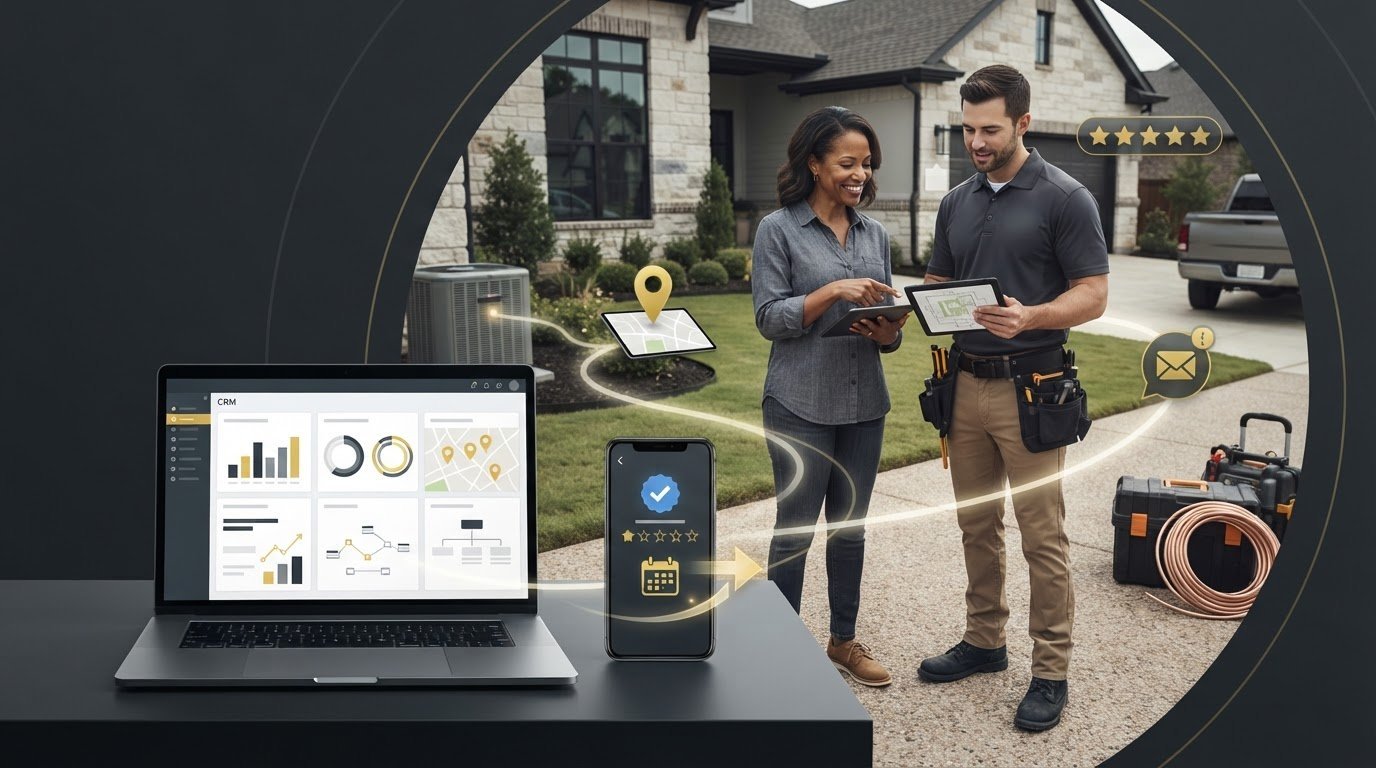
Timing determines your response rate. Waiting two days to send an email invite guarantees low participation. Connect your billing software or CRM to an automated messaging system that deploys an SMS request within fifteen minutes of final invoice payment:
- Direct access: Send a single link that takes the homeowner directly to your Google review submission box with zero clicks in between.
- Concise messaging: Keep text messages under two sentences, thanking them for trusting your team and asking for honest feedback.
- Smart follow-ups: Trigger a single polite reminder three days later if the customer has not opened the original link.
The Technician’s In-Person Hand-Off
Automated software works best when primed by a real human. During the final walkthrough, have the technician inspect the completed repair, confirm the workspace is clean, and explain that a text link will arrive shortly. Handing the homeowner a physical card featuring a direct QR code provides a tactile bridge between the field repair and your online presence. When technicians set expectations face-to-face, submission rates jump because customers feel accountable to the person who just resolved their emergency.
Handling Negative Reviews Professionally
Every service company faces an occasional dissatisfied client. How you handle public criticism shows prospective customers what kind of partner you are when things go wrong. Never argue or make excuses online. Post a calm, professional response within twenty-four hours acknowledging the customer’s frustration, and provide a direct phone number to an operations manager to handle the issue offline. Prospective clients reading your reviews understand that mechanical equipment can fail; what they want to see is an accountable company that resolves mistakes quickly.
Ready to deploy a mechanized review capture and brand protection system across your business? Schedule a consultation with our operations team to audit your feedback workflows.
Step 4: Protect Customer Trust with Rapid Response Systems
Speed serves as the ultimate test of operational reliability. When a homeowner submits an inquiry for a leaking water heater or an electrical fault, the clock starts ticking immediately. If that message disappears into a digital void for two hours, their confidence evaporates. Silence breeds anxiety, and an anxious homeowner simply contacts the next provider on Google Maps. Learning how to build trust with local customers online requires proving responsiveness the second a lead arrives. Implementing automated lead follow-up for service businesses bridges the gap between customer interest and scheduled service.
The Critical Five-Minute Response Benchmark
Contractors often fail to realize how quickly interest goes cold. Leads contacted within the first five minutes are 21 times more likely to be qualified compared to those contacted after thirty minutes. Homeowners directly equate your communication speed with your field performance. If your office takes half a day to reply to an online inquiry, prospects assume your technicians will show up late, deliver poor communication, and delay the job. Immediate engagement reassures the client that your entire operation runs with discipline.
Deploying Automated Acknowledgment Workflows
You cannot expect dispatchers to monitor incoming website forms manually every second of the work day. Connect your website forms directly to your CRM to execute instant acknowledgment sequences:
- Instant confirmation: Trigger an SMS within two minutes acknowledging the inquiry, confirming receipt, and notifying the client that a dispatcher is reviewing details.
- Technician details: Dispatch automated appointment confirmations that include technician arrival windows and direct contact options.
- Customer flexibility: Provide self-service rescheduling links within the message so homeowners retain control if their schedules shift.
Capturing After-Hours Inquiries Automatically
Mechanical emergencies rarely stick to standard business hours. Pipes burst at midnight, and air conditioners stop working on Sunday afternoons. Instead of sending after-hours calls to an empty voicemail box, deploy conversational AI voice agents and web chat tools to triage emergencies. Smart routing systems qualify the severity of the issue instantly. True emergencies route directly to on-call technicians, while standard routine maintenance requests get scheduled straight onto next-day dispatch boards, locking in revenue while competitors remain asleep.
Engineer Undeniable Credibility for Your Service Business
Winning high-ticket jobs no longer comes down to offering the lowest bid or making the loudest claims. Knowing how to build trust with local customers online requires an operational commitment to verifiable proof. When your company pairs active Google profile signals with authentic job-site imagery, automated review collection, and immediate inquiry response, skeptical searchers choose you with total confidence.
You don’t have to juggle fragmented software tools or chase unproven marketing tactics on your own. Tools N Tactics serves as a dedicated implementation partner for trade contractors across Plano, Frisco, Celina, and the broader North Texas region. Through our comprehensive Growth Partner Program, we integrate the Visibility, Conversion, and Authority Engines into a unified system that protects your reputation and drives predictable revenue. Take the next step to command your local market: Build your business trust engine with Tools N Tactics today.
Frequently Asked Questions
Why is online trust more critical for local service businesses than e-commerce brands?
Local service businesses require physical access to a customer’s private home or commercial property, creating much higher personal and financial risk. While an e-commerce customer risks only the cost of a returnable item, a homeowner hiring an electrician or roofer faces property damage if the work fails. Demonstrating how to build trust with local customers online reassures cautious homeowners before they permit technicians inside their property.
How many Google reviews do I need before local customers consider my business trustworthy?
Most local consumers look for at least 30 to 50 genuine reviews alongside a consistent rating above 4.0 stars before calling. Steady recency matters just as much as overall volume. A business with 150 reviews from two years ago looks abandoned compared to a local contractor who gains two fresh, detailed reviews every week from completed jobs across Plano or Frisco.
Can negative reviews permanently damage my local search visibility and customer acquisition?
Negative reviews will not ruin your business if you handle them calmly and maintain a strong volume of positive feedback. An occasional critical review actually makes your profile look authentic to savvy consumers who distrust flawless ratings. What damages visibility is ignoring negative feedback entirely or responding aggressively, which signals poor operational accountability to prospective clients browsing your listings.
What specific information should a service business website display to prove legitimacy?
Your website must clearly display municipal trade license numbers, proof of active general liability insurance, physical shop addresses, and unedited photos of your local team and vehicles. Homeowners across North Texas communities like Celina and Dallas want verification that you operate an established physical facility, not an anonymous lead-generation shell company with no local roots or legal accountability.
How quickly does a local contractor need to respond to an inbound online inquiry?
Service businesses should respond to digital inquiries within five minutes to maximize booking rates. Online searchers seeking plumbing, roofing, or HVAC help rarely wait around. When an inquiry sits unanswered for an hour, the homeowner moves directly down the map pack to contact the next available provider. Fast automated acknowledgments maintain momentum and secure the consultation before competitors react.
Does having inconsistent business information on local directories hurt customer trust?
Mismatched business names, addresses, or phone numbers create immediate friction and make prospects question your legitimacy. If your directory citation lists a previous shop address while your website lists another, consumers assume your company lacks organization. Clean citation data across the web is an essential operational baseline for establishing how to build trust with local customers online.
How can home service businesses collect online reviews without feeling pushy?
Integrate review collection directly into your standard billing and service workflows rather than asking technicians to plead for ratings. When your office closes an invoice, trigger an automated SMS containing a direct link to your Google review profile. When customers receive a frictionless prompt within minutes of service completion, submitting positive feedback feels like an easy, natural conclusion to the job.