
What if the first thing a Princeton prospect sees online is an unanswered complaint or an outdated business profile? If you’re asking how to fix a bad online reputation Princeton customers may see, start by identifying what is damaging trust and where it appears. Don’t rush to answer every negative comment before you understand the broader picture.
Negative reviews and search results can make prospects hesitate before they call. It’s especially difficult to spot what’s working when review responses, profile updates, and customer follow-up happen in separate places. A consistent process makes it easier to address the cause of a reputation problem instead of applying a string of disconnected fixes.
This article walks through a practical recovery plan: audit reviews and search results, respond professionally, and invite honest customer feedback without pressure. It also explains how Google Business Profile accuracy, local visibility, and lead handling can reinforce one another. The goal is to build credible proof of your business’s value and track progress without expecting negative content to disappear overnight.
Key Takeaways
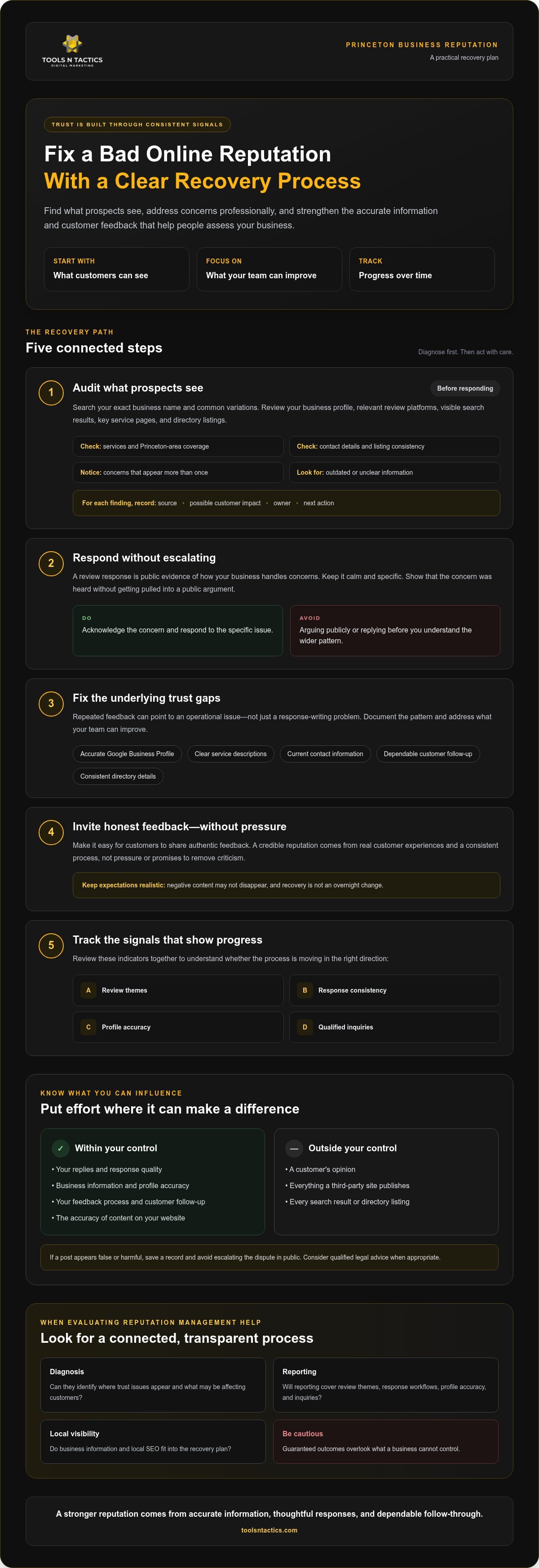
- Start by checking where damaging information appears, then record its source, possible customer impact, owner, and next action.
- Respond calmly and specifically to reviews. Show that concerns are heard without getting pulled into a public argument.
- Learn how to fix a bad online reputation Princeton prospects may see by connecting accurate business information, authentic customer feedback, and dependable follow-up.
- Track review themes, response consistency, profile accuracy, and qualified inquiries to assess whether your recovery process is moving in the right direction.
- When evaluating reputation management help, ask how diagnosis, reporting, response workflows, and local SEO fit together. Be cautious of guaranteed outcomes.
How a Bad Online Reputation Hurts Princeton Businesses, and What You Can Control
A negative review or concerning search result can influence a prospect before they ever call. A homeowner comparing Princeton contractors, for example, may hesitate if a review raises questions or your profile leaves important details unclear. They might contact another business, even if the issue they saw doesn’t reflect the service your team provides today.
Your online reputation is the collection of public signals people encounter when assessing your business. It includes reviews, search results, directory listings, and information on channels you own, such as your website. Reputation management is a broad term for shaping and responding to those public perceptions. For a local service business, reputation recovery is a coordinated process of addressing customer concerns, improving accurate public information, and building credible proof over time.
The distinction matters. You can improve your responses, clarify your services, and invite honest feedback. You can’t control what every customer or third-party site publishes, and no ethical plan should promise to erase criticism or reverse its effects overnight. Focus on what you can address, then make it easier for future customers to assess your business fairly.
Which online reputation signals matter to Princeton customers?
Review the information a prospect could reasonably see before contacting you. Check whether your Google Business Profile details match your current services and service area. Read recent feedback and note concerns that appear more than once. Then search your business name and check the visible results, key service pages, and directory listings. Conflicting details, such as an outdated service list or unclear Princeton-area coverage, can create doubt even when your work is strong.
What can a business owner control during reputation repair?
Start with the parts your team manages: response quality, profile accuracy, the review-request process, and trust signals on your website, including clear service descriptions and contact information. If customers repeatedly mention missed updates or confusing scheduling, document that pattern before drafting another public reply. The feedback may point to an operational issue that needs attention, not just a response-writing problem.
Keep a clear distinction in mind:
- You control: your replies, business information, feedback process, and the accuracy of your own content.
- You don’t control: a customer’s opinion or every third-party search result and listing.
If a post appears false or harmful, save a record and avoid escalating the dispute in public. Consider qualified legal advice when appropriate. If you’re researching how to fix a bad online reputation Princeton prospects may see, begin with that boundary: respond to what you can influence, investigate recurring concerns, and handle the rest carefully.
How to Audit a Bad Online Reputation in Princeton Before Taking Action
Before launching a response campaign or asking customers for reviews, find out what prospects can actually see. A diagnosis helps you identify which platforms, search results, business details, and recurring concerns could affect trust or make it harder for someone to contact you.
How do you check what Princeton prospects see first?
Use the same process each time so you can compare your findings later:
- Search your exact business name, then try common variations such as a shortened name or your name combined with a service.
- Review your business profile, relevant review platforms, branded search results, and key service pages.
- Check directory listings for outdated or conflicting contact details, services, or information about Princeton-area coverage.
Record the date of your review and save notes or screenshots of important findings. Search results can vary, so treat this as a useful baseline, not a guarantee that every prospect sees the same page.
How do you prioritize reputation issues by business impact?
Separate isolated disagreements from recurring patterns. One complaint may describe a specific experience. Repeated concerns about missed updates, unclear estimates, or follow-up may point to a process that needs attention. Don’t treat every critical comment as proof of a wider problem. Look for similar themes across feedback and compare them with what your team knows.
Use a worksheet to turn the audit into an action plan:
- Issue: What is inaccurate, concerning, or repeated?
- Source: Where did you find it?
- Customer impact: Could it confuse a prospect or make it harder to contact you?
- Owner: Who can investigate or make a correction?
- Next action: What response or follow-up makes sense?
Prioritize issues that affect a clear path to contact, such as a wrong phone number, outdated service information, or a repeated service concern. A structured Google Business Profile audit can help you review profile details alongside your other findings. After recording a baseline, check the same items again following updates so you can see what improved and what still needs attention.
This groundwork makes how to fix a bad online reputation Princeton businesses face less about reacting to the loudest comment and more about addressing issues with clear customer impact. If you want help organizing the findings into connected reputation and local visibility actions, you can discuss your reputation priorities with Tools N Tactics | Local SEO & Digital Marketing Solutions.
How to Handle Negative Reviews Without Making Them Worse
A review response isn’t only for the person who wrote the review. Prospective customers may read it too, looking for signs that your business listens and handles concerns professionally. A calm, specific reply can help show that. A defensive argument, private customer details, or the same copy-pasted apology under every review can make the exchange look worse.
What should a professional response to a negative review include?
Acknowledge the concern, keep your tone measured, and invite the customer to continue the conversation privately. Don’t repeat personal or job-specific details in a public reply. Avoid debating each point or making promises before you’ve checked what happened.
For example: “We’re sorry to hear the communication didn’t meet your expectations. We’d like to understand more and review this with you. Please contact our team directly.” Adjust the wording to match the actual concern. A generic “We value your feedback” may sound dismissive if it doesn’t show that you understood the issue.
Before replying, check the job record and speak with the staff involved. If you need more time to investigate, keep the public response brief and follow up through an appropriate private channel. The goal is to show care and accountability, not to win an argument in front of an audience.
How can a Princeton business build a steady review process?
Don’t ask for a burst of positive reviews to bury criticism. First, investigate repeated complaints and address service gaps your team can fix. Then make requests for honest feedback a consistent, non-coercive part of follow-up. Ask without pressure, incentives, or screening based on whether customers seem satisfied. A steady process can help you learn what customers value and where expectations need to be clearer.
Review patterns can point to practical improvements. If customers often ask the same questions about scheduling or service coverage, clarify those details in customer communications and on relevant website pages. If comments point to a repeated handoff problem, review how your team routes and follows up on inquiries. Reputation work is more useful when feedback informs both public responses and internal processes.
Tools N Tactics | Local SEO & Digital Marketing Solutions connects reputation management and review automation through its Authority Engine. For owners considering how to fix a bad online reputation Princeton prospects may encounter, the focus should be consistent, credible action, not a guaranteed change in reviews, rankings, or new business. To discuss how review processes could fit with local visibility work, contact Tools N Tactics | Local SEO & Digital Marketing Solutions.
How to Rebuild Local Trust and Measure Reputation Recovery
Review activity alone isn’t a recovery system. A business can collect feedback while its profile lists outdated services, its website leaves coverage unclear, or customer inquiries go unanswered. Stronger local trust comes from connecting accurate business information, honest customer feedback, useful website content, and dependable follow-up. No single review proves that trust has returned. Look for patterns across the customer journey.
Which reputation metrics help show meaningful progress?
Choose a consistent review cadence and track a small set of indicators against your audit baseline. Note review themes, response consistency, profile completeness, and how your business appears in relevant local searches. Track contact activity and inquiry quality too. For example, note whether incoming prospects understand your services and coverage before they call. Record significant business or process changes alongside the data so you can interpret shifts in context.
| Reputation signal | Action | What to measure |
|---|---|---|
| Repeated review themes | Investigate the cause and address service gaps | Whether the same concern continues to appear |
| Business profile accuracy | Correct outdated services, contact details, or coverage | Completeness and accuracy of key details |
| Customer responses | Use a clear process to review and reply to feedback | Response consistency and common questions |
| Website and inquiries | Make service information and contact steps clear | Relevant search visibility, contact activity, and inquiry fit |
Use the same measures each time you review progress. One positive review can’t confirm that a recurring service problem is fixed, just as one negative review doesn’t define the whole business. Trends across feedback, profile accuracy, and qualified inquiries give you a more useful picture.
How do local visibility and reputation work together?
Accurate local information helps prospects understand what you do and whether you serve their area. Customer feedback adds context, while clear service pages and straightforward contact paths help interested prospects take the next step. If reputation improvements need to connect with review management and website trust signals, explore the Authority Engine. For local search foundations, see local visibility services.
A measured approach to how to fix a bad online reputation Princeton prospects may encounter means improving the signals you control and checking whether those changes support better-qualified inquiries. To discuss a connected plan for local visibility and reputation work, contact Tools N Tactics | Local SEO & Digital Marketing Solutions.
How to Choose Reputation Management Help in Princeton and Start the Recovery
Reputation support should begin with a clear diagnosis, not a promise to make criticism disappear. A suitable partner helps you understand what prospects see, assign responsibility for each task, and connect reputation work with local visibility and customer follow-up. Scattered replies and profile edits can leave underlying issues untouched, so look for a process that links these activities.
What should you ask before hiring a reputation partner?
Ask how the provider reviews feedback patterns, local profiles, and the process for requesting and responding to customer reviews. Find out who drafts and approves responses, who follows up with customers, and how recurring concerns lead to process improvements. You should know what work is included and who owns each step.
Request reporting that separates completed tasks from observed outcomes. Profile updates and response activity are actions; changes in relevant inquiries are business signals. Both can matter, but they are not the same. Be cautious of guaranteed rankings, promises to remove negative reviews, or review-volume targets that aren’t tied to your customer experience and business context. Ask what methods the provider uses and whether they align with your standards.
Tools N Tactics connects reputation management with visibility, conversion, and automation work through its Growth Partner Program. This integrated approach can align customer feedback, accurate local information, and lead follow-up rather than treating each as a separate task. It doesn’t guarantee a specific reputation or business outcome.
What are the first steps to start recovery in Princeton?
Prepare a short working file before you speak with a provider or assign internal owners. Include:
- Your business name and common name variations.
- Links to your profiles, review pages, and key service pages.
- The concerns that appear most often and where you found them.
- Recent customer feedback and any relevant service or process changes.
Start with the issues that are most visible or repeated. Confirm what your team can correct, who will manage responses, and how you’ll review progress. This gives you a practical first phase without trying to fix every search result at once.
If you’re assessing how to fix a bad online reputation Princeton customers may encounter, a focused conversation can help clarify priorities and responsibilities. Discuss your Princeton reputation recovery plan with Tools N Tactics when you’re ready.
Build a Reputation Recovery Process You Can Measure
Repairing trust starts with a clear view of what prospects see, followed by steady action. Audit your reviews, search results, and business information before deciding what to address. Respond with care, investigate recurring feedback, and track whether profile accuracy, customer conversations, and qualified inquiries improve over time.
That’s the practical path for how to fix a bad online reputation Princeton customers may encounter: connect the work instead of treating each review as a separate problem. Tools N Tactics combines reputation management with local SEO, Google Business Profile optimization, and review automation. Its Growth Partner Program connects visibility, conversion, and authority services for service-based businesses, without promising a specific result.
Your next step is to bring your profile links, key concerns, and recent customer feedback into a focused discussion about priorities. Discuss a practical reputation recovery plan for your Princeton business, and start building a clearer, more consistent foundation for local trust.
Frequently Asked Questions
How do I fix a bad online reputation for my Princeton business?
Start by auditing what prospects see, then address the issues you can control. Check reviews, branded search results, business listings, and service pages. Record recurring concerns, correct inaccurate information, and respond to feedback with care. If you’re asking how to fix a bad online reputation Princeton prospects may see, focus on a consistent process rather than quick fixes. Track changes in customer feedback and qualified inquiries to understand whether your actions are helping.
Can a business remove a negative Google review?
A business generally can’t remove a review just because it’s negative or disagrees with the customer’s opinion. If you believe a review violates the platform’s current policies, use its reporting process and provide relevant information. The platform decides whether to take action, so removal isn’t guaranteed. Avoid public arguments or offers meant to change a review. Respond professionally and keep a record of the issue and any steps you take.
How long does it take to improve a business’s online reputation?
There’s no reliable set timeline. Progress depends on the issues involved, how quickly your business can address them, and whether improvements in customer experience and communication are sustained. A profile correction may be straightforward, while changing a recurring service problem takes ongoing work. Set a consistent review schedule, compare current feedback and profile accuracy with your starting baseline, and assess patterns over time rather than expecting one reply or review to change perception.
What should I say when responding to a negative customer review?
Acknowledge the concern, keep your tone measured, and offer a suitable way to continue the conversation privately. For example: “We’re sorry to hear about your experience. We’d like to understand what happened. Please contact our team directly so we can review your concern.” Adjust the wording to fit the feedback. Don’t disclose customer or job details, argue point by point, or post a generic reply that ignores the specific issue.
Should I ask customers to leave positive reviews to repair my reputation?
Ask customers for honest feedback, not specifically for positive reviews. Use a consistent, non-coercive process and don’t pressure people, offer incentives, or screen customers based on whether they seem satisfied. A fair request can help you learn what’s working and identify concerns that need attention. If feedback reveals a repeated service issue, investigate and address it before focusing on collecting more reviews. Authentic feedback is more credible than a sudden push for praise.
Can local SEO help improve my Princeton business reputation?
Local SEO can support trust by making your business information easier to find and understand. Accurate profile details, clear service pages, and consistent contact information help prospects confirm what you do and where you work. For businesses across North Texas, including Plano, Dallas, Celina, Princeton, Melissa, Sherman, and Frisco, local visibility can connect reputation signals with relevant searches. It won’t erase criticism or guarantee rankings, but it can help present an accurate picture of your business.
How do I choose an online reputation management company in Princeton?
Ask how the provider audits reviews and profiles, manages response approvals, handles customer follow-up, and reports on completed work separately from business outcomes. Check how reputation efforts coordinate with local SEO and profile accuracy. Be cautious of guaranteed removals, rankings, or reputation outcomes, as well as review-volume promises without context. Tools N Tactics connects visibility, conversion, and authority work through its Growth Partner Program for service-based businesses in Princeton and North Texas.