
What if your chatbot’s most important job isn’t collecting more inquiries, but helping your team act on the right ones? A lead qualification chatbot for service businesses can ask what service a visitor needs, where the work is located, and how soon they need help. If it only collects a name and email, staff may still spend time sorting poor-fit leads while suitable prospects wait.
Inquiries can arrive while your team is serving customers, and manual follow-up can slow the handoff. A useful chatbot helps determine what happens next, rather than simply completing a conversation.
This article covers how to choose practical qualification questions, route inquiries, connect responses with CRM and follow-up workflows, and assess whether the system is helping your team.
Key Takeaways
- Build your lead qualification chatbot for service businesses around service fit, location, urgency, and contact preference.
- Keep the conversation focused by asking only questions that help determine the right next step.
- Map each answer to a clear owner, CRM status, and follow-up action so qualified inquiries don’t stall.
- Test common requests, edge cases, routing, and handoffs before launch, then adjust the workflow based on what you learn.
- Track qualified inquiries, completed handoffs, misroutes, and staff feedback instead of judging performance by chat volume alone.
Why a Lead Qualification Chatbot Matters for Service Businesses
Website inquiries can arrive while an HVAC crew is on a job, a roofing estimator is meeting a customer, or an office team is handling calls. If every request waits for someone to read it and decide what to do, a suitable prospect may be left waiting. Meanwhile, staff can spend valuable follow-up time on requests outside the company’s services or coverage area.
A lead qualification chatbot for service businesses is a conversational tool that collects useful fit signals, such as the service needed and job location, then guides the visitor to an appropriate next step. It supports the lead generation process by organizing inquiries. It shouldn’t make complex decisions for your team or promise service before someone confirms the details.
What does a lead qualification chatbot do?
A basic FAQ bot answers common questions, such as which services a company provides. A qualification chatbot goes further by asking relevant questions that help staff understand whether a request fits and how to follow up. An HVAC company, for instance, might ask what type of service the visitor needs and which city the property is in.
When the answers match the company’s criteria, the chatbot should explain what happens next, such as submitting the request for staff review. If the request is unclear or outside the stated criteria, the bot should avoid guessing and offer a way to contact a person. Clear limits set expectations and help protect trust.
When is chatbot qualification useful for a service business?
Qualification is especially useful when a business receives similar inquiries across several services or service areas. A contractor can use consistent questions to sort requests by job type and location before staff follow up. That reduces manual sorting without assuming every visitor is a good fit. Questions should reflect actual service boundaries and the team’s capacity to handle incoming work.
Consider a Plano resident asking an HVAC company about a repair. The chatbot can collect the location and service need, then direct the inquiry to the team responsible for reviewing that type of request. It shouldn’t diagnose the problem or imply that a visit is confirmed. If the customer describes an unusual issue, gives conflicting details, or isn’t sure what service they need, route the conversation to a person.
Use the bot for repeatable intake, not to replace human judgment. A reliable setup makes the next step clear to the visitor and gives staff enough context to respond thoughtfully.
How a Service Business Chatbot Qualifies a Lead
A useful chatbot follows a simple intake path instead of asking every visitor the same list of questions. For a lead qualification chatbot for service businesses, each answer should help determine what the customer needs, whether the request fits, and what action should follow.
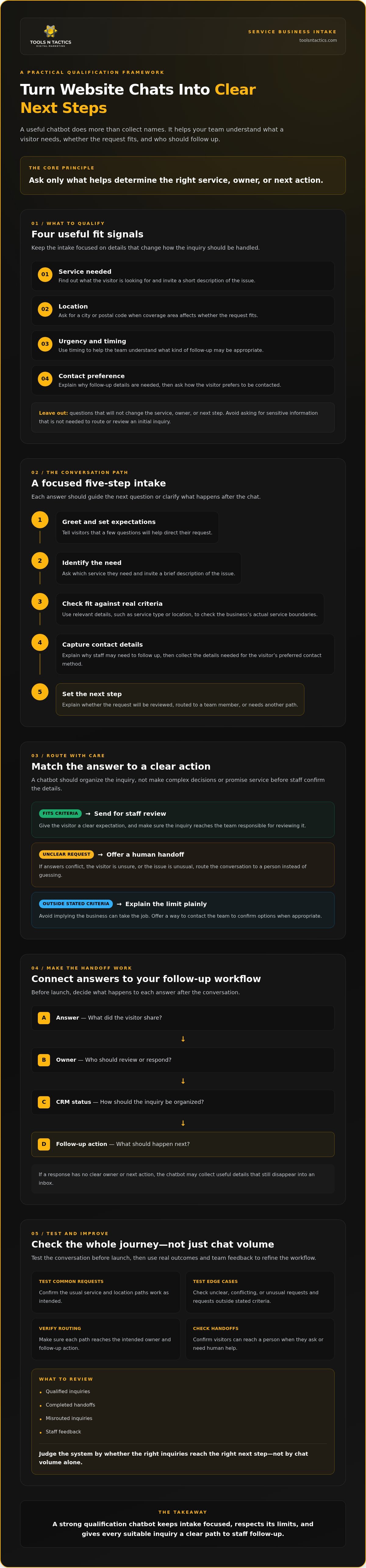
Qualification means matching an inquiry to service fit, urgency, and the right follow-up. A practical conversation moves through five steps:
- Greet the visitor. Set a clear expectation that a few questions will help direct the request.
- Identify the need. Ask which service they’re looking for and invite a short description of the issue.
- Check fit. Confirm relevant details, such as service type or location, against the business’s actual criteria.
- Capture contact details. Explain why the team may need to follow up, then ask for a preferred contact method and the details needed to use it.
- Set the next step. Tell the visitor whether the request will be reviewed, routed to a team member, or needs another path.
Which questions should the chatbot ask first?
Start with the service needed and a plain-language question such as, “What can we help with?” Ask for a city or postal code only if the service area affects eligibility. Request contact details once the visitor understands why they’re needed, for example, so a staff member can review the request. Keep questions short. Skip information that won’t change the service, owner, or next step.
How should chatbot answers change the conversation?
Use conditional paths so the next question depends on the visitor’s service type, location, timing, or request complexity. If someone is outside the coverage area, say so plainly and offer a useful alternative, such as contacting the business to confirm options. If an answer is unclear or the visitor asks for a person, make a human handoff available instead of forcing the conversation down a fixed path.
Keep the first conversation focused. Don’t ask for sensitive information that isn’t needed to route or review an initial inquiry. Before launch, map each answer to a real owner and next action so the chatbot doesn’t collect details that disappear into an inbox. If you’re aligning question logic with follow-up workflows, talk with the Tools N Tactics team about how the pieces can work together.
What Should a Lead Qualification Chatbot Evaluate?
A chatbot should collect signals that change what your team does next. For contractors and professional service firms, that usually means checking service fit, location when coverage matters, timing, and the visitor’s preferred way to be contacted. Qualification rules should reflect your actual service capacity.
Use this framework to connect each answer to a practical next step:
Useful question: “What service do you need?”
Appropriate next step: Route supported requests to the team that handles that service. Send unclear requests for staff review.
Useful question: “Where is the property or project located?”
Appropriate next step: If location affects coverage or dispatch, route eligible areas accordingly. For areas outside the stated service range, explain that the team needs to confirm options.
Useful question: “When do you need help?”
Appropriate next step: Pass the customer’s stated timing to staff so they can review it against current capacity. Don’t imply a response time or appointment is guaranteed.
Useful question: “How would you prefer us to follow up?”
Appropriate next step: Record the visitor’s choice and send the inquiry through the matching follow-up workflow.
Which lead signals matter most to contractors and professional services?
Keep service fit and urgency separate. A request can match your services but have a flexible timeline, or it can be time-sensitive and still require a person to confirm whether your team can help. Geography matters when it affects eligibility or dispatch. For example, a North Texas business might ask for a city or postal code to check whether an inquiry falls within its service area, including areas such as Plano, Dallas, Celina, Princeton, Melissa, Sherman, or Frisco.
Budget or project size can help with routing, but ask only if your business has a clear policy for using that information. Otherwise, it adds friction without improving the next decision.
Should a chatbot score leads or use simple rules?
Rule-based routing is usually easier to set up, explain, and maintain. For example, if a request matches a service and location, send it to the appropriate owner. Scoring can combine several signals into a priority rating, but it requires clear criteria and ongoing review. A lead qualification chatbot for service businesses doesn’t need a hidden rating system to be useful.
Start with a few visible rules, then compare chatbot outcomes with staff decisions. Don’t automatically reject someone because an answer is missing, uncertain, or doesn’t fit an assumption. Route those inquiries for human review. That keeps the process useful for the team without closing the door on a suitable customer.
How to Connect Qualification With CRM Routing and Follow-Up
A chatbot’s answers are useful only if they reach the right person with a clear next action. Before connecting a lead qualification chatbot for service businesses to a CRM, map what should happen for each outcome. That keeps inquiries from landing in a general queue with no owner or follow-up plan.
For each lead path, define three things:
- Owner: Who reviews or handles this type of inquiry?
- CRM status: What stage or label should identify its current state?
- Next action: Should someone review the details, contact the prospect, or clarify whether the request fits?
For example, an inquiry that matches a roofing company’s services and coverage area could be assigned to the person responsible for reviewing new project requests. The CRM record should include the service requested, location, timing, contact preference, and the visitor’s description. That context helps staff continue the conversation without asking the prospect to repeat information.
What should happen after a chatbot qualifies an inquiry?
Set a handoff owner and next step for every route, including requests that need human review. An automatic SMS or email acknowledgment may be appropriate if it accurately confirms that the inquiry was received. It shouldn’t suggest that an appointment is booked or promise a response time unless the business has confirmed and staffed that commitment.
Staff should take over when a request is urgent, an answer is unclear, or the chatbot can’t address the visitor’s question. A visible fallback matters, too. If the chatbot or its connection to the CRM has a technical problem, the inquiry still needs a way to reach the business.
How should chatbot follow-up fit the existing system?
Review your current CRM stages, lead owners, and follow-up rules before adding automation. Confirm that the chatbot can pass the needed details into your chosen systems, and verify integrations and technical requirements before selecting tools. A connected setup can tie qualification to routing and SMS or email follow-up. Tools N Tactics’ Automation Engine service addresses connected automation workflows as part of broader business systems.
Keep the process simple: acknowledge receipt when appropriate, assign an owner, and set a clear next action. Test the handoff and create a human fallback for unanswered questions, urgent requests, and system errors. To review how chatbot qualification could fit your current process, discuss your lead workflow.
How to Test and Improve a Lead Qualification Chatbot
A chatbot can sound polished and still send the wrong inquiry to the wrong person. Test the full path from the first question to the CRM record and follow-up before relying on it. Then keep reviewing real outcomes. A lead qualification chatbot for service businesses should make intake clearer for customers and staff, not add another step they have to work around.
What should you test before launch?
Walk through the conversation as different types of visitors. Check that each path gives a clear response and reaches the right next step.
- Suitable request: Does it capture the relevant details and route the inquiry correctly?
- Unsuitable or out-of-area request: Does it explain the situation honestly and offer an appropriate alternative?
- Urgent request: Does it give the visitor a clear way to reach a person, without implying a response time the business hasn’t confirmed?
- Incomplete or unclear answers: Can the visitor clarify, skip a question where appropriate, or ask for human help?
- Handoff and follow-up: Do the captured details reach the intended CRM record or team member, and does any acknowledgment match what will actually happen?
Also review the questions themselves. Read chatbot transcripts responsibly, limit access to people who need them for review, and remove questions that don’t help determine fit or follow-up. Avoid collecting extra information just because the form or bot makes it possible. Repeated customer confusion can signal that a question is unclear or the path needs revision.
Which measures show whether qualification is working?
Define “qualified inquiry” and “completed handoff” before measuring them. For example, your team might count an inquiry as qualified when it matches a service you provide and the relevant coverage criteria. A handoff is complete when the right owner receives the inquiry with enough context to take the agreed next step. Use the same definitions over time so comparisons remain useful.
Track qualified inquiries, completed handoffs, misroutes, and conversations that end before a useful next step. Chat volume alone can’t show whether the workflow helps staff prioritize. Pair those measures with staff feedback: Are inquiries reaching the right person? Are customers repeating details? Which answers often need clarification?
Review the workflow on a regular schedule and adjust rules based on patterns, not one unusual conversation. For broader website chatbot considerations, see the AI chatbot for local business website guide. To talk through your chatbot and lead-routing process, contact Tools N Tactics.
Build a Lead Workflow Your Team Can Trust
A lead qualification chatbot for service businesses works best as part of a clear process, not as a standalone conversation. Ask only questions that help confirm service fit, location, timing, or follow-up preference. Then route the inquiry with enough context for the right person to take the next step.
Keep the system accountable. Test common and unclear requests, check that handoffs reach the intended owner, and review qualified inquiries, completed handoffs, and misroutes. Staff feedback can reveal where a question creates friction or where a human should step in.
Tools N Tactics offers AI chatbots, CRM services, lead routing, and SMS and email follow-up automation. Through the broader Growth Partner Program, these workflows can connect with visibility, conversion, and authority work, helping align lead handling with the rest of your growth system for service businesses in North Texas, including Plano, Dallas, Celina, Princeton, Melissa, Sherman, and Frisco.
Discuss a chatbot workflow built around your service and lead-routing needs. With clear rules and a reliable handoff, your team can spend less effort sorting inquiries and focus on responding thoughtfully to suitable opportunities.
Frequently Asked Questions
What is a lead qualification chatbot for a service business?
A lead qualification chatbot is a website conversation that gathers details to help a service business decide how to handle an inquiry. It can ask about the requested service, location, timing, and preferred contact method, then direct the visitor to a suitable next step. For a North Texas business serving areas such as Plano, Dallas, Celina, Princeton, Melissa, Sherman, or Frisco, location can help staff check whether a request fits its actual coverage.
What questions should a service business chatbot ask potential customers?
Ask only questions that affect service fit or follow-up. Start with “What service do you need?” and invite a short description of the issue. If coverage matters, ask where the work is located. You might also ask when the customer needs help and how they prefer to be contacted. For example, a contractor serving parts of North Texas can use a city question to guide routing without asking for unnecessary personal details.
Can a chatbot qualify leads and send them to the right employee?
Yes, if its questions and routing rules match your team’s process. Answers can determine which employee or workflow receives the inquiry, along with the customer’s service need, location, and timing. A home service company in Dallas might route one type of request to its HVAC team and another to a roofing lead owner. Confirm that the CRM connection works, and include a human handoff for unclear answers or questions the chatbot can’t handle.
How do I stop a chatbot from turning away good leads?
Don’t let the chatbot reject an inquiry based on a single missing or uncertain answer. Use transparent criteria, give visitors a chance to clarify, and route unclear requests to a person for review. Check the rules against real inquiries from the areas you serve, whether that’s Plano, Frisco, or elsewhere in North Texas. Review misroutes and staff feedback so you can spot when a question or cutoff is excluding a suitable prospect.
Should a lead qualification chatbot use lead scoring or routing rules?
Start with simple routing rules. For example, send requests that match a service and coverage area to the appropriate owner, while unclear cases go to staff review. Rules are usually easier for a team to understand and update. Lead scoring can help prioritize inquiries using several signals, but it needs clear criteria and regular review. Whether your service business works in Sherman or Dallas, don’t use a score as an automatic reason to reject a lead.
How does a chatbot connect to a CRM and follow-up system?
A chatbot can pass the visitor’s answers into a CRM record, apply an agreed status, assign an owner, and trigger an appropriate follow-up workflow. Before setup, map existing CRM stages and responsibilities, then verify the available integration and technical requirements. An acknowledgment by SMS or email should confirm only what’s true, such as receipt of the inquiry. For a North Texas contractor, the CRM record should give the assigned employee enough context to follow up without making the customer repeat details.
How can I measure whether a lead qualification chatbot is working?
Track qualified inquiries, completed handoffs, misroutes, and conversations that end before a useful next step. Define each measure consistently so your team can compare results over time. Chat volume alone doesn’t show whether good inquiries reach the right person. Review staff feedback and recurring customer questions, too. If a business serving Celina, Melissa, or Princeton sees repeated confusion about coverage, it may need clearer wording or a better routing path.