
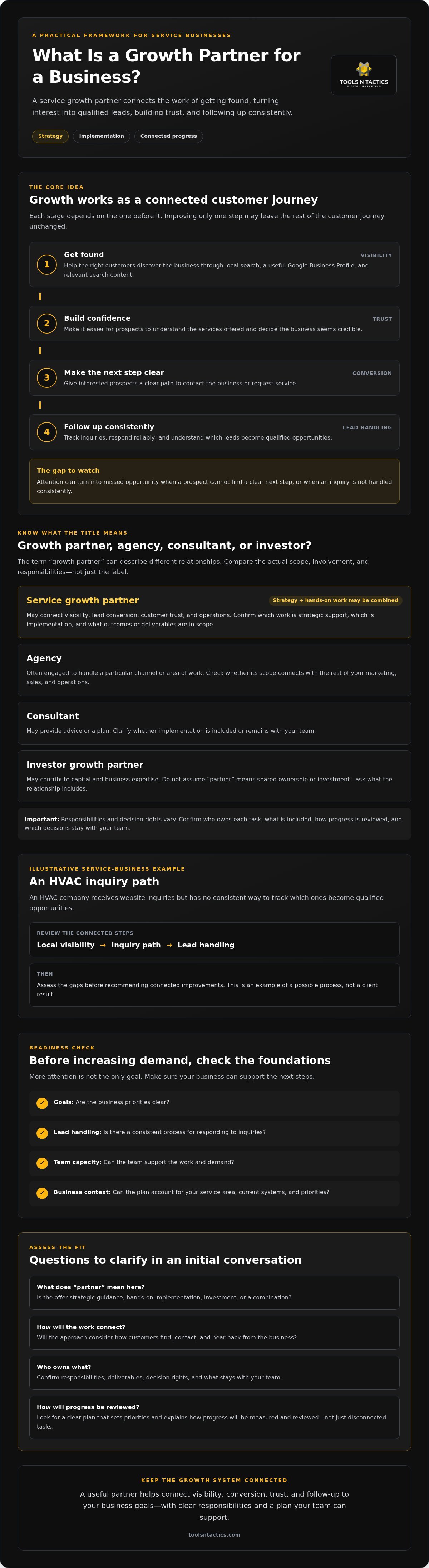
What if your marketing is generating attention, but leads are still slipping through the cracks? That gap is why business owners ask, “what is a growth partner for a business?” The term can sound like an investor, consultant, or another service provider. In practice, a service-based growth partner connects the parts of growth that often operate separately: getting found, turning interest into qualified leads, building trust, and following up consistently.
It’s reasonable to question whether one outside partner can do more than an agency handling a single channel or a consultant delivering a plan. The difference is usually scope: a growth partner may combine strategy with implementation and look at how marketing, sales, and operations work together. For example, an HVAC company serving North Texas may need stronger local visibility, a clear path for prospects to request service, and a reliable process for responding to inquiries. Improving only one step may leave the rest of the customer journey unchanged.
This article explains what a growth partner does, how the model compares with agencies, consultants, and investors, and what to ask before choosing one. You’ll also see how an integrated approach can help a service business connect visibility, conversion, and follow-up to practical business outcomes.
Key Takeaways
- “What is a growth partner for a business” depends on the relationship: clarify whether the offer is strategic support, hands-on implementation, or investment.
- Compare a partner, agency, consultant, and investor by their scope, level of involvement, and what they’re accountable for.
- Check whether your goals, lead-handling process, and team capacity are ready to support growth before increasing demand.
- Use an initial conversation to assess how a potential partner would work with your service area, current systems, and business priorities.
- Look for a clear plan that sets priorities and explains how progress will be reviewed, not just a list of disconnected tasks.
What is a growth partner for a business, in plain language?
A growth partner aligns expertise, systems, and execution with a business’s growth goals. The term can describe different relationships. Some growth partners are investors who provide capital and business guidance. Others are service providers who help a company plan and implement work tied to visibility, lead conversion, customer trust, or operations.
A service growth partner helps a business pursue its goals through strategic guidance and hands-on work; an investor growth partner contributes capital and may also offer expertise. Neither meaning is universal, so ask what the relationship includes before assuming “partner” means shared ownership or investment. The broader idea is related to a strategic partnership, where parties work together toward agreed aims.
This distinction matters when marketing feels like a set of disconnected jobs. One provider may improve local search visibility, another may work on the website, and someone else may manage customer follow-up. If those efforts aren’t connected, it can be hard to tell whether visibility is producing qualified leads, whether prospects can easily contact the business, or whether inquiries receive a timely response. The activity may happen, but gaps between steps can still cost opportunities.
What does a growth partner do day to day?
A service growth partner starts by diagnosing constraints, not by pushing a tool or tactic. They clarify goals, review how customers find and contact the business, then agree on priorities. Depending on the relationship, strategy, implementation, and measurement may sit with the same partner, making it easier to connect the work to business outcomes.
Example: An HVAC company gets website inquiries but has no consistent way to track which ones become qualified opportunities. A growth partner might review local visibility, the inquiry path, and lead handling before recommending connected improvements. This example illustrates a possible process, not a client result.
Why does the term mean different things?
An investor may provide capital and portfolio expertise, while a strategic service partner contributes expertise and execution under an agreed scope. Some providers advise, some implement, and some do both. Responsibilities and decision rights vary, so confirm who owns each task, what deliverables are included, how progress is measured, and which decisions remain with your team.
For example, Tools N Tactics’ Growth Partner Program combines visibility, conversion, and authority work with CRM and automation capabilities for service businesses. The useful question isn’t only whether someone uses the title “growth partner.” It’s whether their responsibilities fit the gaps your business needs to address.
How a growth partner connects visibility, conversion, and authority
If you’re asking what is a growth partner for a business in practical terms, look at how the customer journey works as a whole. A potential customer needs to find the business, decide it seems credible, take a clear next step, and hear back. Each stage depends on the one before it.
When those stages are managed separately, handoffs can break down. Search visibility may attract visitors, but an unclear website can leave them unsure how to request service. Strong reviews may build trust, but a missed inquiry can still end the conversation. A connected approach helps a business see where attention turns into action, and where potential customers drop off.
Visibility: help the right customers find the business
Local SEO, an accurate and useful Google Business Profile, and relevant search content can help customers discover a business while looking for the services it offers. The goal isn’t simply more website traffic. It’s visibility among people in the business’s service area who may need its work.
For example, a roofing contractor serving Plano and Dallas may want its online information to explain its services and service area clearly. The same principle applies to businesses serving Frisco, Celina, Princeton, Melissa, or Sherman: search listings and website information should accurately reflect where the business works. A growth partner can assess whether those details and the rest of the online presence support the business’s goals. Tools N Tactics’ Visibility Engine includes local search work.
Conversion and authority: turn attention into trust
Once someone finds the business, clear service information and a useful call to action make the next step easier. Landing pages can focus on a particular service or audience. Reviews and consistent business details can help customers assess whether the company feels credible. These signals don’t guarantee a sale, but they can give a prospective customer better information to make a decision.
The next handoff matters, too. If an inquiry sits in an inbox or isn’t routed to the right person, interest may fade. A lead-routing process and appropriate email or text follow-up can help the business respond and keep track of inquiries. Conversion work supports the path from visit to inquiry; authority work strengthens the trust customers use to evaluate the business.
These efforts can be assessed through outcomes such as qualified inquiries, meaning inquiries that fit the company’s services and service area; customer trust, reflected in the information and reputation customers can review; and operational efficiency, or how reliably the team handles incoming interest. The right measures depend on the business and its goals.
If you’re identifying gaps between discovery and follow-up, talk with Tools N Tactics about your growth needs.
Growth partner vs. agency, consultant, or investor: what is different?
The title alone won’t tell you what a provider does. If you’re asking what is a growth partner for a business, compare the actual scope, involvement, and terms of the relationship. Some agencies offer broad strategic and implementation support, while some growth partners focus on a narrower set of services. The working model matters more than the label.
Growth partner vs. agency or consultant
A specialist agency may focus on a defined campaign or service, while a consultant may provide advice without carrying out the work. But those lines aren’t fixed: agencies can offer strategic, integrated execution, and consultants may support implementation. Ask who sets priorities, completes tasks, measures progress, and coordinates with your team. Get those responsibilities in writing.
Growth partner vs. investor
An investor relationship may involve capital, ownership, and support for a portfolio company. A service-based growth partner provides agreed expertise and implementation, but doesn’t necessarily invest money or take an ownership stake. Confirm the commercial terms, decision rights, responsibilities, and whether any investment is part of the arrangement.
A broader partnership can connect work across teams, but it can’t guarantee growth or replace internal leadership. Your business still sets its goals, shares operational context, and makes key decisions. Choose a model that fits the work you need, and define how both sides will stay accountable.
How to tell whether your business is ready for a growth partner
A growth partner can help organize the work, but your business still needs clear priorities and the capacity to act on opportunities. Readiness depends on your goals, your team’s capacity, and your ability to respond to incoming opportunities. If priorities are unclear or inquiries go unanswered, address those basics before trying to increase demand.
Signals that coordinated support may be useful
Consider whether marketing responsibilities are spread across people or providers without a clear owner for connecting the work to business outcomes. A contractor, for example, might see website inquiries come in but have no consistent way to tell which services prospects need or who should respond. That isn’t universal, but it can point to a process gap worth fixing.
Before choosing a partner, use this short self-assessment:
- 1. Goals: Can you name the business priorities you want support with, such as attracting more qualified inquiries or improving how leads are handled?
- 2. Capacity: Can someone on your team share information, review decisions, and put agreed changes into practice?
- 3. Lead handling: Do inquiries have a clear owner and next step, or can they sit in an inbox without follow-up?
- 4. Collaboration: Are you willing to share relevant business context and work with an outside partner to set priorities?
If you can’t yet answer these questions, that doesn’t rule out outside support. It may mean the first priority is clarifying goals, assigning responsibility for inquiries, or fixing an inconsistent follow-up process. Scaling demand before the team can handle it may create more friction instead of better business outcomes.
Questions to ask before agreeing to work together
Once you know what you need, ask a potential partner how they’ll turn it into a workable plan. Clear answers should explain who does what, how progress is shared, and how priorities can change as the business learns. Knowing what is a growth partner for a business is only part of the decision; the actual working agreement determines whether the fit makes sense.
- How will you set priorities, report progress, and decide what to adjust?
- What will your team need to provide, approve, or manage?
- Which services and deliverables are included, and what falls outside the scope?
- How will success be reviewed, and which measures reflect business goals rather than activity alone?
Be cautious if the scope is vague, reporting isn’t explained, or promised outcomes aren’t tied to an agreed plan. A credible partner should be clear about responsibilities and limits, not treat any single metric as a guaranteed result. If you’re ready to discuss your priorities and capacity, contact Tools N Tactics about growth partnership options.
What working with a growth partner can look like next
A useful first conversation should clarify the business problem before anyone recommends a service or tool. You might discuss the goals you’re working toward, the area your business serves, how a potential customer finds you and becomes an inquiry, and what happens next. Existing marketing, customer management, and follow-up systems also matter. So do practical constraints, such as team capacity and who can make decisions.
The aim isn’t to assume every business needs the same package. It’s to identify what’s already working, where the process stalls, and who will own each part of any agreed work. For a North Texas service business, that might include checking whether online information reflects the actual service area, whether serving Plano and Dallas or communities such as Celina, Princeton, Melissa, Sherman, and Frisco. City names only matter if they accurately describe where the business can serve customers.
What an initial growth conversation should clarify
Bring a clear picture of the customer journey, even if some steps are informal. How do people discover the business? What helps them decide to reach out? Who receives inquiries, and how are they tracked? A partner should use those answers to identify the main bottleneck before proposing a specific tactic. If lead handling is the constraint, adding more visibility may not be the first priority.
A sound plan should name priorities, responsibilities, and how progress will be reviewed. Over time, that plan may address search visibility, conversion, customer trust, and operational needs in a deliberate order. Priorities can change as the business learns, but the work should stay connected to the goals you agreed on.
How Tools N Tactics approaches a growth partnership
Tools N Tactics is one example of a service-based growth partner for service businesses, not a model every company must choose. Its Growth Partner Program connects three areas: the Visibility Engine for search discovery, the Conversion Engine for helping turn interest into inquiries, and the Authority Engine for building trust. When lead handling needs attention, CRM and follow-up automation are also among its capabilities.
The practical value of this structure is the chance to plan related work together rather than treat each task as an isolated fix. The right scope still depends on the business’s goals, existing systems, and capacity. Before moving ahead, make sure you understand what’s included, what your team needs to contribute, and how decisions will be made.
If you’d like to explore whether this approach fits your business, discuss your business goals with Tools N Tactics. A conversation can help clarify priorities and fit, without assuming a particular service or outcome in advance.
Build a growth plan around what your business needs
So, what is a growth partner for a business? The title matters less than the working relationship: clear goals, defined responsibilities, and support that connects the work to business needs. A service-based partner may help align visibility, conversion, trust, and follow-up, while an agency or consultant may focus on a narrower scope. Neither model guarantees growth, and your team remains central to making the plan work.
Before choosing a partner, identify the bottleneck you need to address and check whether your business has the capacity to act on new opportunities. Then look for a scope that explains priorities, implementation, and how progress will be reviewed.
Tools N Tactics’ Growth Partner Program connects the Visibility, Conversion, and Authority Engines, with capabilities including local SEO, reputation management, CRM, and follow-up automation. For service businesses in North Texas, including Plano, Dallas, Celina, Princeton, Melissa, Sherman, and Frisco, the right fit depends on your goals and needs. To discuss what makes sense for your business, contact Tools N Tactics to discuss your business goals.
Frequently Asked Questions
What does a growth partner do for a business?
A growth partner helps connect expertise, systems, and execution to a business’s goals. Depending on the agreement, that can include diagnosing constraints, setting priorities, implementing work, and reviewing progress. For a service business, the work might connect local search visibility with website inquiries, reputation management, and lead follow-up. The phrase “growth partner” can also describe an investor, so confirm whether the provider offers services, capital, or both.
Is a growth partner the same as a marketing agency?
Not always. A marketing agency may focus on a specific service or campaign, while a growth partner may coordinate work across several areas over time. But the labels aren’t fixed: an agency can provide integrated strategy and implementation, too. Compare the actual scope. Ask who sets priorities, completes the work, coordinates with your team, and reports on progress rather than relying on the title alone.
Can a small business work with a growth partner?
Yes. A small business can work with a growth partner if the scope fits its goals, budget, and team capacity. The work doesn’t have to address every part of the business at once. A local contractor in North Texas, for example, might first clarify its service area and how inquiries are handled. Tools N Tactics works with service businesses in North Texas, including Plano, Dallas, Celina, Princeton, Melissa, Sherman, and Frisco.
How is a growth partner different from a business consultant?
A consultant often assesses a business problem and recommends a plan. A growth partner may combine that kind of strategic guidance with agreed implementation and ongoing coordination. The distinction depends on the provider and contract, since some consultants also help carry out recommendations. Before engaging either, ask who will implement the plan, what your team must handle, and how progress will be reviewed.
Does a growth partner invest money in a business?
Not necessarily. An investor growth partner may contribute capital and could receive ownership or other rights under an investment agreement. A service-based growth partner usually provides agreed expertise and implementation in exchange for commercial terms, without necessarily investing money or taking ownership. Ask directly whether capital or equity is involved, and review responsibilities, decision rights, and payment terms before agreeing to work together.
When should a business hire a growth partner?
Consider one when you can name a growth priority but need help connecting strategy, implementation, or systems to address it. Signs might include marketing responsibilities spread across providers or inquiries that aren’t consistently tracked. First check whether your team can respond to new opportunities and collaborate on decisions. If goals or lead handling are unclear, sorting out those basics may need to come before increasing demand.
How do you choose the right growth partner for a service business?
Start by checking whether the provider understands your services, customers, and service area, then ask for a clear scope, responsibilities, and reporting plan. Find out what’s included, what your team must provide, and how progress will be assessed without relying on one promised result. For North Texas businesses in communities such as Plano, Dallas, Celina, Princeton, Melissa, Sherman, and Frisco, Tools N Tactics’ Growth Partner Program connects Visibility, Conversion, and Authority Engines with capabilities such as local SEO, CRM, reputation management, and follow-up automation.