
A homeowner finds your company in local search, requests an estimate through your website, and hears nothing back until the next day. Meanwhile, your team is posting on social media, asking for reviews, and updating the website without a clear way to see what’s driving results. A small business marketing plan for 2026 should connect those efforts, from discovery to follow-up, instead of leaving them to run on separate tracks.
If marketing feels scattered, the issue may not be a lack of activity. Limited time makes it hard to choose which channels deserve attention, and every missed or delayed inquiry can weaken customer trust. More posts or website visits won’t solve the problem if visibility, conversion, and follow-up aren’t working together.
This article shows how to build a practical plan around your business goals, with clear priorities, owners, and measures. You’ll learn how local SEO and your Google Business Profile can support discovery, how your website and reviews can help turn interest into action, and how consistent follow-up can keep inquiries from slipping through the cracks. The goal is a measurable growth system your team can manage, not another disconnected list of marketing tasks.
Key Takeaways
- Build your small business marketing plan for 2026 around business outcomes, customer needs, and the capacity your team can realistically support.
- Choose channels based on the role each one plays, the work needed to support it, and the measure that shows whether it’s contributing.
- Turn priorities into a workable calendar with quarterly goals, monthly actions, and weekly tasks assigned to clear owners.
- Track the path from local visibility to qualified inquiry and booked work. Use each platform or record to understand a different part of the process.
- Review results regularly and adjust the plan when customer demand, service capacity, or lead quality changes.
Why your small business marketing plan for 2026 needs a clear operating system
Social posts go out. Someone updates a service page. Calls and estimate requests come in, but follow-up depends on who notices them first. When these efforts have no shared priorities, it’s difficult to tell what’s helping the business grow or what needs attention. A small business marketing plan for 2026 connects marketing work to clear goals, assigned owners, and measures tied to business results.
A plan is more than a list of tasks. It sets the outcomes you want, the customers you need to reach, the actions and channels you’ll use, who owns each task, when it will happen, and how you’ll measure progress. That structure matters for small businesses, where time and staff capacity are limited. The Small Business Marketing Overview offers broader context on the challenges small businesses face, but your priorities should reflect your customers, services, and operations.
What a practical small business marketing plan includes
Start with business goals, then connect each one to customer acquisition or retention. If you want more suitable estimate requests, define what makes an inquiry qualified and which services you want to promote. Identify priority audiences, service areas, and the questions customers ask before they call. Then document each channel, planned action, owner, timeline, and tracking measure. The Growth Partner Program brings visibility, conversion, authority, and follow-up together as part of a long-term growth approach.
Keep the plan grounded in what your team can deliver. A contractor serving parts of North Texas may prioritize local search visibility for core services before building content for every service area. The right plan isn’t the one with the most activity. It’s the one your team can carry out consistently while meeting customer demand.
Why disconnected marketing activity stalls growth
Visibility alone doesn’t close the gap between discovery and booked work. A potential customer may find your business in local search, then land on a page that doesn’t explain the service area or make it clear how to request an estimate. If the next step is hard to find, interest can fade. If a call or form goes unanswered, a qualified prospect may move on before your team has a chance to respond.
An integrated marketing plan connects the steps from helping the right customers find your business to making it easy to inquire and following up reliably. That connection gives each task a job and makes gaps easier to spot. A practical small business marketing plan for 2026 should support stronger visibility, relevant inquiries, and a dependable process for handling the interest your marketing creates.
Set 2026 marketing goals from your baseline, customers, and capacity
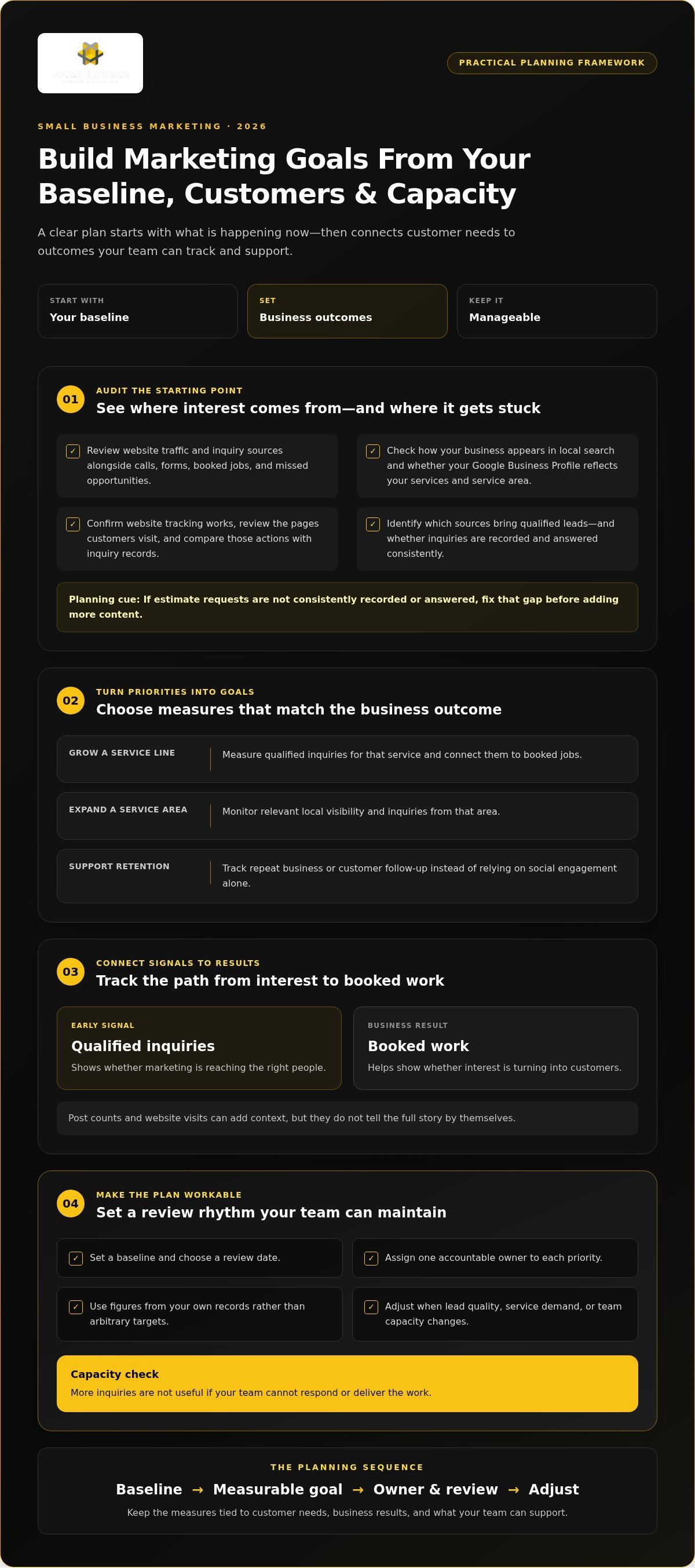
Before choosing new marketing tactics, find out what’s happening now. How do people discover your business? Which sources lead to qualified inquiries, and how many of those inquiries become booked work? A useful small business marketing plan for 2026 starts with those answers, then sets priorities your team can support.
Audit the starting point before choosing new tactics
Review website traffic and inquiry sources alongside calls, forms, booked jobs, and missed opportunities. Check how your business appears in local search and whether your Google Business Profile clearly represents your services and service area. The goal isn’t to collect every possible metric. It’s to see where interest comes from and where potential customers get stuck.
For example, if estimate requests arrive through your website but aren’t consistently recorded or answered, adding more content may not be the first priority. Identify what already brings in qualified leads and where the process loses them. Check that website tracking works, review the pages customers visit, and compare those actions with your inquiry records.
Turn business priorities into measurable marketing goals
Translate a business priority into an outcome you can track. If you want to grow a service line, measure qualified inquiries for that service and connect them to booked jobs. If you plan to expand into a new service area, monitor relevant local visibility and inquiries from that area. If retention matters, track repeat business or customer follow-up rather than relying on social engagement alone.
Pair an early signal with a business result. Qualified inquiries can show whether marketing is reaching the right people; booked work helps show whether that interest is turning into customers. Post counts and website visits may provide context, but they don’t tell the full story by themselves.
Set a baseline, choose a review date, and assign one accountable owner to each priority. Use figures from your own records instead of adopting arbitrary targets. Review progress at a pace your team can maintain, then adjust if lead quality, service demand, or capacity changes. More inquiries aren’t useful if your team can’t respond or deliver the work.
If you’d like help connecting your goals to visibility, conversion, and follow-up, explore a growth plan for your business.
Choosing marketing channels without doing everything
A small business marketing plan for 2026 doesn’t need to include every channel. It needs channels that address your customers’ needs and your business’s current gaps. A North Texas contractor may need stronger visibility in nearby service areas, while another company may already attract visitors but make it hard to request an estimate. Choose based on customer intent, service area, team capacity, and what’s holding back the next step.
Use this comparison to identify where focused effort can make a difference. Assign each action to a specific person on your team, even if outside support helps with implementation.
| Customer need | Channel role | Prerequisites | Measure | Operational owner |
|---|---|---|---|---|
| Find a nearby service provider | Local SEO and Google Business Profile help customers discover the business | Accurate business details, services, and service area | Relevant local visibility and qualified inquiries | Marketing or profile owner |
| Understand a service and take the next step | Website or landing page explains the offer and makes it easy to call or request an estimate | Clear service details and a working inquiry path | Calls, forms, and qualified inquiries | Website owner |
| Get answers before choosing | Useful content addresses customer questions and shows relevant expertise | Accurate, helpful information about services | Relevant search visibility and inquiries | Content owner or subject expert |
| Build confidence in the business | Review requests and responses support customer trust | A consistent process for requesting and managing reviews | New reviews and response completion | Customer experience owner |
| Get a timely response | Lead follow-up routes inquiries to the right person and prompts a response | Clear ownership and a reliable contact process | Response time and inquiry outcomes | Intake or sales owner |
Match each channel to a specific customer journey problem
If nearby customers aren’t finding you, prioritize local search and your Google Business Profile. Review your business details, core services, service area, and website links. This local search visibility framework can help connect local SEO, profile information, and technical site health. If visitors arrive but aren’t sure what you do or how to request service, improve the relevant page before investing more effort in attracting traffic.
When prospects need reassurance or answers, useful content and a steady reputation workflow can address those needs. Choose the channel that removes a real obstacle, not simply the one your competitor happens to use.
Compare channel effort with conversion and follow-up needs
More lead generation won’t solve an unclear website path or unanswered inquiries. If forms sit unattended, first clarify who receives them, where they’re recorded, and how the team responds. Automated lead follow-up for service businesses may be worth exploring when manual follow-up is inconsistent. A focused plan builds the next useful part of the system, then expands as your team has the capacity to manage it.
Build a realistic 2026 marketing calendar with owners and review points
A marketing plan only works if the team can carry it out. Set quarterly priorities, break them into monthly actions, and reserve time for recurring weekly tasks. Assign every priority a named owner, completion date, and success measure. That turns the small business marketing plan for 2026 into an operating schedule, not a list of good intentions.
Create a phased plan that protects focus
Start by fixing the foundation: confirm tracking works, check business and service details on your Google Business Profile, and make sure website visitors can take a clear next step. Then schedule visibility and authority work around your priority services and customers. Add lead routing or follow-up improvements when you find gaps in how inquiries are captured or answered.
For example, a North Texas HVAC company might first clarify its service pages and inquiry path, then focus local visibility work on the areas it can serve. The sequence may differ for a contractor working across a wider territory or a professional service firm with a narrower audience. Use a simple calendar to make the work accountable:
Quarterly priority: Improve the inquiry path for a priority service.
Monthly action: Review the service page and complete agreed updates. Owner: website lead. Due: month-end. Measure: calls and forms from that page.
Weekly task: Route and respond to new inquiries. Owner: intake lead. Measure: response time and inquiry status.
Recurring work: Request reviews after completed jobs, publish useful service content, and check marketing performance. Assign an owner and due date to each task.
If a page needs clearer service details or a stronger next step, landing page and conversion improvements can be part of the plan.
Keep execution realistic for a busy service team
Limit active priorities to the work your team can complete and maintain. A packed calendar can look productive while important tasks, such as responding to estimate requests, keep slipping. Batch related work where it fits: prepare content together, set a regular time for review requests, and schedule technical fixes instead of leaving them on an open-ended list.
Use a monthly check to confirm that planned actions were completed and measures are being recorded. Reserve quarterly reviews for bigger decisions, such as changing priority services, adjusting focus areas, or shifting effort to address a new bottleneck. Don’t assume every North Texas market needs the same schedule or local tactics. Base the calendar on customer demand, service capacity, and what your own results show.
Tools N Tactics | Local SEO & Digital Marketing Solutions connects priorities, page improvements, and follow-up through its Growth Partner Program. Review how a practical marketing plan could support your business.
Measure results and connect your 2026 marketing plan to a growth system
Measurement should show more than whether marketing activity happened. It should help you see how people move from finding your business to becoming customers. In your small business marketing plan for 2026, connect visibility, qualified inquiries, response speed, booked work, reviews, and customer retention where they matter to your goals.
Choose measures that show movement from discovery to revenue
Each tool gives you a different view of the customer journey:
- Google Search Console shows how your site appears in Google Search and which queries lead people to it.
- Google Analytics 4 helps you understand activity on your website, such as visits to service pages and completed inquiry actions.
- Google Business Profile provides signals about how customers find and interact with your local listing.
- CRM records connect calls and form submissions to lead status, follow-up, booked work, and, when relevant, repeat customers.
Keep CRM records consistent. Record the inquiry source, service requested, response status, and outcome using the same labels. That makes it easier to tell whether visibility is attracting the right prospects and whether inquiries are progressing to booked work. Track reviews and customer retention if they support your business goals.
Traffic shows who found you; lead quality shows whether the right people are finding you. A rise in visits matters less if those visitors aren’t looking for the services you provide. Avoid treating outside benchmarks as promises or targets. Use your own baseline and business priorities to judge progress.
Improve the system based on evidence, not guesswork
Review the journey each month: search discovery, website visit, inquiry, response, and outcome. Look for the point where prospects drop off. If people reach a service page but rarely inquire, clarify the offer and next step. Conversion optimization for service businesses can help improve how a website turns relevant visits into action. If inquiries come in but response records are missing, focus on lead routing and follow-up instead.
Choose one bottleneck to address at a time. Make the change, allow enough time to gather useful evidence, then compare the relevant measures with your baseline. In a short monthly review, decide what to keep, improve, pause, or test next. This creates a steady feedback loop without changing tactics every time results shift.
Tools N Tactics | Local SEO & Digital Marketing Solutions connects discovery, clear next steps, and customer trust through its Visibility, Conversion, and Authority Engines. The Growth Partner Program can help bring those priorities into one growth plan.
Put Your 2026 Marketing Plan Into Motion
A practical small business marketing plan for 2026 starts with your business goals and current results, not a competitor’s calendar. Choose channels that address real customer needs, assign clear owners, and set review dates so your team can adjust based on evidence. Most importantly, connect the full path from local discovery to website inquiry, timely follow-up, and booked work.
For service businesses, visibility without a clear next step can leave customer interest untapped. A connected plan aligns local search, conversion, reputation, and lead handling so each part supports the next. Tools N Tactics works with North Texas service-based businesses through integrated Visibility, Conversion, and Authority Engines, supported by lead routing and SMS or email follow-up automation.
Your plan doesn’t need to do everything at once. It needs a clear starting point and a workable next step. Talk with Tools N Tactics about a connected growth plan for your business.
Frequently Asked Questions
What should a small business marketing plan include for 2026?
A useful small business marketing plan for 2026 connects business goals to priority audiences, service areas, marketing actions, owners, timing, and measures. It should account for how customers find you, what helps them trust your business, how they take the next step, and how inquiries receive follow-up. Keep the plan detailed enough to guide weekly work, but flexible enough to adjust when customer demand, team capacity, or results change.
How do I create a marketing plan for a small business?
Start by reviewing current inquiries, lead sources, website pages, local search presence, and follow-up. Then choose a few business outcomes, such as increasing qualified inquiries for a priority service or improving repeat customer engagement. Select actions that address the biggest gaps, assign an owner and due date to each, and track progress consistently. Regular reviews help turn the plan into a working tool instead of a document that sits unused.
Which marketing channel should a small business focus on first?
Focus first on the point where potential customers are getting stuck. If local customers struggle to find your business, review local search visibility. If people visit your site but don’t inquire, improve the relevant service page and next step. If calls or forms aren’t receiving timely responses, address lead routing and follow-up. The best starting channel depends on the bottleneck, not simply on what competitors are doing.
How often should a small business update its marketing plan?
Review planned actions and key measures monthly, then reassess strategic priorities at least quarterly or when business conditions change. Monthly reviews can reveal incomplete work, missed inquiries, or changes in lead quality. A broader quarterly review helps determine whether your channels still fit customer needs, service capacity, and business goals. Keep actions that support meaningful progress, and revise or pause those that no longer fit.
How can a local service business build a marketing plan?
Define the services, customers, and locations your team can serve well, then review local visibility, Google Business Profile details, service pages, reviews, and inquiry handling. A North Texas business might serve customers in Plano, Dallas, Celina, Princeton, Melissa, Sherman, or Frisco, but those markets shouldn’t automatically receive identical priorities. Use actual service coverage, customer questions, and inquiry patterns to shape local content and marketing actions.
How do I measure whether my small business marketing plan is working?
Track measures across the customer journey, including relevant search visibility, qualified inquiries, calls, response and follow-up, booked work, reviews, and retention where relevant. Google Search Console, Google Analytics 4, and Google Business Profile each offer different visibility or engagement signals. CRM records can connect inquiries to their status and outcome. Review lead quality alongside traffic, since more visits alone don’t show whether marketing is supporting business goals.
Can a small business marketing plan work without doing every marketing tactic?
Yes. A useful plan focuses on actions that match your goals, audience, and team capacity. A local service company might prioritize being found in local search, making service details and inquiry steps clear, building customer trust, and responding consistently before taking on more channels. Measure whether those priorities address the current gaps. Add another tactic when the team can support it and there’s a clear reason to do so.