No credible SEO provider can guarantee a specific Google ranking. Local SEO for dentists in Sherman, TX can improve a practice’s visibility in local search and give prospective patients more opportunities to find its website, call, or request directions.
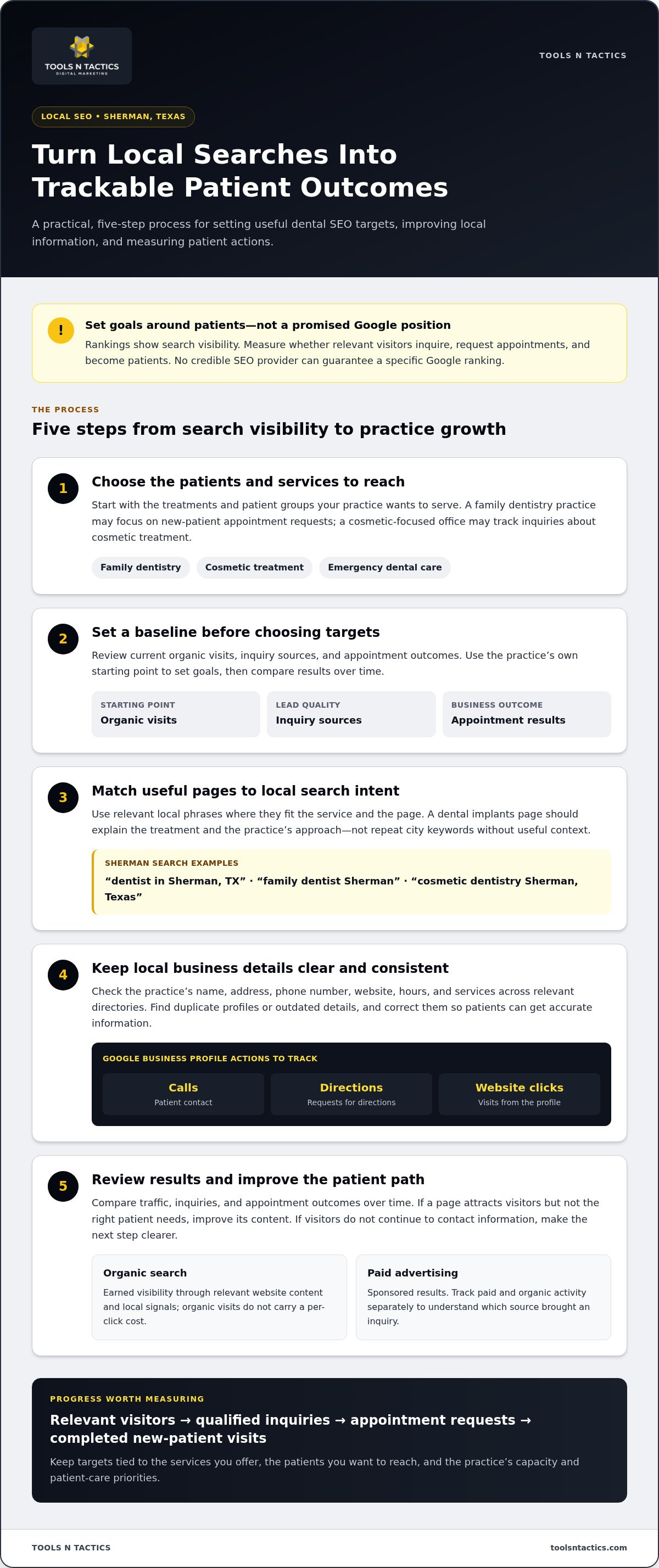
It makes sense to want a clear target for new-patient inquiries, not just a promise to “rank higher.” Useful targets depend on the practice’s starting point, the services it wants to promote, and how effectively its website and Google Business Profile turn local searches into patient inquiries.
This article explains how to set practical traffic and lead targets, what influences local search visibility, and how to track calls, direction requests, and website clicks from a Google Business Profile. You’ll also see how local SEO activities work together, what to expect from sustained effort, and how to assess progress without relying on a guaranteed ranking claim.
Key Takeaways
- Set patient inquiry goals around the services and patient groups your practice wants to reach, then track organic traffic alongside qualified leads.
- Improve local visibility by aligning your website, Google Business Profile, and business listings with the dental services and communities you serve.
- Measure calls, direction requests, and website clicks from your Google Business Profile to see how local searches lead to patient actions.
- Strengthen your website with clear service pages, useful content, sound technical foundations, and credible mentions across the web.
- Use consistent citations and relevant backlinks to support trust and local rankings, while judging progress by business outcomes rather than a promised Google position.
Organic traffic and new-patient lead targets
Organic traffic can bring prospective patients to a dental practice’s website without a charge for each click. Set goals beyond visits: measure qualified inquiries, appointment requests, and completed new-patient visits. Choose the treatments and patient groups the practice wants to reach, then assess whether its pages attract relevant visitors. Increased traffic matters most when it supports the practice’s capacity and patient-care priorities.
Build targets from the practice’s own starting point. Review current organic visits, inquiry sources, and appointment outcomes before setting a growth goal. A practice promoting family dentistry may prioritize new-patient appointment requests, while an office focused on cosmetic treatment may track inquiries for those services. Compare results over time and improve page content if visits aren’t bringing the right patient needs.
Local keyword examples include “dentist in Sherman, TX,” “family dentist Sherman,” and “cosmetic dentistry Sherman, Texas.” Use each phrase where it fits the page’s service and patient intent. A page about dental implants should explain the treatment and the practice’s approach, rather than repeat Sherman keywords without useful context. This helps prospective patients find relevant information before contacting the office.
A dentist’s profile should connect professional information with patient-centered care. Describe the services the practice provides and explain practical details patients may want before booking. For example, a practice offering children’s dentistry can make that service easy to find and explain how families can request an appointment. Clear information helps patients decide whether the practice suits their needs.
Reviews can offer insight into patient experiences, including how comfortable people felt during care. Invite honest feedback consistently, and respond professionally while protecting patient privacy. Don’t rewrite reviews or suggest that one person’s experience represents every patient. A steady feedback process can help the practice understand concerns and build trust.
For Texas dental websites and online reviews, describe services, credentials, treatment, and offers accurately. Present patient feedback honestly, without changing its meaning or suggesting every patient will have the same outcome. These practices support transparent communication with prospective patients.
Local searches may include a city, a treatment, or a phrase such as “dentist near me.” Sherman examples include “emergency dentist Sherman” and “family dentist in Sherman, Texas.” Use terms that match the page’s subject and the services patients can request. A new-patient offer should explain what it includes and how to book, without obscuring important details.
Rankings indicate search visibility, not patient acquisition on their own. Assess local SEO for dentists in Sherman, TX by whether relevant visitors inquire, request appointments, and become patients. This keeps goals tied to practice growth rather than a position in search results.
Local search competition and directory rankings
A Sherman dental practice appears across map results, organic listings, and directory pages. Which practices show up can vary by service searched and the searcher’s location. Review results for distinct needs, such as emergency care or dental implants, and note which listings and pages help patients make informed choices. This can reveal gaps your practice can address with clearer service information.
Directories can help patients discover a practice, but inaccurate listings can undermine trust. Check the practice’s name, address, phone number, website, hours, and services across directories relevant to local patients. Look for duplicate profiles or outdated details that could cause confusion. Record corrections so staff can maintain consistent information when contact details or services change.
Compare nearby practices by the information they provide, not just their placement. Another practice’s page may explain what a treatment involves, who provides it, and how patients can arrange a visit. If your practice offers the same service, create a page that addresses those needs accurately and clearly. Don’t copy another office’s wording or claim services your team doesn’t provide.
Organic search and paid advertising play different roles. Paid ads can place a practice in sponsored results, while organic listings earn visibility through relevant website content and local signals. Organic visits don’t carry a per-click cost. Track paid and organic activity separately to understand which channel brought a call or appointment inquiry. This distinction helps guide improvements to the patient journey.
Engagement can show whether visitors find a page useful. Review which pages people visit, whether they move to related treatment information, and whether they use appointment options. For example, if a page about emergency dental care attracts visitors but few continue to the contact information, make the next step clearer. Review page usefulness and navigation before assuming the search result itself is the problem.
Use this review process to uncover local search gaps:
- Compare map, organic, and directory results for priority dental services.
- Correct inaccurate or duplicate business listings.
- Review competing pages for patient questions your site can answer.
- Measure engagement and inquiries separately by traffic source.
Directory visibility is only useful when information helps patients choose and contact the practice. A focused review can show which listing, page, or patient path needs attention first. If you want help turning those findings into a practical local visibility plan, discuss your search visibility priorities.
Google Business Profile calls, directions, and website clicks
A Google Business Profile gives patients several ways to act before visiting a practice’s website. A call, a route request, and a website visit reflect different kinds of interest. Review each action separately instead of treating every profile interaction as a completed appointment. For example, a patient may request directions to compare travel time, while another may call with a question about a treatment.
Practice owners may still use the older name Google My Business, but the current name is Google Business Profile. Begin optimization by checking the profile’s primary category, service details, appointment link, and contact options. Then test each path as a patient would. An appointment button that leads to a general homepage instead of a booking page can create friction and make the profile less useful.
Connect profile content to the questions patients ask. A Sherman practice offering children’s dentistry can make that service easy to identify and link visitors to relevant information. Use natural wording that describes the practice accurately. Avoid adding unrelated keywords to the business name or profile description, since this can confuse patients and make the listing less trustworthy.
Treat calls, direction requests, and website clicks as separate signals. A call may be a question about insurance or availability, not necessarily a booked visit. A website click may lead to a treatment page, an appointment form, or no further action. Record what happens after each inquiry through the practice’s usual intake process. This makes profile reporting more useful for understanding patient acquisition.
Compare profile activity with what happens on the website and in the office. If people click through to a treatment page but don’t submit an appointment request, review the page’s contact options and booking instructions. If calls bring questions the profile could answer, improve the relevant service details. This creates a practical feedback loop between patient behavior and profile content.
- Test appointment and website links from the profile on a mobile device.
- Review calls, route requests, and website visits as distinct actions.
- Note common questions patients ask after contacting the practice.
- Update profile details when services or booking steps change.
Google Business Profile optimization is most useful when each action leads to a clear next step. A patient who taps to call should reach the practice, while someone visiting the website should find information that matches the profile. Review those paths together and fix gaps that make it harder to ask a question or request an appointment.
On-page, off-page, and technical SEO
For dentists in Sherman, useful local SEO combines accurate service pages, a complete Google Business Profile, consistent local citations, and credible reviews. Build those signals around the dental services patients can book, then connect each page to a clear appointment path. This helps Google understand the practice and helps people find relevant care.
Create focused pages for core services, such as dental exams, cosmetic dentistry, and dental implants, when the practice provides them. Each page should explain the treatment, who it may help, and how to request an appointment. Include Sherman naturally in page titles and useful copy, rather than repeating location keywords where they don’t help readers.
Technical improvements support local visibility and conversions. Make every page mobile-friendly, improve slow-loading pages, and check that appointment forms work on phones. A patient looking for a Sherman dentist may leave if a treatment page is hard to read or its contact button doesn’t work. Test the site on a phone and complete each form yourself.
On-page SEO also depends on clear structure. Use descriptive page titles, headings, internal links, and contact details that match the practice’s information. For example, a cosmetic dentistry page should link to the appointment page, not leave visitors searching for the next step. Helpful content should address a patient’s intent without making unsupported claims about treatment results.
Off-page signals come from outside the website. Reviews, backlinks, and mentions across the web can support a dental practice’s digital reputation. Invite patients to leave honest feedback through a consistent process, and respond professionally. Earn relevant links through useful community resources or credible local mentions. Avoid unrelated links that add no value for Sherman patients.
Use this workflow to keep improvements focused:
- Match each priority dental service to a dedicated, helpful page.
- Check mobile layout, page speed, forms, and phone links.
- Connect service pages to booking options and related information.
- Review citations, patient feedback, and relevant website mentions.
Technical SEO for a Sherman dental website includes improving speed and making every page mobile-friendly. Pair those fixes with clear service content and accurate local information. Then use analytics to see whether visitors reach key pages, use contact options, and submit appointment requests.
Local rankings can’t do the entire job. A well-built page must also make the next step clear to someone comparing dental care in Sherman. Review the site from a patient’s point of view, remove obstacles that interrupt the path, and keep content aligned with the treatments and care the practice provides.
Citation building and backlinks
A citation is an online mention of a dental practice’s name, address, and phone number. For a Sherman office, citations can appear in directories, association listings, and local business resources. Their value depends on accuracy and relevance, not on collecting the largest possible number. A listing with an old phone number can send prospective patients to the wrong place and create conflicting business information.
Start with an inventory. Search the practice name and phone number, then record each directory, profile, and listing that appears. Check the address, website, hours, and practice name against current business information. Correct inaccurate entries and remove duplicates where possible. A spreadsheet with the listing name, status, and update date gives the team a simple record for future reviews.
Prioritize directories that fit the practice and its community. Examples include dental association listings, local business directories, and Sherman-area community resources. A citation should help patients verify the practice or find its services. Skip listings with no clear connection to dental care or the communities the office serves. Relevance keeps the work focused and makes each mention easier to assess.
Backlinks are links from other websites to the practice’s website. A link from a relevant community organization or dental resource can help people discover the practice and support its online authority. Focus on useful relationships, such as contributing accurate oral-health information to a local community resource. Avoid buying links or placing them on unrelated sites simply to increase link counts.
Use a clear outreach process. Identify a relevant website, find a genuine reason for its audience to reference the practice, and provide helpful information. For example, a Sherman community page might link to a dental office’s explanation of what new patients should bring to an appointment. The content should serve readers first. A link without a meaningful reason adds little value for prospective patients.
Track citation and backlink work separately from patient inquiries. Record which listings were corrected, which relevant websites mention the practice, and whether referral visits reach useful pages. Dental SEO is stronger when citations reinforce accurate business details and backlinks point to helpful content. Review target pages regularly, especially after changes to the practice’s name, address, or website.
- Inventory existing citations and document corrections.
- Prioritize Sherman and dental-relevant listings over unrelated directories.
- Seek backlinks through useful content and genuine local connections.
- Review referral visits and listing accuracy as separate measures.
A comfortable patient experience starts before someone enters the office. Accurate listings and useful linked pages help potential patients confirm where to go and what to expect. To build a practical citation and backlink plan, discuss your local visibility priorities.
Tools N Tactics | Local SEO & Digital Marketing Solutions: Growth Partner Program
Tools N Tactics | Local SEO & Digital Marketing Solutions can help Sherman dental practices bring scattered marketing tasks together in a coordinated growth system. Its Growth Partner Program connects visibility, conversion, and authority work, giving practices a practical next step when local search efforts lack direction or aren’t producing useful patient inquiries.
The Visibility Engine supports search presence, while the Conversion Engine focuses on helping visitors take the next step. The Authority Engine builds trust and credibility. Together, these services can align local SEO with the practice’s priorities, from attracting relevant searches to improving the path from website visit to appointment inquiry.
If your practice needs a clearer plan for local visibility and patient acquisition, contact Tools N Tactics to discuss your goals.
Build a stronger path from search to patient
Make the next step a focused review of how your practice earns local visibility and turns it into patient inquiries. Choose the dental services and patient needs that matter most, then align your website, profile, and follow-up around those priorities. A local SEO plan for dentists in Sherman, TX should fit the practice’s capacity as well as its growth goals.
Tools N Tactics connects this work through its Growth Partner Program. The Visibility Engine supports search presence, while the Conversion Engine focuses on the path from visitor to inquiry. Start with the gap that matters most: whether patients aren’t finding the practice or aren’t taking the next step after visiting its site.
Clear priorities make progress easier to assess and improve. Contact Tools N Tactics to discuss your local growth goals and identify a practical next step for your practice.
Tools N Tactics | Local SEO & Digital Marketing Solutions for Sherman Dentists
Tools N Tactics | Local SEO & Digital Marketing Solutions helps dentists move from local SEO planning to implementation through Google Business Profile optimization, citations, SEO services, and content for search visibility.
Turn to Tools N Tactics for support with next steps such as reputation management, analytics and tracking setup, conversion optimization, or SMS and email follow-up automation. Services also include web development, landing pages, CRM services, and AI solutions.
Frequently Asked Questions
Can you guarantee #1 rankings on Google?
No legitimate SEO company can guarantee a specific Google ranking. Search results vary with the searcher’s location, query, and competing pages. Instead of accepting a fixed-position promise, ask for a clear plan and reporting that connects visibility to useful outcomes, such as qualified inquiries. For a Sherman dental practice, progress means relevant patients find accurate information and take meaningful next steps.
How long does SEO for dentists take to show results?
Tools N Tactics reports that SEO results typically become noticeable within 2-6 months. The work progresses from research, audits, and strategy to technical improvements, content, link-building, and ongoing adjustments. Early movement in search visibility is not the same as a steady flow of new appointments. Track rankings, organic traffic, and conversions together so you can see whether the work is reaching prospective patients.
What’s included in your SEO service for dentists?
Tools N Tactics’ SEO services can include keyword research, local SEO, on-page optimization, off-page link-building, technical SEO audits, performance tracking, and reporting. For a dental practice, this work can support service pages for treatments the office provides and identify technical issues that make those pages harder to use. A useful plan connects each activity to a defined goal, such as stronger local visibility or more appointment inquiries.
How can a Sherman dental practice optimize its Google Business Profile?
Assign a team member to review the profile regularly and keep practice details current. Add appointment information that leads to the correct booking page, and check that profile links work on mobile devices. Use performance tracking to compare profile visits with actions on the website. If the practice changes its services or office procedures, promptly update public information so prospective patients don’t rely on outdated details.
How competitive is local dental SEO in Sherman compared with Denison and nearby cities?
Competition can vary by service, search phrase, and the searcher’s location, so Sherman and Denison shouldn’t be treated as identical markets. Compare results for the same service in each city, then note which practices appear and what their pages cover. A Sherman office seeking patients from nearby areas should create useful content for each community it genuinely serves, rather than repeat city names without adding local information.
How can dentists in Sherman get more Google reviews while following Texas rules?
Use a consistent, neutral request inviting every patient to share an honest experience. Don’t offer rewards for positive reviews, ask only patients expected to praise the practice, or rewrite patient comments. Keep public responses professional and avoid sharing private patient details. Describe services and outcomes accurately in practice advertising, and have a qualified reviewer assess specific Texas compliance questions before publishing claims.
How can a dental practice build local citations and backlinks in Sherman, TX?
Start by checking whether existing business listings show the correct practice name, address, phone number, and website. For backlinks, build relationships with relevant community organizations and share useful dental information they may choose to reference. For example, a practice could prepare a patient-friendly explanation of what to bring to a first visit for a local resource page. Track referrals from each mention to learn which sources bring engaged visitors.
How long does local SEO take to improve Google Maps rankings for a dentist?
Measurable local pack movement may appear within 60-90 days, while broader SEO progress typically takes 2-6 months. Review performance across relevant searches and locations, not just one Maps result viewed from the practice. Track profile actions and appointment inquiries alongside ranking changes. This helps distinguish a position shift from meaningful patient interest and points to the areas that need continued attention.