
If you aren’t answering a lead’s question within seconds, someone else will. With 95% of customer interactions forecast to be AI-powered by 2026, a missed call after 5 PM isn’t just a minor inconvenience; it’s a direct gift to your local competition. You’ve likely felt the frustration of waking up to missed inquiries or spending your valuable time in the field answering the same basic qualifying questions over and over. It’s exhausting to balance manual labor with the constant demand for instant digital communication.
This article will show you how to implement an AI chatbot for service business that turns your website into a 24/7 mechanical dispatcher, ensuring you never leak another lead again. You’ll learn how to automate lead qualification, sync appointments directly to your CRM, and integrate these tools into a wider growth system. We’ll explore the specific frameworks needed to scale your revenue in 2026 while maintaining a lean, efficient operation that works even when you’re off the clock.
Key Takeaways
- Plug the “leaky bucket” in your sales process by ensuring every inquiry gets an immediate response, even when you’re off the clock.
- Turn your website into a high-performance Conversion Engine that qualifies leads and filters out tire-kickers before they reach your calendar.
- Understand the critical shift from frustrating scripted bots to generative AI agents that can handle complex trade questions with human-like nuance.
- Learn how to integrate an AI chatbot for service business with your central CRM to create a unified system for lead routing and tracking.
- Move beyond standalone widgets by aligning your automation tools with a broader Visibility Engine for long-term, scalable growth.
What is an AI Chatbot for Service Business and Why Does it Matter Now?
Think of an AI chatbot for service business as a mechanical dispatcher that never sleeps. It isn’t just a floating icon on your website; it’s a sophisticated tool designed to qualify leads and route data directly into your CRM 24/7. While you are busy on a job site or sleeping, this digital agent is busy separating the tire-kickers from the high-value emergency repairs. It transforms your website from a static brochure into a high-performance component of your Conversion Engine.
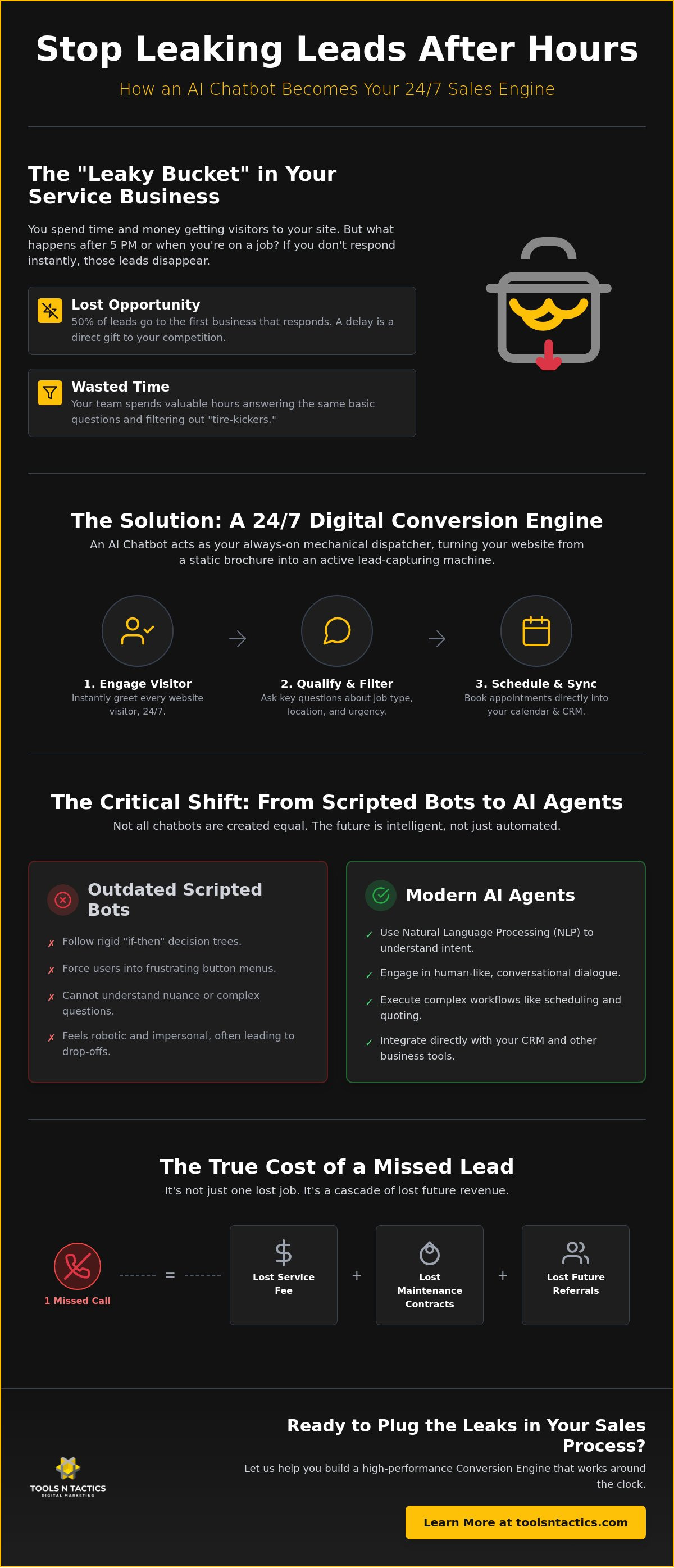
Most service companies suffer from “Leaky Bucket” syndrome. You spend thousands on search visibility to get people to your site, but if they arrive after 5 PM and get a voicemail, they leave. Industry data shows that 50% of leads go to the first business that responds. In the competitive North Texas market, a homeowner with a broken AC in July won’t wait for a callback tomorrow morning. They will simply click the next contractor on the list. An AI chatbot plugs this leak by providing an immediate, intelligent response that secures the lead before they move on to your rival.
The Shift from Scripted Bots to Intelligent AI Agents
Old-school “choose your own adventure” bots are a relic of the past. They frustrate modern customers by forcing them through rigid button menus that rarely address specific problems. Today, a modern Chatbot uses Natural Language Processing (NLP) to understand the nuance of a homeowner’s request. It can tell the difference between a request for a routine inspection and a panicked message about a burst pipe. In 2026, AI agents act as autonomous representatives that interpret human intent and execute complex workflows rather than just following rigid decision trees.
The True Cost of a Missed Lead in Service Industries
The financial impact of a missed call is staggering when you calculate the lifetime value of a customer. For an HVAC or roofing company, one missed lead isn’t just a lost service fee; it’s the loss of potential maintenance contracts, future replacements, and word-of-mouth referrals. Saying “we will call you back tomorrow” is often a death sentence for a conversion. Beyond immediate revenue, your speed-to-lead indirectly impacts your Google Business Profile ranking. Google prioritizes businesses that demonstrate high engagement and responsiveness, meaning a slow response time can eventually push you further down the search results where no one can find you.
How AI Chatbots Function as Your 24/7 Digital Conversion Engine
A website without an active response system is just a static brochure. To scale your revenue in 2026, you need a mechanism that actively engages visitors. An AI chatbot for service business acts as the primary driver of your Conversion Engine. It moves beyond the passive “Contact Us” form, which often feels like shouting into a void for a busy homeowner. Instead, it creates an immediate dialogue that captures intent at the exact moment a prospect is ready to buy.
This system reduces friction by meeting customers exactly where they are. Whether they prefer chat, SMS, or voice, the AI ensures the conversation remains consistent and professional. By removing the barriers to communication, you create a seamless path from a search result to a booked appointment. It functions as a mechanical filter, ensuring your team only spends time on high-value interactions.
Automating the Qualification Process
Not every click is a customer. One of the biggest drains on your operational efficiency is the time spent on tire-kickers or people outside your service area. The AI agent handles this filtering process automatically. It asks the critical questions you would normally ask over the phone, such as the specific nature of the job, the urgency of the request, and the physical location of the property. By gathering this data instantly, the bot can provide immediate pricing estimates for standard services. This transparency builds trust and ensures that by the time you see the lead in your CRM, they are already pre-qualified and ready for a quote.
Meeting Scheduling and Dispatch Integration
The true power of this technology lies in its ability to connect with your existing machinery. Modern AI agents sync directly with field service management software like Housecall Pro or Jobber. This integration allows the bot to see your real-time availability and offer specific time slots to the customer. This eliminates the exhausting back and forth of emails and missed calls. The customer gets the convenience of booking a slot at 11 PM, and you wake up to a populated schedule. Learn how our Conversion Engine turns clicks into customers by removing these manual bottlenecks. If you are ready to stop chasing leads and start managing a system, you can reach out to our team to see how this fits into your specific workflow.
Comparing Scripted Bots vs. Generative AI Agents for Trades
The mechanical integrity of your communication system depends entirely on the technology powering it. For years, service companies relied on scripted bots that functioned like digital phone trees. These systems are rigid, frustrating, and often drive potential customers away because they can’t handle anything outside of a pre-defined path. While they are low cost, the hidden expense is the volume of lost leads they create. In 2026, the standard has shifted toward generative AI agents that act as a more fluid and intelligent component of your AI chatbot for service business strategy.
Generative AI understands nuance. It doesn’t just look for keywords; it interprets the human intent behind the message. This “Intent Recognition” is critical for trades. An intelligent bot can distinguish between a panicked homeowner saying “there is water coming through my ceiling” and a developer asking “can I get a quote for a ten-unit roof replacement?” One requires an emergency dispatch, while the other needs to be routed to a senior estimator. Scripted bots treat these the same, but an AI agent prioritizes them based on the urgency of the situation.
Why Decision Trees Fail Service Businesses
There is nothing more frustrating for a customer than being stuck in a “press 1 for service” loop in a chat window. Rigid decision trees fail because they miss opportunities for upselling and emergency routing. If a customer mentions a specific problem that isn’t in your bot’s script, the system breaks, and the lead is lost. North Texas homeowners expect a personalized, local-feeling interaction. They want to feel like they are talking to a neighbor who understands their specific roofing or HVAC needs, not a cold, mechanical script that can’t answer a basic question about service areas or warranty terms.
The Power of Intent-Based AI Agents
Modern AI agents are trained on historical data specific to your trade. They understand plumbing terminology, roofing materials, and HVAC system types without needing a human to program every possible word variation. This allows them to handle “out of bounds” questions seamlessly. If a user asks about your licensing or a specific brand of equipment, the bot provides a factual answer instead of a generic error message. AI Chatbot for Local Business Website: The 2026 Conversion Engine Guide explains how these systems learn over time to improve their accuracy.
Successful implementation often involves a hybrid approach. The AI handles the initial qualification and data gathering, but it knows exactly when to hand off the conversation to a human expert. When the bot detects a high-value opportunity or a complex technical question, it can ping your team via SMS or your CRM. This ensures your human staff only spends time on the most profitable conversations while the AI chatbot for service business keeps the rest of your pipeline moving smoothly.
Implementation: Integrating Chatbots into Your Automation Engine
Installing a widget on your website is a simple tactic; building a lead-routing system is a business strategy. To see real revenue growth, your AI chatbot for service business must be treated as a core gear within your Automation Engine. Implementation isn’t just about the chat window. It’s about what happens behind the scenes after the customer clicks “send.” A disconnected bot is just a distraction, but an integrated one is a mechanical powerhouse that drives your operation forward.
The implementation process follows a logical blueprint to ensure structural integrity:
- Step 1: Map the Journey. We define the path from the initial Google search to the final service call. This ensures the bot asks the right questions at the right time.
- Step 2: CRM Integration. We connect the chatbot directly to your central CRM. This eliminates manual data entry and ensures every lead is tracked and accounted for.
- Step 3: Trigger Follow-ups. We set up immediate SMS and email triggers. This ensures that as soon as a lead is qualified, the “speed to lead” machinery kicks into high gear.
- Step 4: Continuous Maintenance. We monitor real chat transcripts to refine the AI’s knowledge base, making it sharper and more accurate with every interaction.
The Speed to Lead Advantage
In the service industry, time is literally money. Research from LeadSimple shows that responding to a lead in under five minutes increases conversion rates by 391 percent. If you wait an hour, your chances of closing that job drop significantly. An AI chatbot solves this by providing an instant response. It doesn’t just say “hello”; it triggers instant SMS notifications to your field technicians. This allows your team to see the job details and urgency on their phones while they are still between appointments, giving you a massive competitive edge in the North Texas market.
Data Syncing and CRM Hygiene
Manual data entry is a silent killer of productivity. When your chatbot is properly integrated, it pushes full chat transcripts directly into your lead profiles. This keeps your database clean and actionable. The AI can even tag leads by priority or service type, such as “Emergency HVAC Repair” or “Roofing Estimate.” This level of organization ensures that your North Texas business maintains a clean database for future marketing efforts. If you are ready to stop chasing paper trails and start using a unified system, contact us to build your automation blueprint today.
Scaling with a Growth Partner: Beyond the Chatbot Widget
A standalone chatbot is a tactic. A Growth Partner is a strategy. Many contractors make the mistake of buying a shiny new tool without having a broader blueprint to support it. If your AI chatbot for service business isn’t connected to your visibility and authority systems, it’s like installing a high-performance engine in a truck with no wheels. You might have the power, but you aren’t going anywhere. To truly scale your revenue in 2026, you need a unified machine where every component works in sync.
The Tools N Tactics approach focuses on building this structural integrity for North Texas service businesses. We don’t just hand you a login for a software platform and wish you luck. Instead, we position ourselves as an architect of your growth. We ensure that your digital dispatcher is part of a repeatable system that moves the needle from fragmented efforts to consistent, scalable outcomes. This is the difference between surviving on referrals and owning your local market.
Visibility Meets Conversion
High-ranking SEO is the fuel that powers your conversion machinery. See how the Visibility Engine drives local traffic to ensure your chatbot actually has someone to talk to. If your website is buried on page three of Google, even the most advanced AI agent won’t help you. Your Google Business Profile acts as the front door to your business, but it needs a conversion-ready website to land on. When visibility and conversion are integrated, you create a seamless flow that captures the highest intent leads in your service area before they ever see a competitor’s name.
The Authority Loop
Your AI chatbot for service business can do more than just book appointments. It can also feed your Authority Engine by capturing social proof. After a successful service call is completed in your CRM, the system can trigger the chatbot or an SMS agent to ask for a review immediately. This creates a powerful loop where your high performance in the field directly improves your digital reputation. Consistent, professional interactions build long-term brand trust with homeowners who value reliability over the lowest price.
Building a business that runs without you requires more than just a widget. It requires a partner who understands the mechanical components of digital growth and how to wire them together for maximum ROI. If you are ready to stop managing a collection of disconnected tools and start running a high-performance lead machine, it’s time to change your approach. Apply for our Growth Partner Program to scale your business and secure your bottom line for the long term.
Secure Your Competitive Edge in 2026
The window for manual lead response is closing fast. With 95 percent of customer interactions forecast to be AI-powered by 2026, a sophisticated AI chatbot for service business is now a mandatory component for any contractor who wants to stay profitable. You’ve seen how these digital dispatchers plug the leaks in your sales funnel and qualify leads while you’re busy in the field. However, a standalone widget is just a tool. True growth happens when your automation works in perfect sync with your search visibility and brand reputation.
Tools N Tactics brings North Texas local expertise to your digital strategy. We help you move away from fragmented tactics and build a unified machine using our integrated Visibility, Conversion, and Authority Engines. Our systems focus on sustainable, long-term growth without a heavy reliance on paid advertising. It’s time to stop losing jobs to faster competitors and start running a high-performance operation that works around the clock.
Building a reliable system is the first step toward true business freedom. We look forward to helping you architect your long-term success.
Common Questions About AI Chatbots for Contractors
Will an AI chatbot make my service business feel impersonal?
Modern AI agents are designed to be helpful and responsive rather than robotic. Most customers prefer an immediate answer from a bot over waiting four hours for a human callback. By using an AI chatbot for service business, you provide a professional first point of contact that respects the customer’s time. It’s about providing high-performance service at the exact moment a lead is ready to book.
Can a chatbot actually book appointments in my specific field software?
How much time does it take to manage an AI chatbot once it’s live?
You should spend very little time on daily management. Once the initial blueprints are set and the knowledge base is trained, the system runs autonomously. As your growth partner, we monitor the transcripts and make mechanical adjustments to the AI’s logic to ensure it continues to qualify leads accurately. This allows you to focus on the technical work in the field while the machine handles the front-end communication.
Is an AI chatbot better than a live answering service for contractors?
AI bots offer superior speed and data accuracy compared to traditional answering services. While a human service might put a caller on hold or take incorrect notes, an AI agent captures data perfectly and pushes it into your CRM instantly. It also operates at a much lower cost per interaction. For most North Texas contractors, the bot provides a more reliable and scalable solution for after-hours lead capture.
Does having a chatbot on my site help with my local SEO rankings?
It helps indirectly by improving user engagement signals on your website. When visitors stay on your site longer to interact with a bot, Google sees that your page is providing value. This increased dwell time and higher conversion rate can signal to search engines that your business is a high-authority option in your local area, eventually helping your overall search visibility and ranking.
What happens if the AI chatbot can’t answer a customer’s specific question?
The system is programmed to recognize its limits and trigger a human hand-off. If a customer asks a complex technical question or has a unique emergency, the bot instantly pings your team via SMS or email with the full transcript. This hybrid approach ensures that no lead is ever ignored, but your human experts only step in when their specific expertise is truly required.
Are AI chatbots secure for handling customer contact information?
How do I know if my service business is ready for AI automation?
You are ready if you are currently losing leads to missed calls or slow response times. If your team spends more than two hours a day answering basic qualifying questions or scheduling routine appointments, your operation is prime for automation. Implementing these systems now prevents you from losing market share to more tech-forward rivals in the coming years.