The most expensive mistake a local contractor can make isn’t a bad hire or a missed permit; it is a missed phone call. You might think a standard website chatbot is the fastest way to modernize, but for service businesses, the obvious choice is often the wrong one. Deciding between an ai chatbot vs ai voice agent for local business depends entirely on where your customer journey is currently breaking down.
It is frustrating to watch high value jobs go to competitors just because they answered a text or a call ten seconds faster. You need a system that works as hard as your field crews without the overhead of a 24/7 reception desk. We will show you how to identify the friction in your lead flow and determine which engine will fix it. This guide breaks down the performance metrics, the latest 2026 regulations like the Texas TRAIGA, and the mechanical steps to turn your communication into a reliable lead routing system. You will discover exactly how to stop losing leads and start building a scalable foundation for growth.
Key Takeaways
- Identify the mechanical differences between text-based website assistants and phone-based digital receptionists to ensure no lead falls through the cracks.
- Evaluate the ai chatbot vs ai voice agent for local business debate by matching the technology to your primary lead source, such as Google Business Profile calls or website traffic.
- Prioritize “Speed to Lead” by deploying autonomous voice agents that can qualify and schedule high-ticket service calls before your competitors even pick up the phone.
- Learn why 2026 AI reasoning outperforms old-school scripted bots by understanding complex customer intent and regional Dallas/Plano nuances.
- Shift from buying isolated software tools to building a unified Automation Engine that drives repeatable revenue and operational stability.
Defining the Tech: Chatbots vs. Voice Agents in 2026
By 2026, both technologies have evolved beyond the rigid, “dumb” scripts of the past. They now utilize advanced Natural Language Processing (NLP) to interpret intent. This means they can actually understand a frustrated homeowner’s request rather than just searching for specific keywords. Local businesses across North Texas are moving away from these basic scripts in favor of “autonomous” agents. These systems don’t just talk; they perform tasks like updating your CRM or checking your actual crew availability in real-time. This shift represents a move from simple software to a structural business asset.
What is an AI Chatbot for Local Business?
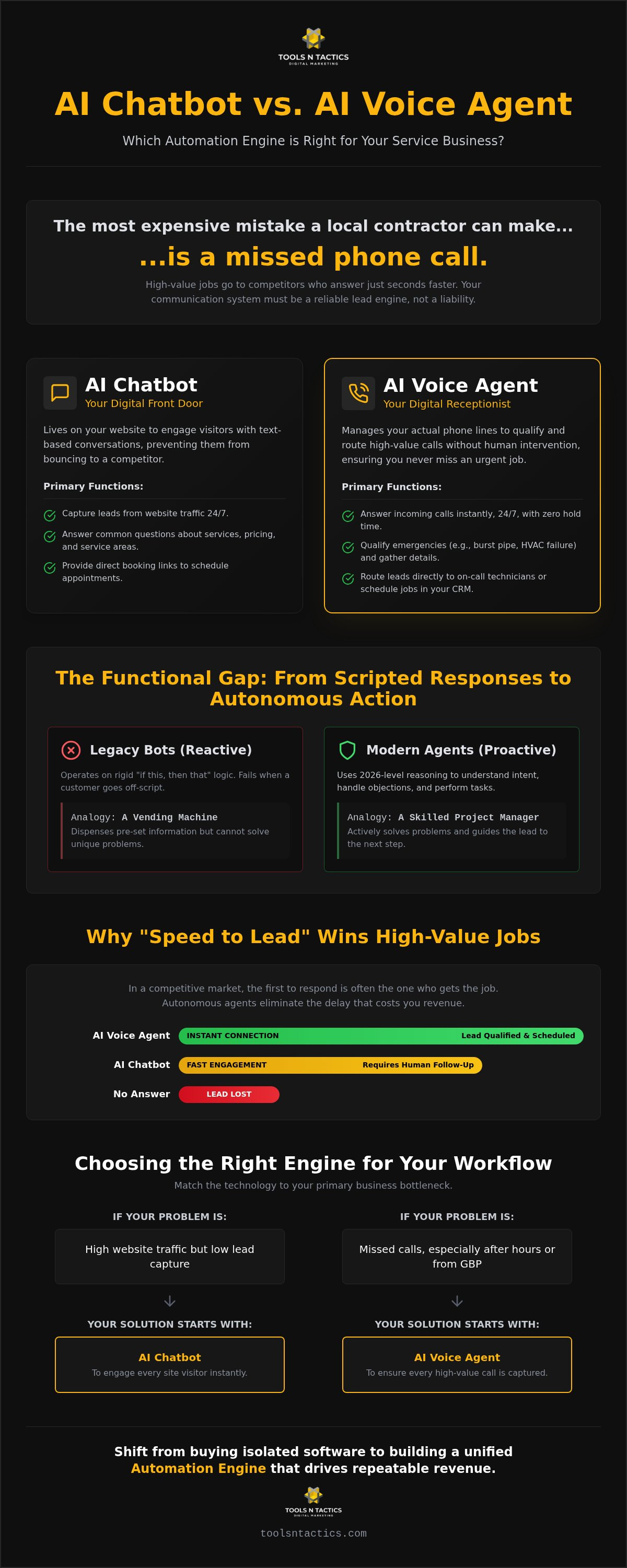
An AI chatbot is a core component of your Conversion Engine. While historical definitions of what a chatbot is often focus on simple rule-based responses, modern versions are far more capable. Instead of forcing a user to click through a series of buttons, these agents engage in fluid dialogue. They can answer complex pricing questions, explain your service area, or provide direct booking links while you are busy on a job site in Frisco. The primary goal is to capture the lead the moment they land on your site. If you don’t engage them within seconds, they will bounce back to the search results and click on your competitor.
What is an AI Voice Agent?
An AI voice agent is the mechanical successor to those annoying “Press 1 for Sales” menus. It is a high-performance part of your Automation Engine. Imagine a homeowner in Plano facing a burst pipe or an HVAC failure at 2:00 AM. They don’t want to navigate a keypad; they want to talk to a voice that can help. A modern voice agent answers instantly with zero latency. It qualifies the emergency, gathers the customer’s details, and routes the lead to your on-call technician immediately. It doesn’t get tired, it doesn’t sound like a computer from the 90s, and it never puts a high-value customer on hold. For local contractors, this is about maintaining a professional presence even when the office is closed.
The Functional Gap: Scripted Responses vs. Autonomous Action
Most business owners have been burned by “dumb” technology. Traditional chatbots operate on a rigid “if this, then that” logic. They’re essentially digital decision trees. If a customer clicks a specific button, the bot provides a pre-written response. This works for simple tasks, but it fails the moment a customer goes off-script. If a roofing lead in Plano asks about specific hail damage timelines and your bot just spits out a generic FAQ link, you’ve already lost that job. The customer doesn’t want a link; they want an answer.
By 2026, the mechanical difference in the ai chatbot vs ai voice agent for local business debate comes down to reasoning. Modern AI agents don’t just retrieve data; they process it. They can understand intent, even when a homeowner uses local slang or provides messy, fragmented information. While a bot might give a link, an agent solves the problem by actively scheduling an estimate or troubleshooting a service issue in real-time. It’s the difference between a vending machine and a skilled project manager.
Reactive vs. Proactive Engagement
Waiting for a customer to click a button is a losing strategy. In a competitive North Texas market, you can’t afford to be passive. Voice agents are inherently proactive. During a phone conversation, they can handle objections on the fly. If a customer is hesitant about a booking fee, the agent can explain the value or offer an alternative immediately. Autonomous reasoning is the digital transmission that allows the engine to adjust its torque based on the resistance of a complex conversation. This level of engagement ensures that the lead stays in your funnel rather than bouncing to the next Google search result.
The Role of Data and CRM Integration
An AI is only as powerful as the data it can access. To be effective, these agents must be deeply integrated with your CRM services. This connection allows a voice agent to check your real-time crew schedule in Frisco before offering a specific appointment window. It kills the back-and-forth of “let me check the calendar and call you back.”
This integration fuels the “Speed to Lead” advantage. Data confirms that businesses responding to inquiries within minutes are seven times as likely to qualify the lead compared to those who wait even an hour. By moving lead data into your follow-up system in seconds, you create a seamless transition from first contact to a signed contract. If you’re ready to see how this fits into your current workflow, consider discussing your lead routing system with a specialist who understands the specific demands of the North Texas service industry.
Speed to Lead: Why Voice Agents Win the Phone Tag Battle
Speed is the only metric that matters when a homeowner has a literal leak in their ceiling. When evaluating an ai chatbot vs ai voice agent for local business, you have to look at lead entry points. Chatbots are excellent for website visitors, but they can’t help the person searching “emergency plumber near me” and clicking the call button on their mobile screen. Voice agents capture that high-value phone traffic instantly. They meet the customer exactly where the most urgent, high-ticket leads originate.
The “I’ll call you back” culture is a sales killer. In Dallas, if you don’t answer, the customer is already scrolling to the next listing. 2026 voice synthesis has reached a point where it is nearly indistinguishable from human speech. It lacks the stilted, robotic cadence of previous decades. This allows you to maintain a professional, high-authority brand image without the overhead of a massive call center. It’s a strategic comparison of AI voice agent vs. chatbot capabilities; one handles the text, while the other masters the verbal interaction that closes the deal.
The Cost of a Missed Call in North Texas
A single missed HVAC replacement call in Plano can represent a loss of $10,000 to $20,000 in immediate revenue. These high-ticket jobs often come in after-hours when traditional offices are closed. This is when your competitors are sleeping. An AI voice agent acts as a 24/7 safety net for your Visibility Engine. It ensures that every dollar spent on local SEO and search visibility results in a conversation rather than a voicemail that never gets returned. You aren’t just buying software; you’re buying insurance against lost market share.
Human Handoff: When the AI Steps Aside
We use a concept called the “Mechanical Threshold.” This is the point where a conversation moves from basic scheduling to complex technical diagnosis. At this stage, the AI identifies the need for a human expert and performs a seamless transfer. Whether your team is based in Celina or Melissa, they receive a qualified lead with a full transcript of the initial interaction. This maintains your authority. The AI handles the friction of the initial intake, and your experts handle the closing of the deal. It ensures your business never guesses an answer, which is vital for building long-term trust with your community.
Implementation Framework: Choosing the Right Engine for Your Workflow
Deploying automation without a clear blueprint is like building a house without a foundation. You’ll end up with a fragmented system that frustrates customers and leaks revenue. To decide on the right ai chatbot vs ai voice agent for local business, you must first audit your primary lead source. If your business depends on “Call” buttons from Google Business Profile listings, your priority is a voice agent. If you generate the majority of your leads through Facebook Ads or a “Get a Quote” website form, a chatbot is your logical starting point.
Scenario A: The Residential Contractor
For a residential contractor, speed is the only metric that matters. Your priority should be a voice agent configured for intake and scheduling. This ensures that when a homeowner calls with an urgent repair, they aren’t met with a voicemail. The voice agent qualifies the lead, checks your availability, and puts the job on the calendar. A secondary chatbot can then be deployed to handle follow-up tasks, such as sending review requests or managing your reputation management efforts once the job is complete.
Scenario B: The Professional Service Provider
A professional service provider, such as an architect or a specialty consultant, often needs more data before a conversation happens. In this case, a chatbot is the primary engine. It can guide a prospect through a multi-step intake form to qualify their budget and project scope. Once the lead is qualified, a voice agent takes over the secondary role. It sends automated SMS reminders and makes outbound confirmation calls to ensure the appointment stays on the books. This integrated approach is a core part of our Growth Partner Program, where we align the technology to your specific operational goals.
Successful implementation requires matching the tool to the task. If you are ready to stop guessing and start building a repeatable system for your North Texas business, connect with our team to map out your automation framework.
The TNT Growth Partner Approach: Building Your Integrated AI Engine
Most business owners treat technology like a shiny new toy. They buy a standalone tool, plug it in, and hope for the best. This fragmented approach is why so many local contractors end up frustrated with “dumb” bots that don’t actually move the needle. When you look at the ai chatbot vs ai voice agent for local business debate, the answer isn’t to pick one or the other. The answer is to stop buying isolated tools and start building a repeatable growth system. At Tools N Tactics, we don’t just hand you software; we act as an architect for your business stability.
Our methodology focuses on integrating specialized components into a unified machine. This involves aligning your Visibility, Conversion, and Authority Engines so they work in sync. For a North Texas contractor, the blueprint is straightforward. Your local SEO and profile optimization drive the traffic, but your AI automation captures the lead. If these gears aren’t meshed perfectly, you’re just spending money to generate calls that nobody answers. We ensure the handoff from search result to scheduled appointment is seamless and mechanical.
Beyond the Bot: The Integrated Marketing Engine
A standalone chatbot is often just a band-aid for a poor marketing strategy. If your website doesn’t have authority or your Google Business Profile is buried on page three, a bot has nothing to do. We integrate AI directly with Google Business Profile Optimization to ensure that when your visibility spikes, your capture rate spikes with it. We don’t care about “cool tech” for its own sake. We focus on business outcomes like revenue potential and customer retention. If a piece of tech doesn’t directly contribute to your bottom line, it doesn’t belong in your engine.
Schedule Your Growth Audit
The first step to fixing a broken system is finding the leaks. We analyze your local market in Dallas, Frisco, or Plano to identify exactly where your growth has stalled. Our team performs a “Speed to Lead” test on your current setup. How fast do you actually respond to a 2:00 PM inquiry? What happens to a 2:00 AM emergency call? Most owners are shocked to find out how much money they’re leaving on the table simply because their intake process is manual and slow.
You don’t need another vendor; you need a partner who values systems and structural integrity. We’ll help you audit your current lead flow and install the automation necessary to stop the leaks. If you’re ready to move from fragmented efforts to scalable outcomes, contact Tools N Tactics to start your partnership. Let’s build a system that works as hard as you do.
Secure Your Lead Flow with an Integrated Automation Engine
The choice between an ai chatbot vs ai voice agent for local business isn’t just a technical decision; it is a strategic one that determines your revenue floor. You’ve seen how voice agents capture high-ticket emergency calls while chatbots filter and qualify website traffic. For North Texas HVAC companies and contractors, the ultimate competitive advantage in 2026 is “Speed to Lead.” If you aren’t answering within seconds, you’re effectively handing your market share to the competition.
We specialize in building the integrated Automation Engine that keeps your crews busy and your schedule full. By aligning these mechanical components with your specific business goals, we move the needle from fragmented efforts to scalable, predictable growth. Stop letting valuable jobs slip through your fingers because of a missed call or a slow response. It is time to treat your lead capture like the high-performance machinery it should be.
Ready to stop losing leads? Schedule your Growth Audit with Tools N Tactics today. Your business deserves a reliable system that works as hard as you do.
Frequently Asked Questions
Is an AI voice agent better than a human receptionist for a small business?
It isn’t a matter of one being better than the other; it is about capacity and availability. A human receptionist provides empathy and complex problem solving during office hours. An AI voice agent provides 24/7 coverage, handles multiple calls at once, and never puts a customer on hold. For a Dallas contractor, the AI ensures you never miss a high-value lead at 2:00 AM when your human team is asleep.
How much does it cost to implement an AI chatbot vs. a voice agent in 2026?
Investment levels depend on your lead volume and the depth of CRM integration required. Chatbots generally involve a lower initial setup for website traffic. Voice agents require more technical configuration to manage phone lines and voice synthesis. Rather than focusing on the price, smart owners look at the revenue potential of capturing just one extra roofing or HVAC job that would have otherwise gone to a competitor.
Will my customers in North Texas know they are talking to an AI?
Transparency is a legal requirement under 2026 regulations like the Texas TRAIGA law. You must disclose when a customer is interacting with an automated system. However, modern voice synthesis is so natural that the conversation feels like a standard professional interaction. Most homeowners in Plano or Frisco care more about getting an instant answer than whether the voice on the other end is human or digital.
Can an AI voice agent actually schedule appointments in my CRM?
Yes, this is a core function of a high-performance Automation Engine. The agent connects directly to your calendar to check real-time availability and writes the appointment data into your system. This eliminates the friction of phone tag. When weighing an ai chatbot vs ai voice agent for local business, remember that the voice agent is often faster at moving a lead from a phone call to a confirmed booking.
What happens if the AI agent doesn’t know the answer to a customer’s question?
The system uses a “Mechanical Threshold” to trigger a human handoff. If a customer asks a highly technical question that exceeds the AI’s training, the agent won’t guess. It politely informs the customer and performs a seamless transfer to your on-call team. This ensures your business maintains authority and provides accurate information for complex construction or repair projects.
Do I need a special phone system to use an AI voice agent?
You don’t need to scrap your existing office phones. Most agents integrate with your current setup through call forwarding or SIP trunking. We configure the technology to act as an automated layer over your existing North Texas business number. This allows you to keep your established contact information while gaining the benefits of a 24/7 digital receptionist.
How long does it take to set up an AI chatbot for my local service business?
A basic website assistant can be live within a few days. A fully integrated ai chatbot vs ai voice agent for local business setup usually takes two to three weeks. This timeline includes the blueprinting phase where we map your specific lead routing and CRM workflows. We ensure the system is stress-tested and ready to handle actual customer inquiries before it goes live on your site or phone lines.