If you aren’t responding to a new lead within the first 120 seconds, you’ve likely already lost the contract to a faster competitor. In the competitive North Texas service market, lead leakage isn’t just a nuisance; it’s a structural failure in your growth strategy. You’ve felt the fatigue of manual follow-ups and the sting of potential clients ghosting you because you were busy on a job site. Implementing high-performance automated SMS marketing for local business is the only way to bridge that gap and turn fragmented efforts into a unified Conversion Engine.
You likely agree that your time is better spent finishing jobs than chasing unread emails. We’re going to show you how to stop the revenue bleed by deploying a system that capitalizes on the fact that 90% of SMS messages are read within three minutes. You’ll discover the blueprints for instant speed-to-lead and higher conversion rates while staying compliant with 2026 A2P 10DLC regulations. We will walk through the specific mechanical components of an Automation Engine that scales your business without adding to your daily workload.
Key Takeaways
- Learn how to plug the “leaky bucket” in your sales process by replacing manual follow-up with a reactive, 24/7 lead retention system.
- Understand why automated SMS marketing for local business serves as the central nervous system of a high-performance Conversion Engine.
- Identify the “Tool Fatigue” trap and see why a unified Automation Engine outperforms a fragmented stack of standalone software subscriptions.
- Discover the specific triggers and nurture sequences designed to turn Google Business Profile inquiries into booked appointments for North Texas service pros.
- Explore how shifting to a Growth Partner Program creates a stable, scalable blueprint for revenue that reduces reliance on unproven marketing tactics.
Beyond Manual Texting: Why Local Businesses Are Losing Leads in 2026
Many North Texas service providers suffer from “Leaky Bucket” syndrome. They invest heavily in visibility but lose revenue through the holes in their follow-up process. In 2026, automated SMS marketing for local business is no longer a luxury; it’s a reactive, 24/7 lead retention system. While a basic SMS app allows you to exist in the digital space, a true Conversion Engine ensures you perform. The difference between the two is the difference between chasing a lead and closing a contract. Modern consumers don’t just prefer a fast response. They demand it. If you don’t reply within the first few minutes, they’ve already clicked the next result on Google.
Foundational strategies in Mobile marketing have evolved from simple broadcast blasts to intelligent, data-aware systems. A standalone app is a tool you have to remember to use. An integrated system is a blueprint that works while you’re on a roof in Frisco or a job site in McKinney. We’ve moved past the era of manual outreach. High-performance businesses now treat their communication as a mechanical component of their growth, ensuring no lead is ever left to go cold.
The Speed-to-Lead Crisis in North Texas
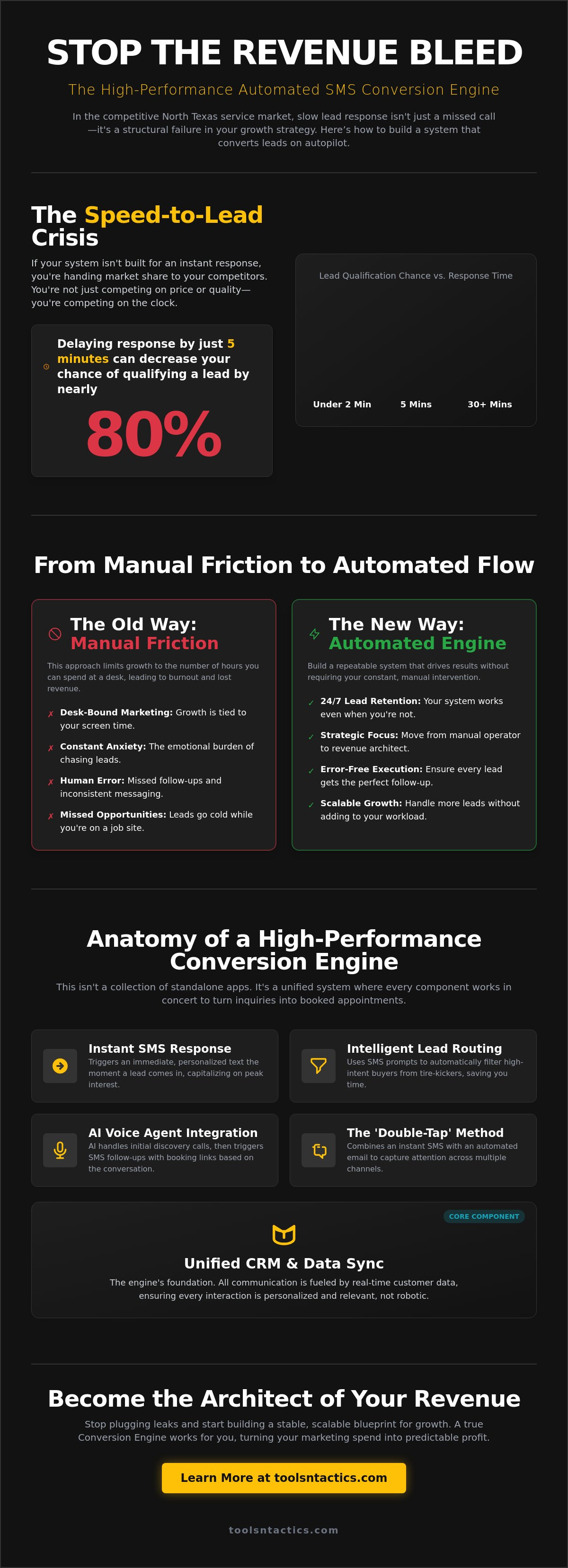
Speed-to-Lead is the definitive competitive moat for Plano businesses in a high-velocity market. Industry research indicates that delaying your response by even five minutes can decrease your chances of qualifying a lead by nearly 80%. In the crowded Dallas and Frisco landscapes, your rivals are likely already using an Automation Engine to capture interest the second it’s generated. You aren’t just competing on price or quality anymore. You’re competing on the clock. If your system isn’t built to trigger an instant text response, you’re essentially handing your market share to the competitor who is willing to automate.
Manual Follow-Up vs. Automated Systems
Manual texting creates friction that slows down your entire operation. It forces you into “desk-bound” marketing, where your growth is limited by how many hours you can spend staring at a screen. This approach carries a heavy emotional burden; the constant anxiety of lead chasing leads to burnout and missed opportunities. Automated SMS marketing for local business replaces that friction with flow. By utilizing lead routing systems and SMS follow-up automation, you remove the human error from the equation. This transition allows you to move from being a manual operator to a strategic architect of your own revenue. It’s about building a repeatable system that drives results without requiring your constant presence.
The Anatomy of a High-Performance SMS Conversion Engine
Building a sustainable business requires more than just buying a subscription to a messaging app. Most vendors sell you a hammer, but they leave you to figure out how to build the house. A high-performance automated SMS marketing for local business strategy treats communication as a structural component, not a bolt-on accessory. We call this the Conversion Engine. It’s a unified system where every text is fueled by real-time data from your CRM. This ensures that every interaction feels personalized rather than robotic. Zapier focuses on simple ‘Zaps’ to connect disparate apps, but a true architect builds a unified blueprint where communication and data are inseparable.
This system doesn’t operate in a vacuum. It adheres strictly to FCC rules to protect your brand’s reputation while maximizing engagement. When you integrate AI Voice Agents with your SMS workflows, you create a seamless qualification loop. The AI handles the initial discovery call, capturing intent and sentiment. Then, the SMS engine immediately follows up with booking links or pricing guides based on that specific conversation. This is often paired with the ‘Double-Tap’ method. By combining an immediate text with a detailed automated email, you capture the recipient’s attention when their interest is highest, ensuring your brand stays top-of-mind across multiple channels.
Intelligent Lead Routing Systems
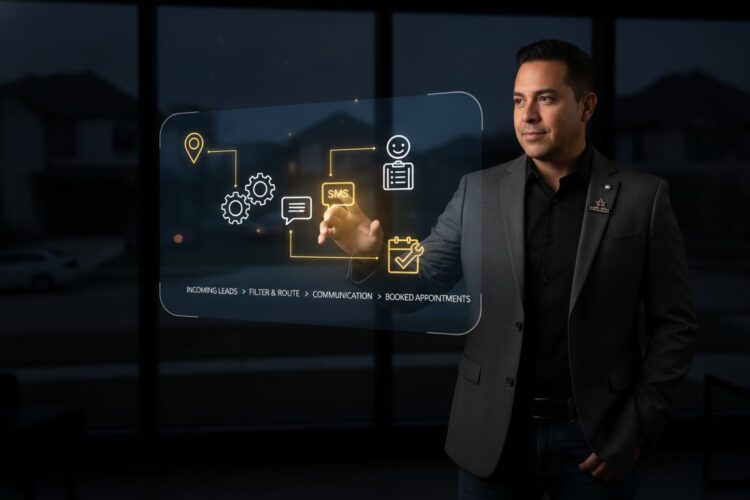
Strategic lead routing systems ensure that no prospect falls through the cracks. The system acts as a mechanical filter during the pre-qualification phase. It uses SMS prompts to separate high-intent buyers from tire-kickers before a live representative ever touches the file. This protects your team’s time and focuses energy on deals most likely to close. Once a lead is qualified, the hand-off is instantaneous. Your sales team receives a notification with the full conversation history. They can step into a warm lead rather than a cold call, knowing exactly what the client needs before they even pick up the phone.
AI Chatbots and Real-Time Engagement
Modern AI chatbots serve as the front door to your Conversion Engine. In 2026, the industry has shifted away from rigid, frustrating scripts toward fluid, natural language processing. These bots don’t just answer questions. They act as strategic growth engines that capture contact info and trigger automated SMS marketing for local business sequences. This ensures your business remains responsive even when you’re off the clock. You aren’t just providing support; you’re building a structural pathway to a sale. If you want to see how these components fit into your specific operation, exploring a Conversion Engine audit is a logical next step.
Software vs. Systems: Why a Standalone SMS App Isn’t Enough
Most service business owners fall into the “Tool Fatigue” trap. They buy a subscription to a standalone messaging app, expecting it to solve their lead conversion problems. Instead, they end up with another login to manage and a disconnected data silo. In 2026, a tool is just a commodity; a system is a competitive advantage. Using automated SMS marketing for local business effectively requires more than just the ability to send a text. It requires a structural blueprint that integrates your communication with your operational goals. A vendor sells you a software license. A growth partner builds the infrastructure that makes that software produce revenue.
The technical requirements for deliverability have shifted significantly. With the mandatory implementation of A2P 10DLC registration, sending business texts is no longer a “plug and play” activity. You must register your brand and your specific campaigns with carriers to avoid message blocking. Standalone apps often leave this complex compliance work to the user, creating a massive risk for your brand. When your communication is fragmented, your data is too. This prevents you from seeing the full picture of your customer journey and ultimately hinders your local SEO efforts by keeping valuable engagement data locked away in a separate app.
The Hidden Burden of DIY Automation
The time cost of setting up complex triggers and workflows manually is the silent killer of productivity. For a busy service pro, spending hours troubleshooting a “no-code” automation is a poor use of resources. There’s also the very real risk of compliance violations. Under TCPA regulations, errors in consent or opt-out processing can result in fines ranging from $500 to $1,500 per message. A DIY approach relies on trial and error, which is a dangerous strategy when legal compliance is on the line. A proven system removes this burden, replacing guesswork with a reliable, managed framework.
Integrated Growth: Beyond the Text Message
Your SMS data shouldn’t exist in isolation. It needs to feed directly back into your Visibility Engine to inform your search strategy. When a lead engages with your automated SMS marketing for local business, that data point should trigger your reputation management system to request a review after the job is completed. This creates a synergy that builds your Authority Engine. By maintaining consistent, automated touchpoints throughout the entire customer lifecycle, you establish a level of professional reliability that manual texting can never replicate. You aren’t just sending messages; you’re building a structural foundation for long-term stability.
Strategic Implementation: SMS Workflows for North Texas Service Pros
- Step 1: The ‘Instant Outreach’ Trigger. When a lead interacts with your Google Business Profile, your Automation Engine must fire within seconds. This immediate response captures the prospect before they move to a competitor’s listing.
- Step 2: The ‘Nurture Sequence’. Leads that don’t book immediately shouldn’t be abandoned. A structured sequence of automated SMS marketing for local business keeps your brand top-of-mind without requiring manual intervention.
- Step 3: The ‘Review Request’ Automation. Once a job in Plano or Frisco is marked complete in your CRM, the system automatically triggers a review request. This is essential for maintaining local authority and visibility.
- Step 4: The ‘Re-Engagement’ Blast. Periodically tap into your existing Dallas and Celina customer base with seasonal offers or maintenance reminders to drive recurring revenue.
Effective execution requires moving from marketing tactics to a disciplined operational system. If you’re ready to stop the lead leakage in your service area, you can schedule a Conversion Engine strategy session to review your current workflows.
Crafting the Perfect Local Message
Personalization at scale is the 2026 gold standard for high-performance communication. Using local landmarks or regional identifiers builds immediate trust and proves you aren’t a generic national call center. For a Plano-based service business, a high-converting template might look like this: “Hi [Name], this is [My Business]. We saw your request for service near Legacy West. Do you have five minutes to chat about your project this afternoon? Reply STOP to opt out.” This simple, grounded approach resonates with homeowners who value neighborhood reliability over abstract corporate promises.
Compliance and Deliverability in 2026
The 2026 regulatory landscape is strict. All businesses must complete A2P 10DLC registration through The Campaign Registry to ensure their messages actually reach the recipient’s inbox. Standard brands face a one-time fee of approximately $46 to $48, while sole proprietors pay around $4. Failure to register leads to message blocking and higher carrier surcharges, especially following the T-Mobile fee increase on January 19, 2026. To maintain high deliverability, you must follow opt-in best practices. Avoid spam triggers like excessive capitalization or suspicious links. Automated SMS marketing for local business only works if your infrastructure is built on a foundation of total compliance and structural integrity.
Scaling Your Local Authority with an Integrated Growth Partner
Marketing tactics often feel like a series of disconnected experiments. You buy a single tool or run a short-term campaign, hoping for a breakthrough that never quite arrives. Scaling a North Texas service business requires a shift from these isolated efforts toward a Growth Partner Program. By deploying a comprehensive Automation Engine, you replace the need for expensive, unproven paid ads with a predictable system for lead retention. This transition moves you away from the frustration of fragmented marketing and toward the security of consistent, scalable outcomes.
The cumulative effect of visibility, conversion, and authority on your bottom line is transformative. When your automated SMS marketing for local business is deeply integrated with your reputation management and SEO, you create a self-reinforcing loop of growth. North Texas business leaders are moving away from the “vendor” model, where they manage multiple disconnected service providers. They are choosing deeply integrated partnership models that prioritize structural integrity over temporary trends. This approach ensures that every lead captured is a lead nurtured, and every job completed becomes a building block for future authority.
The Tools N Tactics Growth Engine
Our framework categorizes growth into specific mechanical components: the Visibility, Conversion, and Authority Engines. These aren’t separate products; they are a unified mechanical system designed to drive revenue. AI Voice Agents play a critical role here by bridging the gap between a text message and a closed sale. While the SMS engine handles the speed-to-lead, the voice agent manages the nuance of discovery and qualification. We act as the architect of this system. We build the blueprints and install the machinery so you can focus on running your business. This removes the operational friction of managing technical workflows yourself.
Next Steps for North Texas Business Leaders
Evaluate your current operation for friction points. If you are experiencing a “leaky bucket” where leads disappear between the first call and the final quote, your current process is failing you. The fragmented agency model often leaves you as the middleman, trying to coordinate between an SEO guy, a web developer, and a software vendor. An integrated growth partner model resolves this by providing a single, steady hand in a chaotic digital landscape. It is time to move past superficial services and invest in a repeatable system. You can scale your service business with the Tools N Tactics Growth Partner Program to secure your long-term stability and market share.
Securing Your Business Stability in a High-Speed Market
The 2026 landscape doesn’t reward hesitation. We’ve established that manual follow-up is a structural liability and that standalone apps often create more friction than they resolve. To truly scale, you need a unified system that treats communication as a mechanical component of your revenue stream. High-performance automated SMS marketing for local business is the engine that converts visibility into booked jobs while you focus on high-level operations. It’s the difference between chasing market share and owning it.
You’ve seen the blueprints for instant speed-to-lead and the necessity of 10DLC compliance. Now, the choice is between continuing with a fragmented approach or adopting a systematic growth model. As North Texas local authority builders and AI-driven lead routing experts, we specialize in removing the technical burden from your shoulders. It’s time to move from being a manual operator to a strategic architect of your own growth. Build Your Conversion Engine with Tools N Tactics through our specialized Growth Partner Program today. Your business deserves the security of a repeatable, automated system that works as hard as you do.
Frequently Asked Questions
Is automated SMS marketing legal for my local business in 2026?
Yes, automated SMS marketing for local business is legal provided you strictly adhere to TCPA guidelines and FCC regulations. You must obtain prior express written consent before sending any marketing messages. As of 2026, real-time opt-out processing is mandatory. Failing to honor a “STOP” request immediately can lead to significant structural fines, so a managed system is far safer than manual oversight.
What is the best time to send automated SMS to customers in North Texas?
Marketing messages are restricted to the hours of 8:00 AM to 9:00 PM in the recipient’s local time zone. In North Texas, respecting these “quiet hours” is critical for maintaining your professional reputation. Sending messages within this window ensures compliance with federal law and state-specific telemarketing rules that took effect in Texas on September 1, 2025. It’s about being a steady partner, not a nuisance.
How do I prevent my automated texts from being marked as spam?
Registration for A2P 10DLC is your primary defense against carrier filtering and shadow-banning. You should avoid high-frequency blasts and suspicious link shorteners that trigger automated blocks. Including a clear opt-out instruction in your initial message and using natural language helps keep your deliverability rates near the 96.8% industry average. A disciplined approach to copy is the best way to maintain structural integrity in your communication.
Can I integrate automated SMS with my existing CRM?
Integration is the backbone of a high-performance Conversion Engine. Your SMS system should be data-aware, pulling customer names and service history directly from your CRM to personalize every interaction. This structural alignment prevents data silos. It ensures that your automated SMS marketing for local business feels like a natural extension of your brand rather than a disconnected bot.
Do I need a separate phone number for automated SMS marketing?
Carriers require a registered 10-digit long code for business messaging to differentiate it from personal traffic. Using a dedicated business line allows you to track performance metrics and maintain a professional identity. It also ensures your personal phone isn’t overwhelmed by automated lead routing responses or customer inquiries while you’re on a job site. It keeps your personal life and business operations separate and organized.
How does SMS automation help with my Google Business Profile ranking?
SMS automation boosts your visibility by accelerating review acquisition. When you automate review requests immediately after a job is marked complete, you increase the volume of high-quality feedback. This activity signals to Google that your business is active and reliable. It’s a key component of building a dominant Authority Engine in your local area without spending a fortune on unproven ads.
What is the difference between a mass text and an automated lead follow-up?
Mass texting is a one-way broadcast often used for generic, low-intent promotions. Automated lead follow-up is a reactive system triggered by a specific customer action, such as a website inquiry or a missed call. While mass texts are often ignored, intelligent follow-up systems capitalize on the three-minute read window to capture high-intent leads before they go cold. One is a broadcast; the other is a conversion tool.