
URL Slug: best-crm-service-businesses
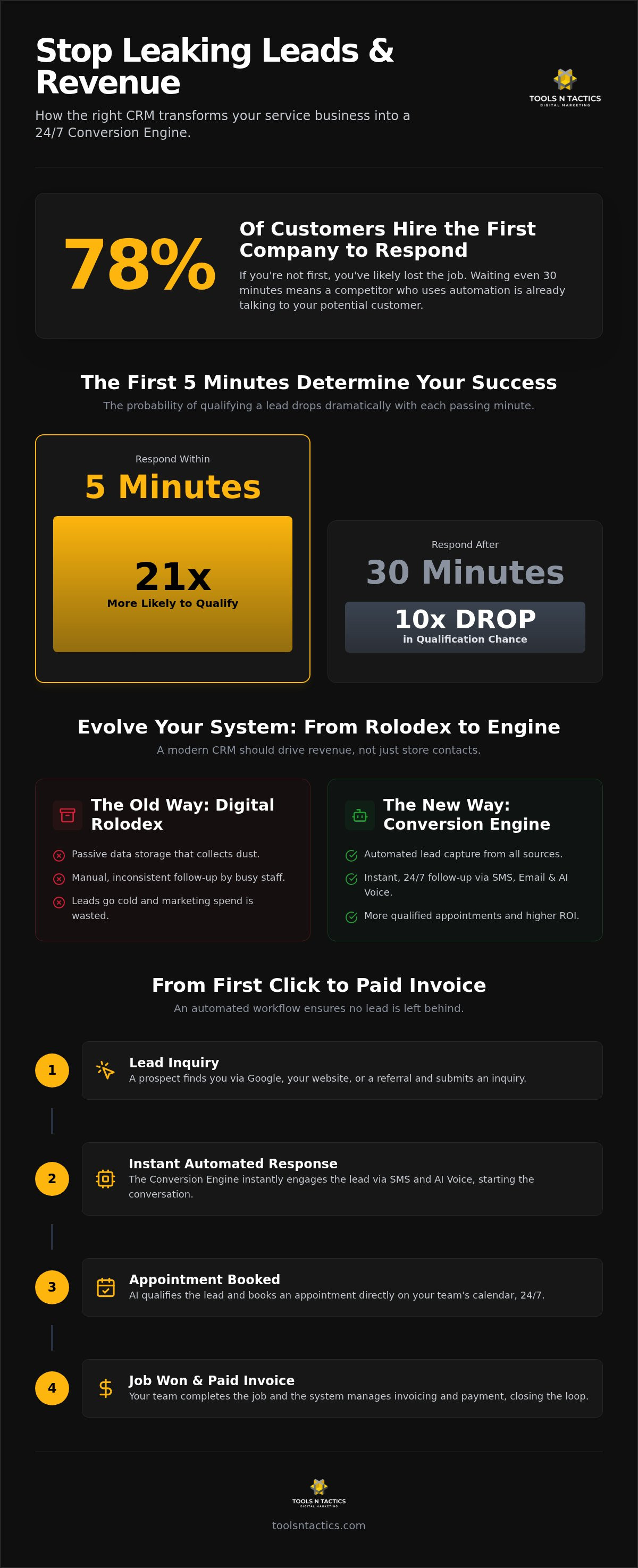
Did you know that 78% of customers buy from the company that responds to their inquiry first? If you wait even thirty minutes to call a lead back, you’ve likely already lost the job to a faster competitor. Finding the best crm for service businesses isn’t about buying a digital filing cabinet for your contacts. It’s about building a mechanical engine that captures every lead and triggers a response before the prospect moves on to the next contractor on Google.
Most service business owners feel the burn of spending thousands on marketing only to see leads go cold because the team is busy on a job site. It’s a common leak in the revenue bucket that is easy to fix with the right tools. This article will show you how to transform basic software into a high-performance lead engine that automates follow-up and secures more jobs. We’ll explore the top CRM platforms for 2026 and the specific systems you need to ensure your single source of truth actually drives growth instead of just collecting digital dust.
Key Takeaways
- Learn why responding to a lead within five minutes makes you 21 times more likely to qualify them compared to waiting just half an hour.
- Understand why the best crm for service businesses must act as a mechanical engine for automation rather than just a digital filing cabinet for names and numbers.
- Discover how to use AI Voice Agents and automated SMS workflows to capture leads and book appointments even when your team is out in the field.
- Get a step-by-step blueprint for auditing your lead sources and mapping a customer journey that moves prospects from inquiry to paid invoice without manual chasing.
- See how North Texas contractors are scaling by shifting from fragmented software tools to an integrated system managed by a strategic growth partner.
Beyond the Digital Rolodex: Why Most CRMs Fail Service Businesses
Most business owners treat Customer relationship management (CRM) as a digital storage bin. It’s where you put names and phone numbers so you don’t lose them. But for a contractor in North Texas, a passive list isn’t enough. If your software doesn’t actively move the needle on your “speed to lead,” it’s just a digital Rolodex. The best crm for service businesses shouldn’t just store data; it should drive revenue by closing the gap between an inquiry and a handshake.
Every second a lead sits untouched is a dollar leaking out of your business. We call this the “Lead Leak.” You spend thousands on marketing to make the phone ring. If that call goes to voicemail or an email sits in an unmonitored inbox, that marketing spend is effectively burned. In a competitive market like Dallas or Frisco, your prospects aren’t waiting around. They’re calling the next person on the list. The “I’ll call them back later” mentality is a silent killer of growth.
The math is brutal. Research shows you’re 21 times more likely to qualify a lead if you respond within five minutes. Once you pass that 300-second mark, the probability of ever booking that job drops by 10x. Relying on spreadsheets or sticky notes creates massive operational friction. These fragmented tools can’t keep up with the pace of a modern service business. You need a mechanical system that captures every lead instantly, ensuring no revenue slips through the cracks.
The Hidden Cost of Unanswered Leads
Marketing ROI isn’t just about how many clicks you get; it’s about how many jobs you book. When leads go cold, your cost per acquisition skyrockets. Beyond the immediate financial loss, slow response times damage your brand authority. A homeowner in Plano with a broken HVAC unit doesn’t care about your years of experience if you don’t answer the phone. They hire the first professional who provides a solution. By failing to respond quickly, you’re essentially subsidizing your competitors’ growth.
Common Friction Points in Service Sales
Field technicians are often too busy on ladders or in crawlspaces to handle incoming inquiries. Meanwhile, office staff can easily become overwhelmed by a flood of leads from your website, Google Business Profile, and referrals. Without a centralized “single source of truth,” follow-up becomes inconsistent. This lack of structure leads to missed opportunities and frustrated prospects. To fix this, you need a Conversion Engine that turns clicks into customers and an Automation Engine that handles the heavy lifting of the initial follow-up.
The Mechanics of a High-Performance Lead Conversion Engine
Manual lead management is a race you’ll eventually lose. If your team is manually dialing every new inquiry, they’re fighting a losing battle against time. High-performance growth requires a shift from “chasing” to a systematic “Speed to Lead” workflow. This isn’t just a tech upgrade. It’s a mechanical overhaul of how your business processes interest. Classic research from Harvard Business Review confirms that companies waiting too long to respond see their lead quality vanish. The best crm for service businesses solves this by acting as a 24/7 dispatcher that never sleeps and never misses a call.
Success in 2026 depends on a multi-channel trifecta: SMS, email, and voice. When a homeowner in Frisco submits a web form, they shouldn’t just get a “we’ll call you Monday” message. They need an immediate text, a professional email, and ideally, an AI-driven voice touchpoint. Integrating your CRM with automated lead follow-up ensures that the conversation starts while the prospect’s problem is still urgent. This isn’t just about being fast. It’s about being omnipresent across every channel your customer uses.
AI Voice Agents and Chatbots: Your 24/7 Sales Team
Most service leads come in when you’re busy or closed. AI Voice Agents handle these after-hours inquiries by qualifying the prospect and checking your availability in real time. They don’t sound like a robotic menu from the 1990s. They hold natural conversations, answer basic questions about your services, and book appointments directly into your calendar. Similarly, AI chatbots serve as the first line of defense on your website. They capture contact details and intent before the user bounces to a competitor’s site, ensuring your marketing spend isn’t wasted on silent visitors.
The SMS Advantage for Contractors
Emails get buried, but text messages get read. With a 98% open rate, SMS is the most effective tool in your arsenal. The best crm for service businesses uses automated SMS to bridge the gap when a phone call is missed. You can automate “I’m on my way” notifications or send a quick “Thank you for your inquiry” text the second a lead hits your system. This keeps the engagement high and prevents the prospect from calling the next contractor on their list. If you’re tired of losing jobs to slower systems, it’s time to talk to a growth partner who can build these engines for you.
Software vs. Systems: Choosing the Best CRM for Service Businesses
Choosing a CRM is often the first mistake a contractor makes. They look for a tool to manage contacts; they ignore the underlying system required to grow. A standalone piece of software is just an expense. An integrated engine is an asset. To implement effective small business growth strategies, you need more than a login. You need a blueprint. The best crm for service businesses acts as the central nervous system for your entire operation. It connects your marketing spend directly to your booked jobs.
Our Conversion Engine is designed to turn silent website visitors into active inquiries. Once that lead exists, the Automation Engine takes over as the mechanical heart of your follow-up. It ensures every prospect receives a consistent, professional experience without your office staff lifting a finger. These systems integrate directly with your Visibility Engine. This allows you to track real ROI from every marketing dollar spent. You stop guessing which ads work and start seeing which leads actually turn into paid invoices.
A “software-only” approach leaves the heavy lifting to you. You’re forced to figure out the workflows, the triggers, and the messaging. A Growth Partner approach provides the structural integrity your business needs. It’s the difference between buying a pile of lumber and hiring an architect to build your home. We don’t just give you a tool; we build the system that powers your long-term stability.
Building the Authority Framework
A CRM shouldn’t just be about sales. It’s about building trust. We use automated follow-up sequences to deliver educational content that positions you as the local expert. If a homeowner in Plano gets a guide on maintaining their HVAC system after a service call, you aren’t just a contractor anymore. You’re a trusted advisor. This is where reputation management becomes critical. By baking review requests into your post-service follow-up, you build a wall of social proof. You become the dominant local authority in Frisco or Dallas by default.
Lead Routing and CRM Integrity
Speed is useless if the lead goes to the wrong person. Automated lead routing ensures that a high-value roofing repair lead goes to your top estimator instantly. This eliminates the delay of office staff manually checking schedules. All these interactions must live in a “Single Source of Truth.” When your data is centralized, you eliminate duplicate entries and lost contact info. You gain a clear view of your business health. A growth partner ensures this system is built for your specific workflow, rather than forcing you to adapt to a rigid software template.
Blueprint for Success: Implementing an Automated Follow-Up Workflow
Building a lead engine requires a clear blueprint. You can’t just install software and hope for the best. You must first audit your current lead sources. Look at your website, your Google Business Profile, and your referral channels. If you don’t know which pipe is leaking, you can’t fix the pressure. The best crm for service businesses acts as a pressure gauge; it shows you exactly where your marketing spend is working and where it’s stalling.
Once you’ve identified your sources, map the ideal customer journey. This path starts at the first inquiry and ends only when the final invoice is paid. Most contractors stop at the “Contacted” stage. High-performance businesses configure their Automation Engine for immediate response triggers. When a lead hits the system, the machine should take over instantly. This allows your team to focus on the work while the system handles the handshake. Finally, train your staff on a new “Speed to Lead” Standard Operating Procedure. Technology is the engine, but your team must know how to drive it.
Mapping the Service Pipeline
A disorganized pipeline leads to forgotten jobs. You need to define clear stages: New Lead, Contacted, Quoted, Booked, and Post-Service Follow-up. Automating the transitions between these stages reduces manual data entry and human error. For example, when an estimate is sent, the CRM should automatically move the lead to “Quoted” and start a follow-up sequence. If a lead sits in one stage for too long, set “Stale Lead” alerts. These notifications act as a safety net, ensuring no inquiry in Plano or Dallas is ever neglected for more than a few hours.
Crafting High-Converting Templates
Your automated messages shouldn’t sound like a robot wrote them. Use a “No-Pressure” follow-up script for residential inquiries. Instead of a hard sell, offer a clear next step. Use a “Contrast-and-Resolve” structure in your emails. Present a common pain point, like a broken AC in 100-degree Frisco heat, and resolve it with your specific service solution. Personalization is key. Even at scale, your texts should include the customer’s name and the specific service they requested. This makes automation feel like a human conversation rather than a generic broadcast. If you’re ready to stop chasing leads and start closing them, contact us to build your custom automation blueprint.
Scaling Your North Texas Business with a Strategic Growth Partner
Scaling a service business in a market as aggressive as North Texas requires more than just a software subscription. You need a system that handles the pressure when lead volume spikes. Many contractors in Plano, Dallas, and Frisco find themselves stuck in a cycle of “buying more leads” to solve revenue problems. But if your internal follow-up is broken, more leads just mean more wasted marketing spend. The best crm for service businesses isn’t a tool you manage yourself; it’s a mechanical component of a larger growth engine.
Our Growth Partner Program is designed to move you beyond isolated marketing tactics. We don’t just hand you a login and walk away. We act as the architects of your business growth, building the blueprints and the infrastructure needed for long-term stability. This systematic approach prepares you for the day your lead volume doubles. Without automation, that growth would crush your office staff. With it, your revenue scales while your manual workload stays the same. The first step to fixing your system is knowing where it’s currently leaking. You can start by getting a Free SEO and Lead Audit to identify the gaps in your current workflow.
From Fragmented Tactics to Integrated Engines
A tool is only as effective as the technician using it. Most CRM platforms are sold as a generic solution, but the best crm for service businesses must be tailored to the specific rhythms of the trades. There is a powerful synergy between working with a specialized SEO company in Plano and having a robust lead system. When your visibility increases through search, your conversion engine must be ready to process that traffic instantly. This integration creates a predictable revenue machine. It reduces your reliance on expensive, fluctuating paid ads by maximizing the value of every organic inquiry you receive.
Local Accountability in North Texas
National software companies don’t understand the local trade competition in the Dallas-Fort Worth metroplex. They don’t know the specific seasonality of HVAC leads in Frisco or the roofing demands after a Plano hailstorm. We do. Having a local partner provides a layer of accountability that a Silicon Valley help desk can’t match. We’ve seen real-world results where local service businesses reclaim ten to fifteen hours of their week by automating their administrative heavy lifting. This shift allows you to move from being a “firefighter” in your business to being a strategic leader focused on the bottom line. If you’re ready to stop the lead leaks and build a repeatable system for growth, it’s time to take action. Schedule your strategy session with Tools N Tactics today and let’s build your engine.
Build a Lead Engine That Never Sleeps
Your business deserves a system that works as hard as your field crew. We’ve seen how the “Lead Leak” drains revenue from North Texas contractors who rely on manual follow-up. By shifting from fragmented tools to an integrated engine, you ensure every inquiry in Dallas or Plano is met with an immediate, professional response. The best crm for service businesses isn’t just a place to store data; it’s the mechanical heart of your growth. It combines specialized AI voice agents and automated SMS to book jobs while you’re on a job site or asleep.
Success comes from moving beyond isolated tactics. Our proprietary framework focuses on the three pillars of Visibility, Conversion, and Authority to create a repeatable revenue stream. With our local expertise and specialized automation integration, we act as the architect of your business scaling. It’s time to stop chasing leads and start managing a high-performance machine. Build your automated lead engine-Contact Tools N Tactics today. You’ve built a great business through hard work; let’s build the system that ensures your long-term stability.
Common Questions About Service Business CRMs
What is the best CRM for service businesses in 2026?
The best crm for service businesses in 2026 is an integrated growth engine that prioritizes automation over simple data storage. While many platforms manage contacts, a high-performance system must bridge the gap between marketing and sales by triggering instant follow-ups. It acts as a mechanical system that ensures your visibility on Google actually results in booked appointments.
How fast should a service business follow up with a new lead?
You should follow up with a new lead within five minutes to maximize your conversion rate. Research shows that responding within this window makes you 21 times more likely to qualify the prospect compared to waiting 30 minutes. In a competitive landscape like Dallas, speed is often the deciding factor in who wins the job.
Can I automate lead follow-up without sounding like a robot?
Yes, you can maintain a human touch through automation by using personalized templates that reflect your unique brand voice. Modern systems use dynamic data to insert the customer’s name and specific service needs into every text and email. This makes the communication feel like a one-on-one conversation rather than a generic automated broadcast.
What is the “Speed to Lead” rule for contractors?
The “Speed to Lead” rule states that 78% of customers buy from the company that responds to their inquiry first. For contractors in North Texas, this means the first professional to answer the phone or reply to a text usually secures the contract. If your system is slow, you are essentially paying for leads that your competitors will close.
How much revenue is lost due to poor lead follow-up?
Service businesses lose a significant portion of their potential revenue to the “Lead Leak,” where inquiries go cold before a human responds. When you account for the high cost of acquisition in Frisco or Plano, every missed lead represents wasted marketing dollars. A broken system can easily cost a growing business 20% or more of its annual revenue potential.
Do I need AI voice agents for a small service business?
AI voice agents are highly effective for small businesses because they serve as a 24/7 dispatcher that never misses a call. They can qualify prospects and book appointments directly into your calendar while your crew is busy on a job site. This ensures you capture every opportunity even when you aren’t available to answer the phone.
How does automated lead routing work for multi-location businesses?
Automated lead routing uses pre-set logic to distribute inquiries to the correct technician or office based on their specific territory or skill set. This eliminates the friction of manual office coordination and ensures the lead is handled by the right expert instantly. It is a critical component for maintaining efficiency across multiple North Texas locations.
What is a Conversion Engine in digital marketing?
A Conversion Engine is a systematic framework designed to turn website visitors and inquiries into paid invoices. It focuses on the mechanical components of the sales process, including lead capture, automated follow-up, and reputation management. It’s the difference between having a website that looks good and one that consistently generates revenue.