
By 2026, 91% of companies with 10 or more employees rely on a CRM to keep their operations running. For a North Texas contractor, CRM implementation for small service company isn’t just about buying software; it’s about fixing the structural leaks in your revenue bucket. You’ve likely felt the sting of a high-value lead going cold because a sticky note vanished or a follow-up text was forgotten. When your customer data is scattered across legal pads and personal cell phones, you’re losing market share to competitors who respond in seconds.
We understand that you didn’t start a service business to spend your evenings wrestling with spreadsheets. You need a system that works as hard as your crews in the field. This blueprint will show you how to transform manual chaos into a high-performance conversion engine. We’ll walk through the exact steps to automate your lead routing, unify your fragmented data, and build a professional brand image that scales without adding more admin staff to your payroll.
Key Takeaways
- Learn why software alone won’t fix a broken sales process and how to map your manual workflows into a digital system.
- Discover how a proper CRM implementation for small service company uses an Automation Engine to route leads to the right technician instantly.
- Understand the hidden time-sinks of DIY setup and why standard settings often fail HVAC and roofing businesses.
- Follow a five-step blueprint to audit your lead flow and define a “Golden Path” that turns prospects into loyal customers.
- See how moving from survival mode to a systematic approach builds authority and predictable growth in the North Texas market.
Why CRM Implementation Fails for Most Small Service Companies
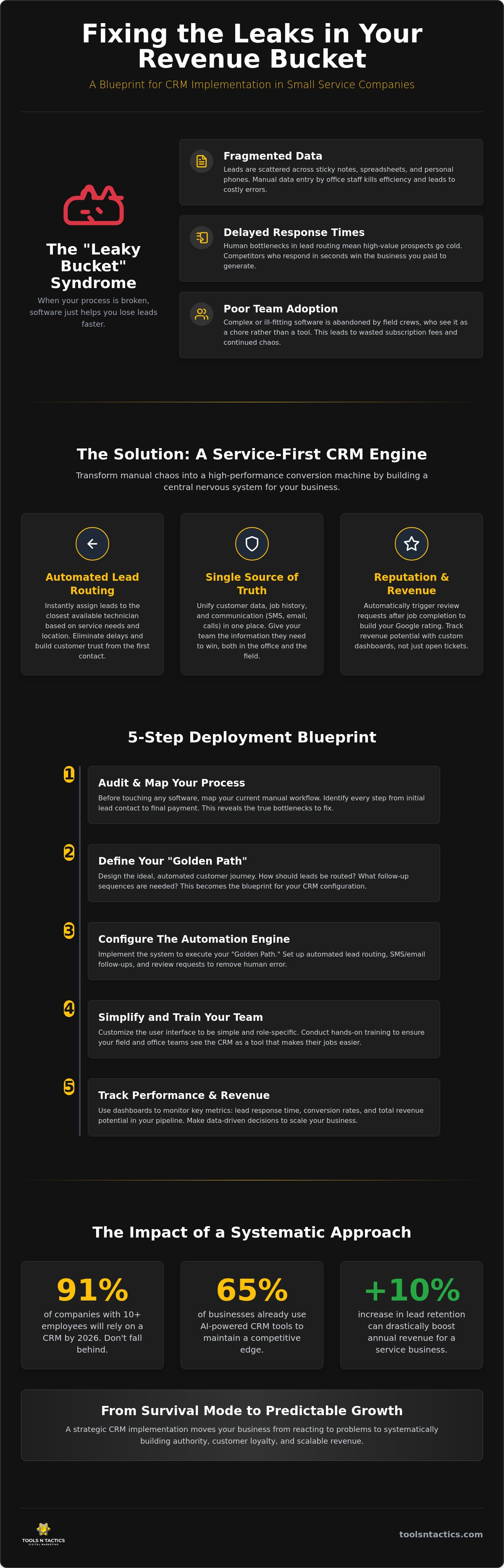
Most business owners view software as a magic pill. They believe that signing up for a monthly subscription will instantly fix their communication gaps. This is the “Leaky Bucket” syndrome. If your current sales process is a mess of missed calls and unreturned texts, adding a digital tool only helps you lose leads more efficiently. Software cannot fix a broken process; it can only accelerate a functional one.
At its core, Customer relationship management (CRM) implementation is the mechanical process of mapping your manual workflows into an automated digital system. It is the bridge between how you work today and how you want to scale tomorrow. A successful CRM implementation for small service company isn’t just about data entry. It is about building a structural blueprint that ensures no prospect ever falls through the cracks again.
Many local contractors make the mistake of choosing a system based on the lowest price rather than the best operational fit. If the software doesn’t match the way your team actually works in Plano or Dallas, they will eventually abandon it. The consequence of ignoring a strategic setup is severe. You end up with wasted ad spend and a shrinking North Texas market share as more agile competitors snatch up your frustrated leads.
The Problem with Fragmented Tools
Managing a service business with separate apps for SMS, email, and scheduling kills your team’s efficiency. When your data is fragmented, your office staff spends hours on manual data entry instead of booking jobs. This disjointed approach creates friction for your field technicians who need instant access to job history and customer notes. To win in 2026, your customer data must live in a single source of truth. Integrating an Automation Engine into your daily workflow allows you to route leads to the right technician instantly, removing the human bottleneck that slows down your response time.
Overcoming the “Too Complicated” Objection
Your field crews don’t want to spend their day fighting with a complex app. Successful adoption depends on simplifying the user interface and establishing clear lines of accountability. When the system is easy to use, it becomes a tool rather than a chore. Prioritizing a proper CRM implementation for small service company ensures your team is trained to use the system correctly from day one. For a roofing company, a 10% increase in lead retention can drastically boost annual revenue simply by ensuring every estimate is followed up on within 24 hours.
The Anatomy of a Service-First CRM Engine
A high-performance CRM implementation for small service company acts as the central nervous system for your business. It isn’t just a digital filing cabinet. It is an active participant in your sales cycle. Integrating a proprietary Automation Engine into your daily workflow ensures that every lead is handled with mechanical precision. This system removes the human error that often leads to lost opportunities and forgotten follow-ups.
Lead routing is the first critical component of this engine. Speed is the primary currency in the home services industry. Your system must ensure the right technician gets the right data instantly. If a homeowner in Plano requests an emergency HVAC repair, the system shouldn’t wait for an office manager to manually check an inbox. It should identify the closest available tech and ping their phone immediately. This reduces friction and builds trust with the customer before your truck even pulls into the driveway.
The engine also powers your reputation management. It automatically triggers review requests the moment a job is marked as “complete” in the field. This turns your daily labor into a growing library of Google reviews. Additionally, custom dashboards allow you to track revenue potential instead of just “open tickets.” You need to see exactly how much money is sitting in your pipeline at any given moment. This financial clarity allows you to make better hiring and equipment decisions based on hard data rather than gut feelings.
AI and Automation Components
Modern service businesses use AI voice agents to handle after-hours inquiries without a human receptionist. These agents don’t just take messages; they qualify leads and schedule estimates. This is vital because 65% of businesses now use AI-powered CRM tools to maintain a competitive edge. Automated SMS and email follow-up sequences prevent leads from going cold during the busy season. For operations spanning Plano and Dallas, automated lead routing ensures geographic efficiency, keeping your crews on the job and out of unnecessary traffic.
The Conversion Engine Framework
Connecting your Conversion Engine to your CRM creates a seamless flow of data. High-converting landing pages feed your database directly, removing the need for manual entry. In the competitive North Texas market, speed-to-lead is the deciding factor in winning a contract. If you don’t respond within minutes, the prospect is already calling the next contractor on the list. If you’re ready to stop the lead leakage, you can speak with a growth partner to audit your current systems.
Implementation Path: DIY SaaS vs. Strategic Growth Partner
Choosing the right path for CRM implementation for small service company often comes down to a choice between a DIY software project and a strategic partnership. Most business owners choose the former because the monthly subscription price looks attractive. However, they quickly discover the hidden time-sink. Setting up a CRM by yourself isn’t just about clicking buttons. It requires a deep understanding of your operational mechanics. You can easily spend forty hours trying to customize a template and still end up with a system that doesn’t capture the data your technicians actually need in the field.
Generic “out-of-the-box” settings rarely work for HVAC and roofing contractors. These platforms are built for general sales, not the specific workflows of a trade business. They don’t account for job site photos, weather-dependent scheduling, or complex estimate approvals. If your system is built for a five-person team but lacks the structural integrity to support fifty employees, you’ll be forced to rip it out and start over just as your business starts to gain momentum. The Growth Partner Program provides a structural solution that grows with you rather than holding you back.
The Risks of the DIY Approach
The DIY route is often paved with good intentions but leads to data migration nightmares. Verified industry data shows that data cleanup and migration always take longer than anticipated. Without an expert hand, you risk importing “dirty data” that makes your new system useless from day one. This leads to the “Ghost Town” effect. If the tool is frustrating or inaccurate, your crews will stop using it. They’ll go back to their personal texts and legal pads, leaving you with an expensive software bill and zero visibility into your lead flow. Fragmented support from big tech companies won’t help you; they sell software, not business results.
Benefits of an Integrated Growth Partner
A strategic partner provides customized blueprints tailored specifically to North Texas service industries. We don’t just hand you a login. We build a system that reflects the reality of doing business in Plano and Dallas. This includes continuous optimization rather than a one-time setup. As your market changes, your system evolves. By integrating your CRM with broader marketing services, you ensure that your visibility, authority, and conversion engines are all pulling in the same direction. This unified approach moves the needle from manual frustration to consistent, scalable revenue.
5 Steps to Deploy a CRM That Actually Drives Revenue
Deploying a system that sticks requires more than just an account login. A successful CRM implementation for small service company follows a disciplined, five-step process. This isn’t about technology for technology’s sake. It is about building a repeatable engine that produces profit. Most businesses fail because they skip the blueprint phase and go straight to data entry. We ensure every mechanical component is aligned before you ever send your first automated text.
- Step 1: Audit your current lead flow. You must track every touchpoint from the first Google click to the final invoice. If you don’t know where the friction exists, you can’t fix it.
- Step 2: Define your “Golden Path.” Map out the ideal customer journey. This includes instant response times, automated estimate reminders, and clear post-job communication that leads to a review.
- Step 3: Connect your technical assets. Link your Visibility Engine directly to your CRM. This ensures every call and form submission is captured automatically without manual work.
- Step 4: Automate the follow-up. Build sequences that handle the heavy lifting. Set up review requests that trigger the moment a technician closes a job in the field to build your local authority.
- Step 5: Launch and monitor. Train your team on the “why” behind the system. Watch your conversion metrics closely during the first month to identify any remaining bottlenecks in your sales process.
Auditing Your Current Lead Flow
Most contractors have fragmented data scattered across personal cell phones, legal pads, and messy email inboxes. To build a solid foundation, you must gather this information into a single source of truth. Identify exactly where prospects drop off. A “leaky lead” is a prospect who enters your sphere but vanishes due to slow follow-up; when you consider the cost of acquiring a single qualified customer, these missed connections represent a measurable loss of your annual marketing budget.
Training and Optimization
Your field crew will only love the new system if it makes their jobs easier. Focus on high-performance functionality that removes paperwork from their trucks. Set up simple dashboards that show you exactly where your money is at a glance. You shouldn’t have to dig through menus to see your active pipeline. After 30 days, perform a structural review. Tweak your automations based on real-world feedback from your team to ensure the system remains agile. If you are ready to fix your broken sales process, you can schedule a systems audit with our team.
Scaling Your North Texas Business with a Systematic CRM
Scaling a service business requires a shift in mindset. You have to move from survival mode, where you react to every ringing phone, to a state of predictable growth. A successful CRM implementation for small service company provides the structural integrity needed to handle this transition. In Plano and Dallas, the market is too competitive for manual workflows. You need a system that acts as a 24/7 sales machine, using AI voice agents and automated routing to capture leads and schedule estimates while you sleep.
A solid CRM doesn’t just manage contacts; it builds an Authority Engine in your local market. By consistently following up and delivering a professional experience, you separate yourself from the “chuck in a truck” operations. This systematic approach prepares your business for high-volume seasons. When a summer heatwave or a spring hailstorm hits, your office won’t descend into chaos. Your automation handles the surge, ensuring every North Texas prospect receives a prompt response and a clear path to booking.
Local Market Dominance
Local contractors often face pressure from large, out-of-state companies with massive marketing budgets. You beat them by leveraging your local roots and your CRM data. By tracking where your most profitable jobs are located, you can use your CRM to power targeted growth in specific neighborhoods. This data-driven strategy ensures your trucks stay in a tight radius, reducing fuel costs and increasing technician billable hours. Professionalism is your best defense. Integrating your CRM with broader marketing services ensures your brand looks like a market leader, even if you’re still a small team.
Your Next Steps to Growth
The cost of waiting is higher than most owners realize. Every week you delay a proper CRM implementation for small service company, you’re losing revenue to lead leakage and inefficient scheduling. A systematic approach beats a creative one every time because systems are repeatable. You can’t scale a personality, but you can scale a blueprint. If you’re tired of fragmented efforts and want to see how a unified system can stabilize your bottom line, the time to act is now. You can request a free system audit to see exactly where your current engine is losing power.
Secure Your North Texas Market Share with a Systematic Engine
Successful CRM implementation for small service company turns a leaky sales process into a repeatable revenue engine. You’ve seen how software alone fails without a structural blueprint. By mapping your manual workflows and automating your lead routing, you stop the constant stress of manual follow up. You move from reacting to daily chaos to leading a stable, growing business that operates with mechanical precision.
Tools N Tactics brings North Texas localized expertise to every project. Our proprietary Growth Partner Framework ensures your system is built for the specific demands of the trade industries in Plano and Dallas. We focus on building structural value that lasts. This means you can achieve predictable growth with zero reliance on expensive paid ads that eat your margins. We help you build the infrastructure that converts your existing local visibility into a library of loyal customers.
Don’t let another high-value lead vanish into a messy inbox or a forgotten text thread. You have the tools to build a professional brand that dominates your local market. Build your systematic growth engine with a free consultation. The future of your business depends on the systems you build today. You’ve done the hard work of building a great team; now give them the engine they deserve to win.
Frequently Asked Questions
How much does a CRM implementation cost for a small service company?
Software costs in 2026 vary by platform. Verified market rates show options like Less Annoying CRM at $15 per user, Zoho CRM starting at $14, and HubSpot’s professional tiers reaching $90 per month. However, the total cost of CRM implementation for small service company depends on the complexity of your data migration and process mapping. Investing in a strategic setup prevents the long term expense of a failed system that your team eventually abandons.
Will a CRM help my HVAC or roofing business get more Google reviews?
Yes, a CRM is the primary driver of a consistent review strategy. By triggering an automated SMS or email request the moment a technician marks a job as complete, you capture customer feedback while the experience is fresh. This systematic approach builds your local authority and ensures you don’t have to rely on technicians remembering to ask for reviews at the door.
Do I need a CRM if I only have three employees?
Small teams actually benefit the most from a CRM because it acts as a virtual office manager. It allows a three person crew to handle the lead volume of a much larger company by automating follow ups and scheduling. Without a system, small teams often lose North Texas market share because they’re too busy in the field to respond to new inquiries quickly.
How long does it take to fully set up a CRM for a service business?
A professional implementation typically takes between 30 and 60 days. This timeline includes auditing your current lead flow, cleaning up messy data from old spreadsheets, and training your field crews. Rushing the process often leads to “dirty data” and technical friction that causes teams to revert to their old manual habits.
Can a CRM automate my lead follow-up via SMS and email?
Automation is a core component of a modern service CRM. You can build sequences that send an instant text to any homeowner who fills out a form on your site. This “speed to lead” is vital in competitive markets like Plano and Dallas, where the first contractor to respond usually wins the contract.
What is the best CRM for a North Texas contractor in 2026?
The best CRM is the one that matches your specific field workflows and integrates with your local visibility engines. While platforms like Pipedrive or ServiceTitan are popular, the software brand matters less than the operational blueprint. You need a system that handles trade specific data, like job site photos and emergency dispatching, without adding unnecessary complexity.
How do I get my field technicians to actually use the CRM?
Technicians will adopt a CRM if it makes their jobs easier and reduces their paperwork. Choose a mobile first interface that allows them to talk to text their notes and upload photos directly from their phones. When the system replaces a frustrating manual task, adoption happens naturally across the entire crew.