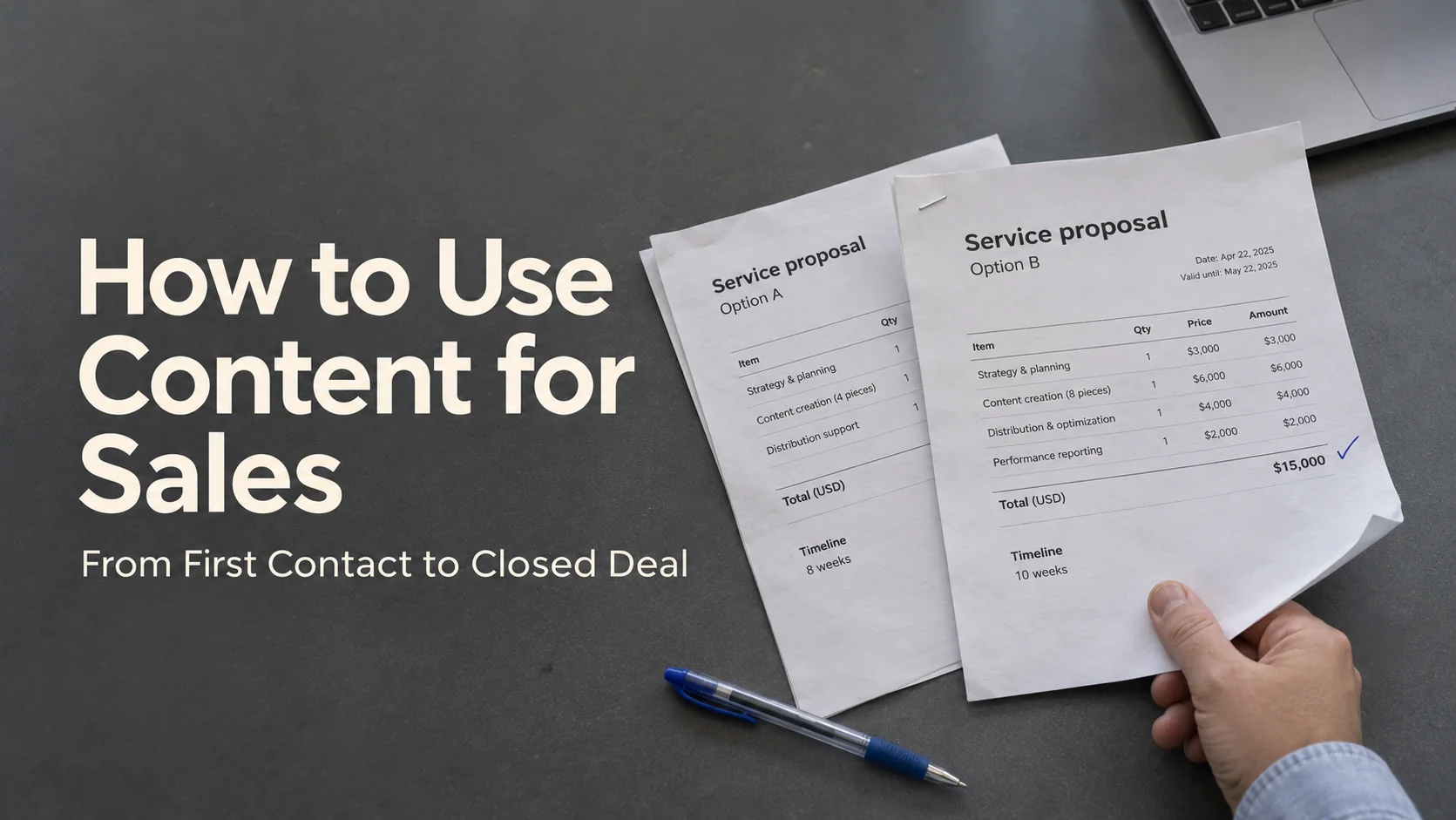
To use content for sales, start with the question standing between your buyer and their next decision. Before they contact you, that question might be “What will this cost?” After they receive your proposal, it might be “How do I explain this expense to my boss?” A pricing guide can answer the first question. A one-page summary the buyer can forward to finance is better suited to the second.
Imagine a commercial cleaning company bidding on an office contract. Its pricing guide earns an inquiry from Maya, an office manager. A checklist helps her prepare for the walkthrough. Later, a side-by-side comparison helps her decide whether the office needs cleaning three or five nights a week. Follow that example through the sales process and you can see where each piece of content earns its place.
How to Choose Sales Content for Each Stage of the Buyer’s Journey
Look at your last five sales conversations and finish this sentence from each buyer’s perspective: “Before I can move forward, I need to know ___.” Their answers will tell you which sales enablement content to create and when to share it.
| Sales stage | Buyer’s question | Content to share | Next step |
|---|---|---|---|
| Discovery | What does office cleaning usually cost? | Pricing guide with cost factors and example scopes | Request an estimate |
| Before the call | What information do you need from me? | Short walkthrough checklist | Confirm the visit and gather the details |
| Comparing providers | Why are these two quotes different? | Side-by-side comparison of tasks and visit frequency | Agree on the scope |
| Reviewing the proposal | How will you prevent the problems we have now? | Relevant case study or sample inspection report | Resolve the outstanding concern |
| Internal approval | How do I justify this expense to finance? | One-page summary of cost, coverage, and terms | Approve the proposal or request a revision |
Pay attention to the questions buyers ask after reading your website. If several people ask whether supplies are included, that detail belongs on the service page and in the quote. Fixing one unclear sentence may do more for the next sale than publishing another blog post.
How to Use Content to Attract Qualified Leads
Some buyers discover your business while searching for an answer. Others get to know you because you invite them to contribute to something useful. Both approaches can start a sales conversation, even if your business has a small audience.
Answer the Questions Buyers Search Before They Contact You
Someone searching for office cleaning tips may just want to get coffee out of a carpet. Someone searching for office cleaning cost three nights a week is working through a buying decision. The second search gives you a clearer topic and a natural reason to offer an estimate.
A useful pricing guide would explain how floor area, restroom count, visit frequency, and after-hours access affect the quote. Show two example scopes and explain why they cost different amounts. Finish by telling readers which details to send for an estimate.
If those questions are missing from your website, start with the page where customers decide whether to get in touch. Our branding and content marketing services help service businesses turn recurring customer questions into clearer service pages and supporting content.
Start Conversations Through Interviews, Workshops, and Partner Content
Suppose the cleaning company wants to meet local property managers. It could invite a facilities manager to help create an office move-out checklist. The manager knows which handover details tenants overlook. The cleaner knows which jobs take longer than tenants expect. Together, they can make something both would send to a client.
There’s a natural reason to get back in touch, too. After the manager uses the checklist at a handover, ask which item saved time and what was missing. That conversation tells you more about a potential customer’s priorities than a generic introductory email would.
What Content Should You Send Before a Sales Call?
Send one resource that will make the upcoming conversation more productive. If the buyer asked about price, give them enough detail to judge whether the service fits their budget. If they’ve booked a site visit, help them prepare for it.
Share Pricing and Process Guides to Set Expectations
Maya requests a quote for a 12,000-square-foot office. A short walkthrough checklist tells her what to bring: a floor plan, the current cleaning schedule, and a list of recurring complaints. With those details in hand, the rep can spend the visit inspecting problem areas instead of collecting information Maya already has at her desk.
If you share an indicative price, state the assumptions behind it. A monthly figure means little until the buyer knows how many visits it covers, which rooms are included, and who supplies consumables. Those details also give the buyer a fair basis for comparing quotes later.
Write a Pre-Call Email That Gives the Buyer a Reason to Read
Refer to something the buyer told you, explain why the attachment is worth opening, and give them one manageable task.
Hi Maya,
You mentioned that the kitchen still needs attention on mornings after a cleaning visit. I’ve attached the one-page checklist we’ll use on Thursday. Could you mark the two or three tasks your team most often has to redo?
We can start in the kitchen and use those examples to agree on what each evening visit should cover.
Thanks,
Alex
Maya can see how her reply will shape the meeting. That gives her a reason to open the attachment before Thursday.
How to Use Content During a Sales Conversation
Listen for the point where the buyer struggles to compare two options, picture how something works, or trust a claim. That’s the moment to bring out a comparison guide, a short demo, or a piece of customer evidence.
Use a Demo or Comparison Guide When the Buyer Is Weighing Options
Say Maya has two cleaning quotes and yours is higher. Put the scopes side by side. Does each quote include kitchen cleaning at every visit? Is periodic floor care included in the monthly fee? Who comes back if a task is missed?
Leave a blank wherever the competing quote is unclear. Maya now has a precise question to ask the other provider. You might also discover that your own quote includes a service she doesn’t need, while there’s still time to revise it.
The same principle applies to a product demo. If a software buyer asks whether invoices will sync with their accounting system, show that single workflow. Watching one invoice arrive in the right place answers the question more directly than a tour of the entire platform.
Match a Case Study to the Buyer’s Main Objection
If Maya worries about inconsistent cleaning, a testimonial praising your friendly staff won’t settle it. Choose a case study that explains how a similar customer reported missed tasks, what changed, and how the customer checked the work afterward.
If you have no documented result for that situation, show her a sample inspection report. Walk her through who records an issue, who owns the correction, and where she can see that it was resolved. An ordinary document she’ll actually use as a customer can be more persuasive than a polished brochure.
What to Send After a Sales Call to Move the Deal Forward
Before the meeting ends, ask, “What will you or your team need to see before you can approve this?” The answer gives your follow-up email a purpose. It can also reveal who else needs information before anyone can sign.
Answer the Open Question in Your Follow-Up Email
Suppose Maya says finance wants to know whether three cleaning visits a week would be enough. Here’s a follow-up she can act on or forward.
Hi Maya,
I’ve attached the three-visit and five-visit options we discussed. Both include the kitchen and restrooms at every visit. With the three-visit plan, there’ll be two weekdays each week without an evening clean.
You mentioned that Tuesdays and Thursdays are your busiest office days. If you send me your preferred third night, I can update the schedule and give finance one monthly figure to review.
Thanks,
Alex
The email explains what Maya gains or gives up with each option. She can make a decision without reopening the entire proposal.
Give Buyers a Summary They Can Share With Decision-Makers
Maya walked through the building with you. Her finance director didn’t. Give her a one-page decision summary that makes sense to someone who missed the conversation.
Include the problem the team wants to solve, the recommended scope, the monthly cost, any separate fees, and the terms that affect approval. Keep the buyer’s own language where it’s more precise. “The kitchen must be ready for staff by 8 a.m.” tells finance exactly what the company is buying.
How to Measure Whether Content Helps Close Sales
Track two things separately: which content brings qualified buyers into the pipeline, and which content helps those buyers make a decision. A pricing guide can do both. A proposal summary might never attract a search visitor and still be worth keeping.
Track Which Content Generates Qualified Inquiries and Booked Calls
For each inquiry, record the first known page or campaign, whether the prospect fits the service you offer, and whether they book a call. When the source is unclear, ask how they found you. Their answer may reveal that a colleague forwarded a guide you had credited entirely to search.
Suppose a pricing guide brings in 12 inquiries and four become qualified walkthroughs. An office-care article brings in 30 inquiries and one becomes a qualified walkthrough. If the aim is to book visits with potential customers, the pricing guide delivered the better outcome during that period.
Compare Win Rate and Time to Close for Deals Where Content Was Shared
In your CRM or sales spreadsheet, record the resource shared, the question it answered, the proposal date, and the final outcome. For example, if six out of 20 completed opportunities that received your comparison guide became signed contracts, that group had a 30% win rate. Compare it with similar completed opportunities where the guide wasn’t shared. For won deals, compare the typical number of days from proposal to signature.
Treat any difference as a reason to investigate. Larger contracts may take longer, and reps may share the guide more often with buyers who are already close to signing. Ask a new customer what helped them decide. You might learn that one row in the comparison settled the issue for finance. If so, put that detail in the standard proposal.
Which Piece of Sales Content Should You Create First?
Start where a promising sale most often stalls. If buyers hesitate over price, write the pricing guide. If they doubt you can deliver consistently, show them how you inspect the work. If proposals sit in finance for weeks, create a summary the person who met you can forward to the person who signs.
Open your last five stalled conversations and find one question that came up twice. Write the answer you wish you’d had ready, send it the next time someone asks, and listen to what they ask next. That’s how one useful answer becomes a sales content strategy.
If you’d like help finding that starting point, bring a recurring buyer question to Tools N Tactics. We can help you decide where the answer belongs on your website and how your team can use it in the next sales conversation.