
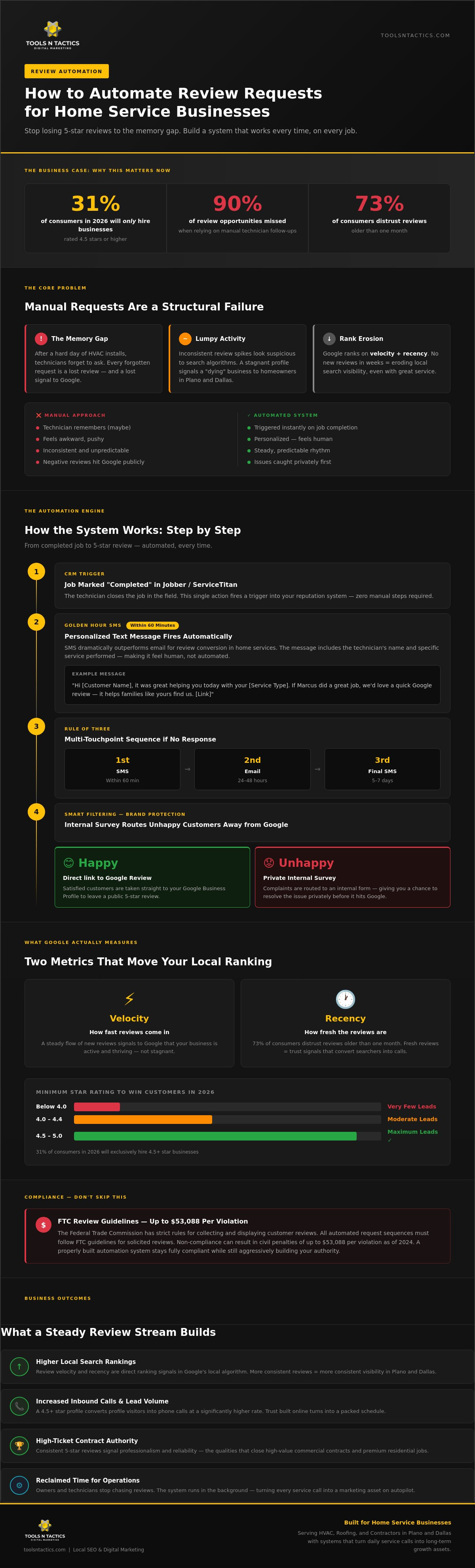
Did you know that 31% of consumers in 2026 will only hire a business with a rating of 4.5 stars or higher? For service companies in Plano and Dallas, the gap between a packed schedule and a quiet phone often comes down to the freshness of your Google reviews. If you’re still relying on technicians to remember to ask for feedback at the end of a long job, you’re leaving your local search rankings to chance. It’s frustrating to provide elite service only to see your online authority stall because manual follow-ups are inconsistent or feel too pushy.
We agree that your time is better spent on operations than chasing stars. This article shows you exactly how to automate review requests by replacing manual hurdles with a systematic automation engine. You’ll learn how to build a repeatable process that generates a consistent stream of 5-star reviews and builds your online authority on autopilot. We will examine the mechanical components needed to secure your spot at the top of local search results so you can focus on growth instead of marketing chores.
Key Takeaways
- Stop losing feedback to the “memory gap” by replacing manual technician follow-ups with a systematic workflow that never forgets to ask.
- Discover how to automate review requests using your CRM as the central brain to trigger messages the moment a job is marked complete.
- Protect your brand from negative public feedback by using internal surveys to catch and resolve issues privately before they hit Google.
- Turn a steady stream of 5-star ratings into higher local search rankings and increased lead volume across Plano and Dallas.
- Shift from using disjointed marketing tools to a unified Authority Engine that builds trust and generates high-ticket contracts on autopilot.
Why Manual Review Requests Are a Leak in Your Business Growth
Technicians are trade specialists, but they aren’t trained marketers. After a grueling HVAC install in the North Texas humidity, their primary goal is to pack up and head to the next job site. Relying on your field staff to ask for a Google review creates a “Memory Gap” that results in missed opportunities on 90% of your calls. This isn’t just an operational oversight; it’s a structural failure that limits your revenue potential. Learning how to automate review requests is the primary way to fix this inconsistency and plug the leak in your growth strategy.
While you provide elite service, your competitors in Plano might be outranking you simply because they’ve moved away from manual follow-ups. They don’t necessarily have better technicians or higher customer satisfaction; they simply have better systems. An inconsistent brand image caused by “lumpy” review activity signals to potential leads that your business is unreliable or struggling to stay active.
The Hidden Cost of Stagnant Reputation
Google’s algorithm prioritizes two specific metrics for reviews: velocity and recency. If your profile hasn’t seen a new 5-star rating in several weeks, your local search visibility will begin to erode. Data shows that 73% of consumers don’t trust reviews older than one month. A stagnant profile looks like a “dying” business to a homeowner in Dallas, regardless of your actual skill level. Professional online reputation management requires a steady, predictable pulse of feedback to maintain trust and high search rankings.
Moving from Fragmented Tasks to Integrated Systems
Many “one-off” marketing agencies treat reviews as a separate task or a side project. This fragmented approach is exactly why your lead flow feels unpredictable and disconnected from your daily work. We view your reputation as a mechanical component of your business architecture. By building a permanent Authority Engine, Tools N Tactics | Local SEO & Digital Marketing Solutions turns your daily service calls into growth assets. You stop asking for favors and start completing a professional workflow that builds your bottom line on autopilot.
How the Automation Engine Powers Your Reputation
Review automation is more than just a piece of software. It is a precise workflow that triggers requests based on real-world actions. Instead of a technician forgetting to ask for feedback, the Automation Engine handles the heavy lifting. It ensures every customer receives a prompt at the exact moment their satisfaction is highest. This system eliminates human error and creates a predictable rhythm of feedback that builds your brand’s credibility without manual intervention.
The CRM Connection: Your Single Source of Truth
Your field service software, such as Jobber or ServiceTitan, acts as the brain of this operation. Integration is non-negotiable for a professional setup. When a technician marks a job as “Completed” in the field, that data flows instantly into your reputation system. This trigger starts the clock. CRM integration is the bridge between operational work and marketing authority. It transforms a simple service call into a powerful data point for business growth.
Multi-Channel Sequences for Maximum Reach
A single request is rarely enough to move the needle. We follow the “Rule of Three,” which uses a sequence of touchpoints to ensure your message is seen. SMS is the primary tool here because it significantly outperforms email for review conversion in the home services industry. Most homeowners are on their phones and will respond to a text within minutes. Timing is also vital. The “Golden Hour” is the sixty-minute window immediately following a service call. This is when the value you provided is freshest in the customer’s mind.
Personalization makes these automated messages feel human. We use merge tags to include the technician’s name and the specific service provided. This increases the likelihood of a response because the customer feels recognized rather than just processed. While building these sequences, we strictly follow the Federal Trade Commission’s guidelines for collecting and displaying customer reviews. This ensures your brand remains compliant while you aggressively build authority. Following these rules prevents the risk of civil penalties, which can reach up to $53,088 per violation as of 2024.
If you are tired of fragmented tools that don’t talk to each other, it might be time to look at a unified system. You can speak with a growth consultant to see how an integrated engine can stabilize your lead flow. Understanding how to automate review requests is the first step toward moving from a manual chore to a high-performance marketing asset.
Step-by-Step: Setting Up Your Review Request Workflow
Building a high-performance review system requires more than just sending a random text. It requires a blueprint that aligns with your daily operations. When you understand how to automate review requests, you move from a reactive posture to a proactive strategy. This workflow ensures that no customer is overlooked and every positive experience is documented. By identifying specific success triggers and timing your sequences correctly, you create a self-sustaining engine for your online authority.
Choosing Your Automation Triggers
Your automation needs a clear starting point. This is the “Success Trigger” that signals a job is well done. For most North Texas contractors, we recommend three primary triggers to ensure maximum coverage:
- Trigger 1: The Invoice Paid Event. This is the most common trigger. When a customer pays their bill, it signals a successful transaction. It’s the perfect time to capture their initial satisfaction.
- Trigger 2: Job Status Changed to Complete. This works best for onsite technicians. As soon as the technician closes the ticket in your CRM, the system fires off a request. This hits the customer while your team is still in their driveway.
- Trigger 3: The 7-Day Follow-Up. Sometimes a customer needs time to experience the results, such as a new roof after a storm or a full HVAC install. This delayed trigger catches them after the “honeymoon phase” is over.
Implementing these strategies for getting more positive reviews ensures your business remains competitive in the local market. Each trigger serves a different psychological moment in the customer journey.
Crafting High-Converting Templates
The “Perfect Ask” is short, direct, and outcome-focused. You should never use corporate buzzwords or fluff in these messages. For a Plano HVAC company, a template might be as simple as: “Hi [Customer Name], this is [Technician Name] from [Company Name]. How is your AC running? We’d love to hear your feedback here: [Link].”
This message works because it starts with a service-related question rather than a demand. It feels like a continuation of the service call. Your Call to Action (CTA) must be a single, direct link to your Google Business Profile review page. Don’t send them to your website or a third-party landing page first. Every extra click you add to the process reduces your conversion rate by half. Keep the path to the 5-star rating as clear and unobstructed as possible.
A standard “Drip” schedule should include three messages. The first goes out immediately after the trigger. If they don’t respond, a second reminder follows two days later. A final “last call” message goes out at the seven-day mark. This persistent but professional cadence is the secret to how to automate review requests effectively. It respects the customer’s time while ensuring your business gets the credit it deserves.
Filtering Feedback: How to Protect Your Brand from Negative Reviews
Every business owner fears the rogue 1-star review. You might worry that learning how to automate review requests will open the floodgates to public complaints from difficult customers. This is a common point of friction that prevents many contractors from scaling their reputation. However, a professional automation engine doesn’t just blast out links; it acts as a strategic filter. By using an “Internal First” strategy, you can catch service issues before they ever reach a public forum.
The goal isn’t to hide the truth but to resolve problems where they belong: between you and the customer. Google’s 2026 guidelines and the FTC’s Consumer Review Rule (16 C.F.R. Part 465) are very strict about “review gating.” You cannot legally block a customer from leaving a review. Instead, you should use your automation to prioritize internal feedback loops. This approach respects the customer’s voice while giving your team a chance to perform a “service rescue” before a complaint goes viral.
The NPS Feedback Loop
We use a Net Promoter Score (NPS) framework to segment customer sentiment automatically. This removes the need for your staff to manually guess who is happy and who isn’t. The system follows a simple, three-step mechanical sequence:
- Step 1: The system sends a text asking, “On a scale of 1-10, how likely are you to recommend us?”
- Step 2: If the score is a 9 or 10, the automation immediately sends your Google Business Profile link. These are your promoters who will build your authority.
- Step 3: If the score is a 1 through 6, the system bypasses the public link and triggers an internal “High Priority” task in your CRM.
This internal alert ensures a manager calls the customer within the hour. Resolving a 3-star experience privately often turns a frustrated homeowner into a loyal advocate for life.
Turning Complaints into Authority
Transparency is a powerful tool for local SEO. If a negative review does slip through, it isn’t the end of the world. In fact, a profile with a 4.8 rating and professional, empathetic responses often converts better than a “perfect” 5.0 that looks fake. You can find more details on this in our guide on Online Reputation Management for Service Businesses in Plano.
We automate “Response Notifications” so you never miss a public comment. The faster you respond, the more trust you build with potential leads watching from the sidelines. They aren’t just looking at the complaint; they are looking at how you handle it. A systematic response shows you are a disciplined operator who takes accountability. If you want to stop reacting to fires and start building a stable reputation, you can schedule a strategy session to see how we architect these systems for growth.
The Growth Partner Approach: Beyond Simple Software
Many business owners have a drawer full of unused software subscriptions. Buying a tool is the easy part. Building a profitable system that actually runs without you is where most contractors struggle. If you simply buy a subscription and hope for the best, you’re still acting as the technician of your own marketing. A Growth Partner provides a different level of security. We act as the architects who design, build, and maintain your reputation machinery so you can stay focused on managing your crews.
A tool is a cost, but a system is an investment. When you understand how to automate review requests as part of a larger strategy, it changes your business trajectory. We integrate your review volume directly with our Local SEO strategies to ensure your high ratings translate into top-tier search rankings. This creates a feedback loop where your online authority generates more leads, which then generates more reviews. It is a unified engine designed for long-term stability rather than temporary spikes.
Building Your Authority Engine in North Texas
Your reputation shouldn’t just sit on your Google Business Profile. We take the social proof generated by your automated system and hardwire it into your Landing Page Design. This significantly increases your conversion rates because 97% of consumers in 2026 read reviews before making a local hire. By displaying fresh, recent feedback on your site, you give Plano and Dallas homeowners the confidence to book a call immediately. This transforms your reputation into a 24/7 sales force that never takes a day off.
Next Steps: From Manual to Systematic
It’s time to stop treating reviews as a “maybe” and start treating them as a “must.” Every day you rely on manual follow-ups is a day you risk losing market share to a more systematic competitor. You don’t have to figure out how to automate review requests on your own. We provide the blueprints and the technical expertise to get your system running in weeks, not months.
The first step is knowing exactly where you stand in the North Texas market. You can start with a Free SEO Audit to identify the leaks in your current visibility. From there, we can discuss how our Growth Partner Program can take the weight of marketing off your shoulders. Let’s move your business from fragmented effort to consistent, scalable outcomes.
Secure Your Local Authority with a Systematic Reputation Engine
Manual follow-ups are a structural weakness that keeps your business from dominating the North Texas market. By closing the “memory gap” and integrating your CRM with a dedicated sequence, you ensure every completed job contributes to your long-term visibility. You now understand how to automate review requests as part of a broader strategy to build a permanent asset that converts leads on autopilot. This system handles the technical heavy lifting so you can focus on managing your crew and completing your next project.
We don’t rely on generic stock photos or speculative trends. Our approach focuses on real results for real trades, powered by an integrated AI and Automation Engine. With deep North Texas local expertise, we architect the systems that move the needle for HVAC, roofing, and construction leaders. Stop leaving your online reputation to chance and start building for structural integrity.
Build Your Authority Engine: Book a Growth Strategy Call
Your next 5-star review is already waiting for you. You just need the right system in place to catch it and turn it into a lead-generating machine.
Frequently Asked Questions
Is it against Google’s terms of service to automate review requests?
No, it’s not against Google’s terms to ask for feedback automatically. They actually encourage businesses to collect authentic reviews from their customers. The key is to avoid “review gating,” which is the illegal practice of only sending links to customers you know are happy. As long as you’re asking for honest feedback from everyone, your automation is fully compliant and safe to use.
Can I automate review requests if I don’t have a CRM?
You can use standalone tools, but they often require manual data uploads that eat up your time. A CRM acts as the brain of your system and is the only way to achieve true, hands-off automation. Without a CRM integration, you’re still stuck in a manual loop of moving data from one place to another. Integrating your field software is the best way to learn how to automate review requests effectively.
What is the best time of day to send a review request text?
The “Golden Hour” is the most effective time to reach a customer. This is the 60-minute window immediately after your technician leaves the job site and the value of your work is fresh. If you miss that window, weekday afternoons between 2:00 PM and 4:00 PM are the next best option. This is when people are most likely to check their phones and take action on a text message.
How do I prevent the same customer from getting multiple review requests?
Professional systems use frequency caps to protect your customer experience. These are simple rules that tell the system not to send a request if the customer already received one in the last 60 days. This prevents you from looking disorganized or pushy to your loyal, repeat clients. It keeps your brand image professional and shows you respect their time while still building your online authority.
Should I offer a discount or incentive for a Google review?
Never offer incentives like discounts, gift cards, or free services for reviews. This violates both Google’s policies and the FTC’s Consumer Review Rule. As of 2024, the FTC can issue civil penalties of up to $53,088 per violation. It’s much safer and more effective to build a system that earns reviews through elite service and consistent, automated follow-ups that don’t rely on bribes.
How many reviews do I need to rank #1 in Plano local search?
There’s no single number that guarantees a top spot in search results. Google looks at your review velocity and recency compared to other local contractors. If your top three competitors in Plano have 50 recent reviews, you should aim for 60 to 75. Freshness matters more than total volume, as 73% of consumers don’t trust reviews older than one month. Consistency is the real secret to ranking.
What happens if I accidentally send a review request to an unhappy customer?
This is why we use an “Internal First” strategy with NPS surveys to catch issues early. If a mistake happens and a negative review goes public, don’t panic. A fast, professional response shows potential leads that you take accountability for your work. Most homeowners understand that mistakes happen, but they want to see that you’re a disciplined operator who resolves issues quickly and fairly.