
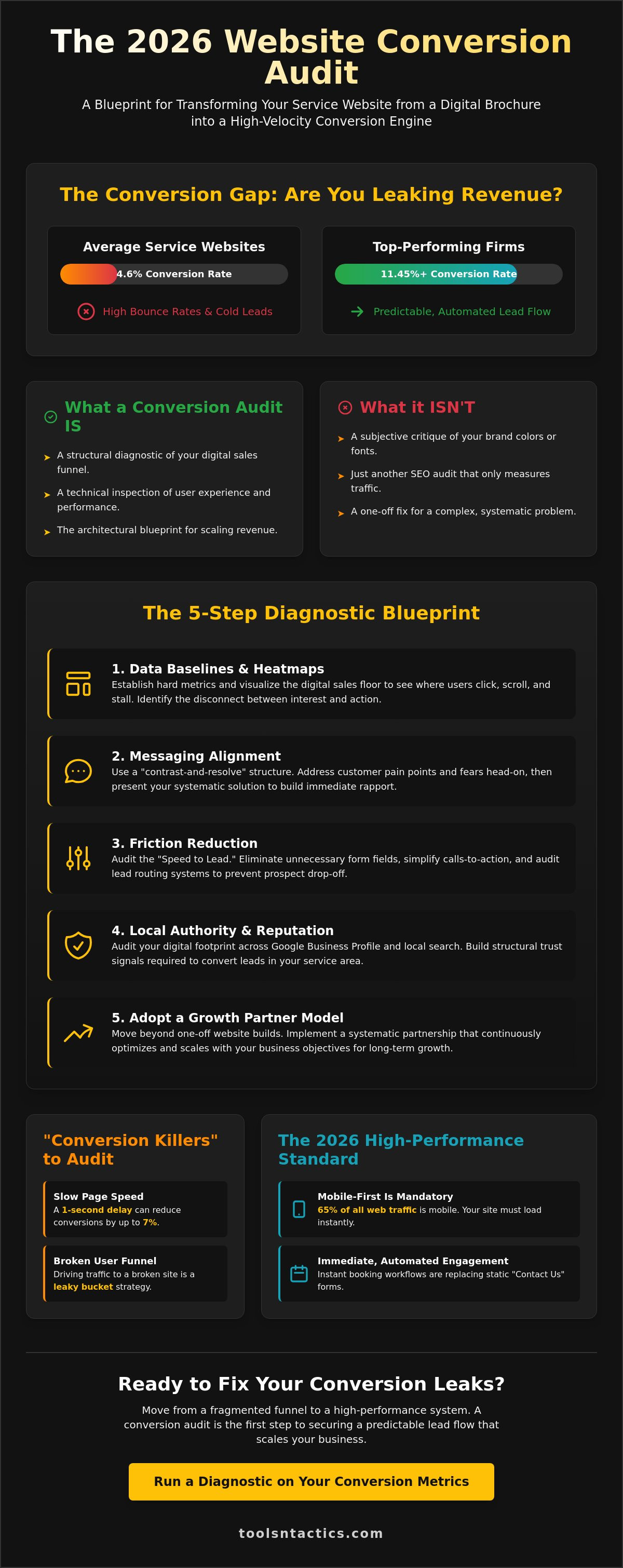
While the average professional service website converts at roughly 4.6 percent, top-performing firms in 2026 use a website conversion audit for service business growth to hit rates of 11.45 percent or higher. If your site is stuck in the lower bracket, you’re likely dealing with high bounce rates and leads that go cold before your team can even pick up the phone. It’s frustrating to invest in visibility only to watch potential revenue slip through the cracks of a fragmented sales funnel. You need a system, not just a digital brochure.
This guide identifies every friction point in your current setup and provides a clear roadmap to transform your underperforming site into a high-velocity conversion engine. By moving from disconnected tools to a unified strategy, you can secure a predictable lead flow that converts automatically. This blueprint breaks down the mechanical components of a successful audit, from mobile-first optimization to the trust signals that build authority and close the deal.
Key Takeaways
- Understand how a website conversion audit for service business operations acts as a structural diagnostic to identify where potential revenue is leaking from your sales funnel.
- Learn the 5-step blueprint to establish a data-centric baseline, ensuring your messaging addresses the specific pain points of your local North Texas audience.
- Discover why your response time is the critical failure point and how auditing your lead routing systems can prevent prospects from turning to competitors.
- Audit your digital footprint across Google Business Profile and local search to build the structural trust required to convert Plano and Dallas leads.
- Move beyond the limitations of one-off website builds by adopting a systematic Growth Partner model that scales with your business objectives.
What is a Website Conversion Audit for a Service Business?
A website conversion audit for service business operations is a systematic diagnostic of your digital sales floor. It isn’t a subjective critique of your color palette or brand fonts. Instead, it is a rigorous inspection of the structural integrity of your sales funnel. This audit evaluates user experience, technical performance, and the psychological triggers that move a prospect from curiosity to commitment. Think of a conversion audit as the architectural blueprint for scaling revenue; it identifies exactly where your foundation is cracked and how to reinforce it for long-term growth.
For service providers, the goal of a website is simple: transform a cold visitor into a booked lead. Many firms rely on standard SEO audits, but these only measure your ability to get people to the door. A conversion audit focuses on what happens after they arrive. This process utilizes the principles of Conversion rate optimization (CRO) to ensure your digital presence functions as a high-performance sales tool rather than a static brochure.
The Difference Between Traffic and Conversion
Driving more traffic to a broken website is a leaky bucket strategy. It is an expensive way to lose market share. In our framework, we distinguish between a Visibility Engine and a Conversion Engine. A Visibility Engine handles search rankings and reach, but the Conversion Engine is the mechanical assembly that captures that energy and turns it into profit. When we analyze your analytics dashboard, we look for “Conversion Killer” metrics. A high bounce rate on a primary landing page or a 1-second delay in page load time, which can reduce conversions by up to 7 percent, indicates a mechanical failure in your funnel. Traffic doesn’t pay the bills. Leads do.
The 2026 Standard for High-Performance Service Sites
The standard for service-based websites has shifted toward immediate, automated engagement. In 2026, professional service conversion rates typically hover between 4.6 percent and 6.1 percent, but top performers exceed this by eliminating friction. Static “Contact Us” forms are being replaced by instant booking workflows and AI-driven engagement. Prospects no longer want to wait for a callback; they want to see your availability in real time.
Mobile-first optimization is also no longer optional for North Texas service pros. With mobile accounting for 65 percent of all web traffic, your site must load instantly and navigate flawlessly on a smartphone. If your mobile experience is clunky, you aren’t just losing a click; you’re handing a lead directly to a competitor who has already optimized their digital machinery.
The 2026 Website Conversion Audit Blueprint: A 5-Step Diagnostic
Step 1 & 2: Data Baselines and Messaging Alignment
Your audit begins by establishing hard metrics. We use heatmaps to visualize the digital sales floor, revealing exactly where North Texas homeowners click, scroll, and stall. If users are hovering over a service description but failing to click your booking link, there is a disconnect between interest and action. This data allows us to synchronize your Visibility Engine with your Conversion Engine, ensuring the traffic you work hard to earn actually reaches the finish line.
Messaging alignment follows. We employ a “contrast-and-resolve” structure. We identify the common industry failures your customers fear, such as unreturned calls or hidden fees, and immediately resolve them with your unified, systematic solution. When your copy speaks directly to local pain points in Dallas or Plano, it builds the immediate rapport necessary to move a prospect through the funnel. If you want to see how your current site measures up, you can run a diagnostic on your conversion metrics to find the leaks.
Step 3 & 4: Friction Reduction and Authority Building
Friction is the silent killer of lead generation. Every extra form field you require can act as a speed bump, potentially costing you a significant percentage of your conversion rate. We analyze your call-to-action (CTA) elements to ensure they are direct and punchy. A high-performance service site shouldn’t ask for a prospect’s life story before a consultation; it should provide a clear, frictionless path to engagement.
Authority building is the secondary pillar. We evaluate the placement of trust signals and social proof. In the service industry, proximity equals trust. Placing verified local reviews and reputation signals near your primary booking forms reinforces your reliability at the exact moment a decision is being made. Integrating a robust system for reputation management ensures that your digital footprint confirms your expertise before the first phone call even happens.
Step 5: Technical Load Speeds and Mobile Responsiveness
The final step is the technical inspection. A 1-second delay in page load time can reduce conversions by up to 7 percent. For B2B or high-ticket service sites, speed is a direct indicator of professional reliability. We assess your site’s mobile responsiveness to ensure on-the-go customers have a seamless experience. With mobile accounting for 65 percent of traffic in 2026, any lag in your mobile interface is a direct invitation for prospects to call your competitors instead. A website conversion audit for service business success must confirm that your technical foundation is fast, accessible, and ready to convert traffic at peak efficiency.
Auditing the Speed to Lead: Why Your Forms are Killing Your Growth
A website conversion audit for service business performance often reveals a critical misunderstanding: many owners believe the conversion ends at the “Submit” button. In reality, that click is just the beginning of the transaction. If your digital sales floor captures a prospect but your back-end systems fail to route that lead instantly, you’re essentially building a high-pressure engine with a massive leak in the fuel line. An audit must examine the mechanical assembly of your lead routing to ensure no prospect is left idling in an inbox.
Lead decay happens in minutes, not hours. For service-based industries, the expectation for immediate gratification is at an all-time high. When a North Texas homeowner has a plumbing emergency or a business owner needs an immediate consultation, they won’t wait for a manual callback. Integrating AI voice agents and automated lead routing ensures that every inquiry is met with an immediate, professional response. This structural shift moves your business from a passive recipient of data to an active participant in the sales cycle.
The Cost of Delayed Follow-Up
The math of lead response is brutal and unforgiving. Industry data suggests that responding to a lead within 5 minutes can increase your conversion odds by 9x compared to waiting even half an hour. When you manage multiple disconnected marketing tools, the resulting operational friction creates a lag that kills your ROI. A comprehensive automated lead follow-up system seals these leaks by triggering SMS and email sequences the second a form is submitted. This keeps the prospect engaged with your brand while your competitors are still checking their notifications.
AI Chatbots as the 24/7 Conversion Architect
Traditional websites have “dead zones” during nights and weekends when staff aren’t available to answer the phone. Auditing your site for these gaps allows you to deploy AI chatbots for local business growth, ensuring you never miss a lead regardless of the hour. These aren’t the basic, frustrating scripts of the past. Modern AI agents act as lead-qualifying architects, asking the right questions to determine if a prospect is a fit before they ever reach your CRM. By moving from static forms to intelligent, interactive conversations, you transform your website into a high-performance engine that operates 24/7 without human intervention.
Local Authority & Reputation: Auditing Your North Texas Digital Footprint
A comprehensive website conversion audit for service business growth must extend beyond your domain name. It must encompass your entire North Texas digital footprint. In highly competitive markets like Dallas and Plano, prospects look for local proof before they ever click your booking button. If your Google Business Profile (GBP) tells one story but your website tells another, the resulting friction will kill your conversion rate. We use an Authority Engine approach to ensure you aren’t just another listing; you’re the neighborhood leader with the social proof to back it up.
In 2026, trust signals are the primary currency of the service industry. A website conversion audit for service business success analyzes how your local search optimization impacts website trust. If your site lacks a clear connection to the communities you serve, visitors will bounce in favor of a provider who feels like a local fixture. Establishing this neighborly reliability requires a mechanical alignment between your search visibility and your on-site messaging.
GBP and Website Synergy
Your website messaging must mirror your local citations and reviews. We audit your technical SEO to ensure local-specific landing pages for cities like Celina, Frisco, and McKinney are perfectly synchronized with your GBP data. When a prospect sees a five-star review on Google and finds that same project highlighted on your site, the psychological loop closes. Disjointed messaging creates doubt. Doubt prevents conversion. Every landing page should act as a structural extension of your local reputation, grounding your expertise in specific community contexts.
Reputation as a Conversion Driver
Reputation management isn’t just about collecting stars; it’s about strategic placement. We audit the placement of “Verified Resident” reviews on your primary service pages. These signals act as immediate social proof at the exact moment a prospect is deciding whether to engage. Utilizing high-converting landing pages allows you to showcase this local authority by highlighting work completed in the prospect’s specific neighborhood.
Consistently generating fresh, local proof is a core component of a high-performance conversion engine. If your last review was from six months ago, your authority is decaying. We evaluate your review automation systems to ensure you’re building a steady stream of recent, relevant testimonials. This systematic approach to reputation ensures that your digital footprint confirms your expertise before the first phone call is even made. If your local presence feels fragmented, you can request a local authority diagnostic to identify exactly where your reputation is leaking leads.
Transforming Your Audit into a High-Performance Conversion Engine
One-off website builds are the industry standard for mediocrity. They are often treated as static art projects rather than dynamic sales machinery. While a website conversion audit for service business operations identifies the structural leaks in your funnel, the diagnostic blueprint is only valuable if it leads to a total system overhaul. Most business owners are left with a list of problems but no mechanic to implement the solutions. To scale a service business long-term, you must move beyond temporary fixes and build a repeatable system that converts traffic into revenue automatically.
The transition from a simple “audit” to a high-performance engine requires the integration of three core components: visibility, authority, and conversion. When these engines are synchronized, your website stops being a digital brochure and starts functioning as a high-velocity growth machine. This structural alignment ensures that every visitor is guided through a frictionless path to engagement, backed by the local proof and technical speed required to close the deal in a competitive market.
The Growth Partner Advantage
Service businesses in Plano and the surrounding North Texas areas often choose a partner over a traditional agency because they value accountability. A traditional agency might deliver a report and disappear; a partner stays to ensure the machinery actually works. Our Growth Partner Program is designed to act as a steady hand in a chaotic digital landscape. We don’t just point out the cracks in your foundation. We reinforce them. By implementing the audit findings for you, we move the emotional needle from the frustration of fragmented efforts to the security of consistent, scalable outcomes.
Building Your Repeatable System
We prioritize tangible outcomes and financial growth over abstract creative concepts. A high-performance conversion engine relies on continuous analytics and tracking to maintain a high ROI. This isn’t about speculative methods or following temporary trends. It’s about structural integrity. By focusing on the mechanical components of your sales funnel, such as automated lead routing and AI-driven engagement, we create a system that works while you focus on your trade. The end result is a predictable lead flow that doesn’t depend on manual intervention.
If you’re ready to stop guessing and start growing, the first step is a professional diagnostic of your current digital sales floor. You can schedule your comprehensive Growth Engine audit with Tools N Tactics to identify every friction point and begin the process of transforming your site into a high-velocity conversion engine. It’s time to stop losing market share to rivals and start building a system that secures your long-term stability.
Build Your High-Velocity Conversion Engine
A website conversion audit for service business growth is the essential diagnostic tool to stop your revenue leaks. We’ve explored how structural failures in lead routing and a lack of regional authority are handing your market share to rivals. However, a blueprint without a builder is just paper. You need a system that integrates your visibility, authority, and conversion engines into a single, automated workflow. This transition moves your digital presence from a passive expense to a high-performance asset.
We specialize in North Texas service businesses, utilizing our proven Visibility-Conversion-Authority framework to bridge the gap between web traffic and bankable revenue. By deploying an integrated AI and Automation Engine, we ensure your follow-up is immediate and your digital reputation remains bulletproof in a crowded landscape. It’s time to replace fragmented marketing efforts with a reliable, repeatable system that powers your long-term stability and bottom line.
Stop Leaking Leads—Get Your Growth Engine Audit Today
The future of your business depends on structural integrity, not temporary trends. We’re ready to help you build a foundation that scales with your ambition.
Frequently Asked Questions
What is a website conversion audit for a service business?
A website conversion audit for service business operations is a structural diagnostic of your digital sales funnel. It identifies exactly where prospects are dropping off before booking a call or requesting a quote. Instead of focusing on subjective aesthetics, this process evaluates the mechanical integrity of your user experience, technical performance, and messaging clarity. It acts as the architectural blueprint for transforming an underperforming site into a high-performance lead generation engine.
How much does a professional conversion audit cost in 2026?
The investment for a professional diagnostic depends on the complexity of your sales funnel and the depth of data analysis required. While small business website builds in 2026 typically range from $3,000 to $25,000, a conversion audit is a specialized strategic service. The focus is on identifying revenue leaks and providing a roadmap for structural improvements that deliver a measurable return on investment rather than just a visual refresh.
How long does it take to see results after implementing audit recommendations?
Technical improvements like page speed optimization often yield immediate performance gains in user engagement. For messaging shifts and structural funnel changes, most service businesses see measurable improvements in lead flow within 30 to 90 days. This timeframe allows enough traffic to pass through the updated Conversion Engine to establish statistical significance and verify that the previously identified friction points are successfully sealed.
Do I need a completely new website or just a conversion audit?
You rarely need a completely new website to achieve a significant jump in lead volume. A conversion audit identifies the specific components of your existing foundation that need reinforcement. Blindly rebuilding a site often replicates the same structural flaws. By auditing first, you ensure that any future development is driven by hard data rather than speculation or temporary design trends that don’t impact your bottom line.
Can AI automation really improve my website conversion rates?
AI automation is the primary driver of “speed to lead” for modern service providers. By integrating AI chatbots and voice agents, you provide the immediate gratification that prospects demand in 2026. These systems handle lead qualification 24/7, ensuring your team only spends time on high-value calls. This eliminates the “dead zones” in your sales funnel where leads typically go cold while waiting for a manual response.
Why is my Plano-based business losing leads to competitors with worse websites?
Competitors with “worse” websites often win because their Conversion Engine is more efficient. They likely have faster response times, more prominent local trust signals, or a more seamless Google Business Profile integration. If your North Texas business is losing market share, it’s usually because your site has high-friction barriers or a lack of neighborly reliability that prevents visitors from taking the final step toward engagement.
What are the most common “conversion killers” for service-based landing pages?
The most frequent conversion killers include slow page load times and excessive form fields. A 1-second delay in load time can reduce conversions by up to 7 percent. Other major leaks include hidden contact information, a lack of recent local reviews, and messaging that fails to address specific community pain points. These speed bumps frustrate prospects and drive them directly to the next service provider in the search results.
How does a conversion audit integrate with my existing SEO strategy?
A website conversion audit for service business growth is the logical extension of your SEO strategy. While your Visibility Engine handles search rankings and traffic, the audit ensures that traffic actually converts into bankable revenue. By synchronizing these two systems, you ensure your investment in search visibility isn’t wasted on a site that can’t close the deal. It turns your digital presence into a unified, repeatable growth machine.