
What if the best local keyword for your business isn’t the city name with the highest search volume? Local SEO keyword research for service area businesses works best when it starts with the jobs you do and the places you genuinely serve. Yet keyword tools may show little data for specific service-and-city searches, leaving business owners unsure what to target.
That uncertainty can make it tempting to build a page for every town or chase broad phrases that bring clicks but few qualified inquiries. Neither approach gives you a reliable plan. A town deserves its own page only when you can make that page useful and relevant, not just swap in a new location name.
This article shows you how to build a practical, prioritized keyword list from your services, customer language, and real coverage area. You’ll learn how to assess search intent, decide which topics belong on dedicated pages, and avoid duplicating location content. The goal is a clear connection between what people search, the pages that answer their needs, and the calls or form submissions that support business growth.
Key Takeaways
- Build your keyword list from the services you actually offer and the locations you genuinely cover, not every nearby city.
- Use search suggestions and results to discover how customers phrase their needs, then assess intent and business fit before prioritizing a term.
- Local SEO keyword research for service area businesses should weigh relevance, coverage, lead intent, current visibility, and business value, not search volume alone.
- Group closely related searches on one useful service page. Create a location page only when it can offer distinct value to customers.
- Connect keyword priorities to page updates and track visibility alongside qualified calls or form submissions when measurement is available.
Start Local SEO Keyword Research with Your Services and Real Coverage
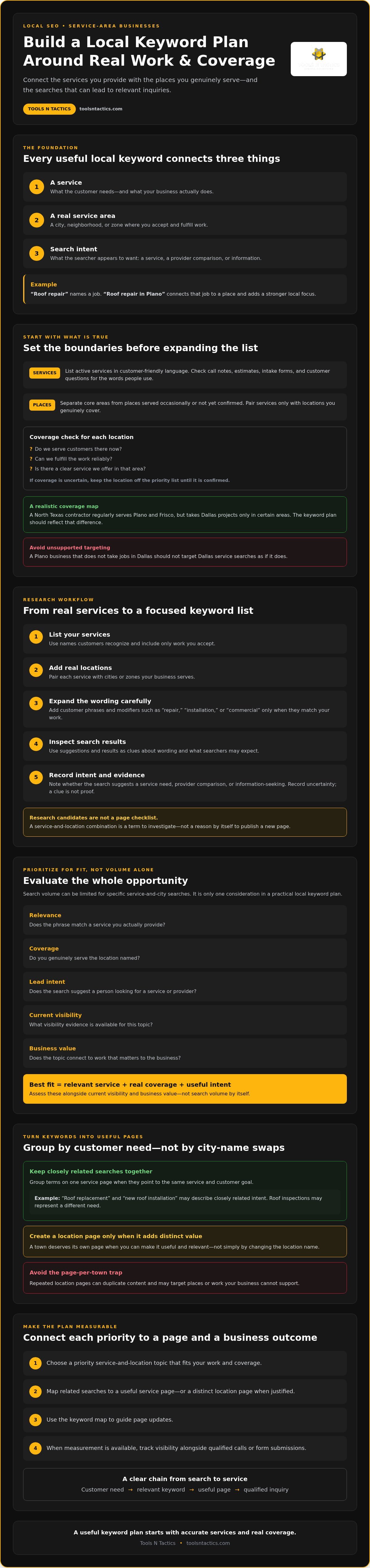
Local SEO keyword research connects three things: the service a customer needs, the place they need it, and the intent behind their search. A person searching “roof repair” may be exploring options. Someone searching “roof repair in Plano” is looking for a local provider. That difference helps you choose terms and pages that can attract relevant inquiries, not just general website traffic.
A broad service keyword names the job; a service-area keyword connects that job to a place where you actually take customers. “Air conditioning repair” is broad. “Air conditioning repair in Frisco” adds a location and a stronger local focus. This is the working foundation of Local search engine optimization, but a useful keyword plan must also reflect how your business operates on the ground.
Separate core services from customer search language
Start with a list of services you actively provide. Write each one in plain language, then add the words customers use to describe the same need. For a roofer, “roof replacement” and “new roof installation” may describe closely related intent. Roof inspections may serve a different need and belong in a separate group. Check call notes, estimates, intake forms, and customer questions for actual phrases. Group terms only when they point to the same service and customer goal.
Define locations the business genuinely serves
List the cities, neighborhoods, and service zones where you accept and fulfill work. Mark core areas separately from places you serve only occasionally or haven’t confirmed. That distinction keeps your research tied to real capacity. A Plano business that doesn’t take jobs in Dallas shouldn’t target Dallas service searches as if it does. Those searches may attract people the business can’t help, wasting time for both sides.
For example, a North Texas contractor might regularly take work in Plano and Frisco but accept Dallas projects only in certain areas. The keyword map should show that difference instead of treating all three cities as equal. Before adding a place, ask: Do we serve customers there now? Can we fulfill the work reliably? Is there a clear service we offer in that area? If the answer is uncertain, keep it off the priority list until coverage is confirmed.
This is why local SEO keyword research for service area businesses starts with an accurate service-and-location inventory, not a long list of nearby city names. It gives the next research steps a solid base and helps prevent pages from making promises your operations can’t support.
How to Find Local SEO Keywords for a Service Area Business
A useful first-pass list doesn’t depend on one keyword tool. Combine confirmed services and locations with customer language, search-result clues, and performance data where available. The result is a set of terms to investigate, not a promise that each phrase has demand or needs its own page.
Use this five-step workflow:
- 1. List your services. Use the names customers recognize and note the work you actually accept.
- 2. Add real locations. Pair services only with cities or zones your business serves.
- 3. Expand the wording. Add customer phrases and relevant modifiers such as “repair,” “installation,” or “commercial” when they match your work.
- 4. Inspect search results. Look for clues about what people may expect from the search.
- 5. Record intent and evidence. Note whether the search suggests someone is seeking a service, comparing providers, or looking for information. Record uncertainty instead of treating a clue as proof.
Expand service and location combinations carefully
Combine each service with locations you genuinely cover, then add modifiers only when they describe work you provide. A Plano HVAC company might investigate “AC repair Plano,” “furnace installation Plano,” or “commercial HVAC Plano” if it handles those jobs. If emergency service isn’t part of its offer, it shouldn’t target “emergency HVAC” as though it were. These combinations are research candidates, not a checklist of pages to publish.
Compare customer wording with your official service names. A company may call a job “system replacement,” while customers search for “new air conditioner installation.” Keep both phrases in your research notes, then confirm they refer to the same accepted work before grouping them.
Use search results and tools to validate intent
Google Search suggestions can reveal wording people might use. Search results and Google Maps listings can help you see whether people appear to want a local provider, a specific service, or general information. Treat these as discovery clues, not confirmed demand. Google Keyword Planner can provide another source of keyword ideas, but its estimates shouldn’t decide priorities on their own.
Where data exists, review Google Search Console query and landing-page performance to see which searches already lead people to your site. In your keyword sheet, record the phrase, service, location, likely intent, evidence source, and confidence level. For example, a term supported by customer inquiries and Search Console data has different evidence behind it than a phrase suggested only by a keyword tool. Keeping those sources separate makes it easier to distinguish observed performance from assumptions.
This measured approach is the foundation of local SEO keyword research for service area businesses: build from real work and coverage, then check each idea against search clues and your own data. If you want a second set of eyes on your local keyword plan, talk with Tools N Tactics | Local SEO & Digital Marketing Solutions.
Prioritize Service-Area Keywords Beyond Search Volume
A keyword tool may show a low estimate or no volume for a search like “heat pump repair in Plano.” That doesn’t prove the search has no value. Local searches can be specific, and tools may not show a clear estimate for every service-and-city combination. Treat volume as one clue, not a verdict. Look for supporting evidence in customer inquiries, search results, and your own website data where available.
For local SEO keyword research for service area businesses, compare each opportunity using the same criteria. A simple rating of strong, possible, or weak is enough to make the trade-offs clear.
Relevance: Does the phrase match a service you actively want to sell?
Service-area fit: Is the location within your real coverage and operational capacity?
Intent: Is the searcher researching a problem, comparing providers, or looking to hire?
Current visibility: Does your site already appear for related searches, or is there room to build visibility? Use available query and landing-page data as evidence.
Business value: Does the service fit your business goals and justify a useful page or other SEO work?
Compare opportunities using consistent criteria
Intent helps determine what a search deserves. “How long does a furnace last?” suggests research. “Furnace replacement cost” may signal comparison. “Furnace replacement Plano” points more directly to a local service need. These are clues, not guarantees of what a searcher will do. Check the results and consider whether your page can answer the need clearly.
Prioritize a keyword only when the service, coverage, intent, and destination page align. If a phrase matches the service but the location isn’t served, it’s not a sound target. If the phrase is relevant but no useful page can meet the searcher’s need, address the page gap before prioritizing the keyword.
Use North Texas examples without assuming equal demand
“AC repair Plano” and “AC repair Frisco” are separate hypotheses. The business may serve both cities, but that alone doesn’t prove the searches have equal demand, competition, or value. Dallas and Sherman shouldn’t automatically be treated as equivalent either. Search results, customer intent, and fit with your operations may differ.
Check each location against your coverage, business goals, and ability to provide meaningful information for people there. A missing volume estimate can stay on the list as an unconfirmed opportunity, but don’t let a city name alone justify a new page. This keeps your priorities grounded in work you can serve and content that can genuinely help prospective customers.
Map Local Keywords to Useful Pages Without Repeating City Pages
A keyword map should lead to a clear page plan, not a separate URL for every phrase. When several searches share the same service need and intent, group them around one strong service page. This helps customers find a useful answer and gives your site a clearer structure.
Choose a destination page for each keyword group
Review your current pages before creating another one. Map branded searches to a page that clearly identifies your business, broad service searches to the relevant service page, and service-plus-location searches to the page best suited to answer that local need. Assign one primary page to each distinct intent, then track closely related terms as supporting queries.
For example, “roof repair,” “roof leak repair,” and “roofing repair service” may belong together if they lead customers to the same type of work. If a separate service has a different purpose, such as roof replacement, it may need its own page. Don’t create another URL simply because a keyword list contains a new wording or city name. Check whether an existing page already serves that purpose.
Decide when location-specific content is genuinely useful
A dedicated location page should help customers in that area make a decision. Include accurate coverage details, relevant service information, and context that’s genuinely useful to people there. Don’t imply an office, local presence, or service availability you can’t verify. If the page would only repeat the same copy with a different city name, it probably isn’t ready to stand on its own.
Local trust can also come from clear service information and credible customer feedback. For further reading, see Online Reputation Management for Service Businesses in Plano. For a broader view of how service coverage fits into local visibility, refer to The Local Search Guide for Plano Service Areas. Use resources like these to strengthen the page plan, not as a reason to publish thin location pages.
This is a core step in local SEO keyword research for service area businesses: connect each keyword group to one useful destination, then make sure that page matches both the searcher’s need and your real coverage. A focused map can also guide broader local SEO and visibility work, instead of letting location pages grow without a clear purpose.
If your service pages and city targets overlap, talk with Tools N Tactics | Local SEO & Digital Marketing Solutions about mapping your local keywords to useful pages.
Turn Your Keyword Map into a Measurable Local Visibility Plan
A keyword map becomes useful when it guides page updates and helps you judge whether visibility is reaching potential customers. Rankings alone don’t tell the full story. A page can appear in search results without attracting the right service requests, so connect search performance to qualified calls and form submissions where tracking is available.
Build a simple research-to-measurement routine
Keep the plan in a simple working document. For each keyword group, record its intended page, target service area, and reason for priority. Then follow a repeatable sequence:
- Select priorities: Focus on terms that fit your services, coverage, and business goals.
- Update pages: Make sure each destination page answers the searcher’s need and clearly explains the relevant service.
- Measure visibility: Use Google Search Console, where data is available, to review queries and the landing pages receiving impressions and clicks.
- Review leads: Compare page performance with qualified calls or form submissions when your tracking allows it. Check whether inquiries match the work and locations you want.
- Refine: Adjust priorities as your services, coverage, customer questions, or performance evidence changes.
Look at the full path, not one metric. If a page gains visibility but the inquiries aren’t a fit, review the query intent, page message, and service-area details. If relevant leads come through a page with modest search visibility, that evidence may still support keeping it in your plan.
Know when to get implementation support
Research is harder to act on when keyword groups, website pages, your Google Business Profile, and lead tracking are managed separately. Tools N Tactics | Local SEO & Digital Marketing Solutions’ Visibility Engine brings local SEO and Google Business Profile optimization into local visibility work. The aim is a joined-up plan, not a promise of specific rankings or lead volume.
A disciplined local SEO keyword research for service area businesses workflow gives you a clear way to choose priorities, improve relevant pages, and learn from actual business outcomes. Keep the map current, and let evidence guide the next adjustment.
Discuss a practical local keyword strategy and talk through your visibility priorities.
Build a Local Keyword Plan You Can Put to Work
A useful local keyword map starts with the services you want to grow and the places you genuinely serve. Search volume can offer a clue, but it shouldn’t outweigh service fit, customer intent, or whether you can create a helpful page. Group related searches around the right destination instead of publishing near-identical city pages.
Then connect visibility to business evidence. Review query and page performance alongside qualified calls or form submissions where tracking is available. Rankings matter, but the right inquiries matter more.
That’s the practical value of local SEO keyword research for service area businesses: it gives your local SEO work a clear structure and a way to learn what’s reaching the customers you can serve. Tools N Tactics | Local SEO & Digital Marketing Solutions’s Visibility Engine includes local SEO and Google Business Profile optimization. Its Growth Partner Program connects visibility with conversion and authority work, so search activity can be considered as part of a broader growth system.
Discuss a practical local keyword strategy with Tools N Tactics | Local SEO & Digital Marketing Solutions and take the next step with a clearer plan for local visibility.
Frequently Asked Questions
How do you find local SEO keywords for a service area business?
Start by listing the services you actively provide, then pair each with only the locations you genuinely serve. Expand the phrases using customer wording from calls, estimates, and intake forms. Review Google Search suggestions and results for clues about intent, then check Search Console data where available. This is a practical starting point for local SEO keyword research for service area businesses. Treat tool estimates as evidence to consider, not proof of demand.
Should a service area business create a page for every city it serves?
No. A city should have a dedicated page only when the business can provide useful, distinct information for customers there. A page that only swaps “Plano” for “Frisco” or “Dallas” may add little value. For a North Texas business, cities such as Celina, Princeton, Melissa, and Sherman belong in the plan only if they’re genuinely served and the page can clearly explain relevant coverage and services.
Can one service page target multiple nearby cities?
Yes. One service page can explain coverage across several nearby cities when the service and customer intent are the same. Make the service clear and list only locations where the business accepts and fulfills work. For example, a Plano-area HVAC company might describe its confirmed coverage across Plano and Frisco on one AC repair page. Consider separate city pages only when each can answer a distinct local need with helpful details.
Is search volume enough to choose local SEO keywords?
No. Search volume estimates can be missing or low for specific service-and-city phrases, so don’t use them as the only filter. Weigh service relevance, real coverage, search intent, current visibility, and likely business value. Then compare the phrase with customer questions, search results, and your own query or lead data where available. A term is a stronger priority when it connects a real service need to a useful page and qualified inquiry.
How can I find the keywords local competitors target?
Search for your main services with the cities you serve, then review competitors’ visible service pages, page titles, headings, and location details. Note which services and areas they emphasize, and compare that coverage with your own capabilities. Public pages can reveal themes, but they won’t show a competitor’s complete keyword data or prove demand. Use the findings to spot gaps and questions your pages could answer more clearly, not to copy their city-page structure.
What is the difference between a service keyword and a service-area keyword?
A service keyword names the work, such as “water heater repair.” A service-area keyword connects that work to a location, such as “water heater repair in Dallas.” The location adds local context, but it should reflect where the business actually serves customers. The same distinction applies across North Texas: a Plano contractor shouldn’t target Sherman or Celina searches unless those areas are within its genuine service coverage.