
What if your Plano website doesn’t need a new look, but a clearer path from first visit to inquiry? Plano website conversion optimization starts by finding where relevant visitors hesitate, get confused, or leave without calling or submitting a form. More traffic won’t resolve those barriers on its own.
If your site attracts visitors but produces inconsistent leads, it can be hard to tell whether the problem is your message, mobile usability, trust signals, or what happens after someone reaches out. This article explains how to diagnose those barriers, improve the visitor journey, and measure inquiries so you can tie changes to business outcomes, not just appearance.
Key Takeaways
- Separate visitor volume from meaningful outcomes, such as qualified inquiries, booked appointments, and new customers.
- Diagnose the visitor journey before changing the design. Check whether tracking, mobile usability, or a specific page is creating friction.
- Make it easy for Plano prospects to understand your services, see relevant trust signals, and take a clear next step.
- Use plano website conversion optimization to connect local search context with pages that match visitors’ needs and service locations.
- Build a repeatable improvement plan by setting one primary objective, recording a reliable baseline, and prioritizing changes you can measure.
Plano Website Conversion Optimization: Why Traffic Alone Does Not Create Leads
A website can attract visitors and still leave the phone quiet. The gap often sits between finding a business and feeling confident enough to contact it. For a Plano service company, plano website conversion optimization means improving that path so more relevant visitors take a meaningful next step, not simply changing how the pages look.
Conversion rate optimization (CRO) is the process of improving the share of visitors who complete a desired action. For a local business, that action should connect to customer acquisition. Page views and button clicks can help show how people behave, but they don’t confirm that a qualified prospect contacted the business, booked an appointment, or became a customer.
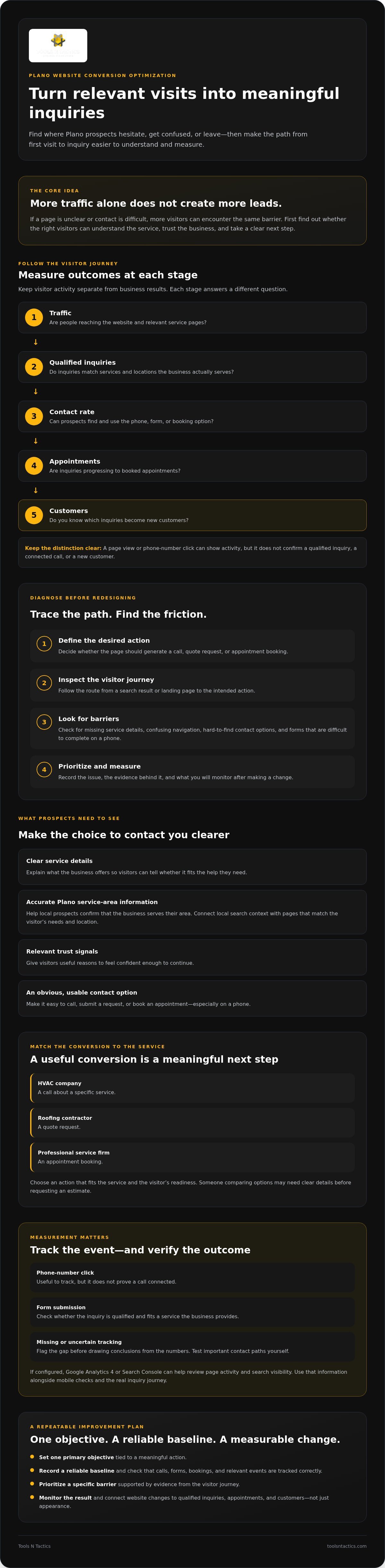
Track the stages separately: traffic, qualified inquiries, contact rate, appointments, and customers. If traffic is steady but qualified calls are scarce, the issue may be unclear service information or a hard-to-find contact option. If inquiries arrive but appointments don’t, the website may not be the only barrier. Follow-up and lead handling matter too.
What counts as a website conversion for a Plano service business?
A conversion depends on what the business wants a ready prospect to do. An HVAC company may want a call about a specific service. A roofing contractor may prioritize a quote request, while a professional service firm may prefer an appointment booking. Match the action to the service and the visitor’s readiness. Someone comparing options may need clear details before they’re ready to request an estimate.
Count meaningful inquiries, not every interaction as a lead. A phone-number click is useful to track, but it doesn’t prove a call connected. A form submission needs enough context to assess whether the person needs a service the business provides. These distinctions make reports more useful for business decisions.
Is more website traffic the answer to low lead volume?
Not by itself. More visits can help when they come from people looking for the services and locations the business actually serves. But increasing traffic to a page that doesn’t explain the offer or make contact easy can send more people into the same dead end.
Picture a Plano homeowner searching for an air-conditioning repair company. They land on a generic page that lists several services but doesn’t clarify whether the company serves Plano or how to request help. The visitor may leave to compare another provider. Clear service details, accurate service-area information, relevant proof, and an obvious next step give that prospect a stronger reason to continue.
Conversion optimization makes the next step clearer and easier for the right visitors to take. Start there before deciding whether the barrier calls for better messaging, stronger trust signals, simpler contact options, or more qualified visibility.
How to Diagnose Plano Website Conversion Problems Before Changing the Design
Start with evidence, not a new color palette. A useful plano website conversion optimization audit follows the visitor’s path from finding a page to contacting the business, then checks where the journey breaks down. Work through these steps in order:
- Define the desired action. Decide whether the page should generate a call, quote request, or appointment booking.
- Inspect the journey. Follow the path a prospect takes from a search result or landing page to that action.
- Look for friction. Check for missing service details, confusing navigation, hard-to-find contact options, or forms that are difficult to complete on a phone.
- Prioritize and measure. Record the issue, the evidence behind it, and what you’ll monitor after making a change.
Review high-intent service pages closely. A visitor looking for a specific repair or estimate may need to confirm the service is offered, the company serves their area, and how to get in touch. Compare those needs with what the page actually answers. If the answers are buried or missing, that’s a more useful diagnosis than “the site feels dated.”
Which website signals help reveal where leads are lost?
Check whether calls, form submissions, appointment bookings, and relevant thank-you events are tracked and recorded correctly. If Google Analytics 4 or Search Console is installed and configured, use its data to review page activity and search visibility. Check mobile usability too, and test important contact paths yourself. A tracked phone-number click doesn’t prove that a call connected, and a form event doesn’t prove that the inquiry was qualified.
Separate what you can observe from what you suspect. If calls aren’t tracked or form events are missing, flag that gap before drawing conclusions from the numbers. For search visibility, a free SEO audit can help surface issues to consider alongside the on-site journey.
How should a business prioritize conversion fixes?
Rank each issue by its likely effect on visitors, the strength of the evidence, and the effort needed to address it. Fix a broken form or unclear contact path before spending time on a minor visual detail. Then make one focused change and review the same relevant signals again, so you can assess whether the adjustment helped.
Tracking must come before confident optimization, because you can’t reliably improve a result you can’t measure. If the diagnosis points to gaps in conversion tracking or the visitor journey, Tools N Tactics can discuss its conversion optimization support as part of a connected visibility-to-lead system.
Which Website Changes Help Plano Prospects Trust You and Take Action?
Once you know where visitors hesitate, make the page answer their questions in the order they’re likely to ask them. A high-intent service page should quickly clarify what you do, who the service is for, whether you serve the prospect’s area, and how to take the next step. If a Plano homeowner is looking for roof repair, a page that only says “quality service” leaves key questions unanswered.
What should a high-intent service page make clear?
Be direct about the service, the customers it fits, and the locations covered. Then explain what a prospect can expect when requesting an estimate or appointment. Keep each claim specific and verifiable. Describe the actual steps in your process instead of relying on broad promises such as “the best service in town.”
Use proof that helps a visitor assess the decision: relevant reviews, credentials the business holds, accurate project examples, and clear service details. Keep the evidence current and genuine. A review about one service may not reassure someone considering another, so place proof near the related service or decision point.
Make the call to action specific and easy to spot. “Request a roofing estimate” tells visitors what happens next more clearly than “Learn more.” The button or link should lead to the action it promises, without surprise steps or unnecessary fields. For focused landing-page guidance, see the Plano landing page design guide.
How do mobile usability and trust affect contact decisions?
Check the page on a phone, not just a desktop screen. Service details should be readable, contact actions easy to tap, and forms straightforward to complete. If a visitor has to pinch, zoom, or hunt through menus to find the phone number, the page adds friction at the moment they’re deciding whether to reach out.
Place proof where it supports a choice, but don’t crowd the page with repeated badges, long testimonial blocks, or pop-ups that interrupt reading. Avoid vague buttons and unsupported guarantees. A clear service promise, credible evidence, and a simple next step work together. Any one of them is weaker when the others are missing.
Effective plano website conversion optimization isn’t about adding more persuasive language. It’s about making the page relevant, credible, and easy to act on. If you want help assessing that path, you can discuss conversion optimization with Tools N Tactics.
Website Conversion Optimization for Plano Searchers
Local relevance should help visitors recognize that a business fits their need, not just repeat a city name. Compare a generic service page that lists several services with one that clearly names the service, confirms accurate Plano-area coverage, and answers practical questions about what happens next. The second page gives a local prospect more useful context before they decide to call or submit a request.
How should service businesses reflect Plano search intent?
Start with verified details. Name the services you provide and the locations you actually serve. Explain relevant parts of your process, who the service is for, and how prospects can ask a question or request an estimate. If you use project examples or reviews, make sure they’re genuine and relevant to the service described.
A location page should offer value beyond swapping in “Plano” wherever another city name appeared. Thin, repetitive pages can frustrate visitors because they don’t answer local questions or help them judge whether the business is a good fit. Build a page only when you can provide useful service-area information, accurate business details, or examples that add real context.
Local discovery and choosing a provider are related, but they aren’t the same step. A Google Business Profile or search result may help someone find your company. The website still needs to explain why your service fits their need, establish trust with supportable proof, and make the next action clear. Keep your business name, contact details, service descriptions, and coverage consistent across the profile and website.
How do website, local visibility, and follow-up work together?
Think of the path as one connected system: a Plano prospect finds your business through local search, lands on a relevant service page, and sees a clear way to contact you. After the inquiry, organized lead routing and timely follow-up help ensure the request reaches the right person and doesn’t stall. A strong page can make contact easier, but it can’t replace a workable process for responding.
Review the whole path, not just the landing page. Does the search listing lead to a page that matches the service? Does the contact action work? Does the inquiry reach someone who can respond? A gap at any point can weaken the result.
Tools N Tactics’ Conversion Engine overview describes conversion work as part of a connected growth system. If you’re ready to review how your local visibility, website journey, and lead follow-up fit together, talk with Tools N Tactics about your conversion path.
Build a Measurable Plano Website Conversion Optimization Plan
Improvement becomes more reliable when each change has a clear purpose and a way to review its effect. For plano website conversion optimization, begin with one primary business objective, such as generating more qualified estimate requests from a key service page. Then establish what you can trust in your current data. If calls or forms aren’t tracked consistently, record that limitation before using the numbers as a baseline.
What should a practical website optimization plan include?
Keep a simple record for each proposed change. Note the intended audience, page goal, available baseline, observed friction, planned adjustment, and person responsible. For example, if a service page receives inquiries but prospects often ask whether a specific service is available in Plano, clarify the service and coverage details. That change has a defined reason and a result the team can review.
When practical, make one clearly defined change at a time. Review the relevant signals afterward, such as qualified inquiries, completed forms, connected calls, or appointment requests. Page views and button clicks provide context, but they don’t show whether the business received a suitable lead or followed up effectively.
Keep a record of what happened and what you learned. If several changes go live together, tracking is incomplete, or inquiry volume is limited, you may not be able to identify what caused a change in results. Treat the evidence carefully. A useful plan improves decisions, not just reports.
When should a business bring in a conversion partner?
Outside support may help when analytics, page messaging, website changes, and lead follow-up need to work together. A conversion partner can connect the diagnosis to implementation and measurement while considering how inquiries move into CRM, lead routing, or follow-up workflows. The aim is a coordinated process, not a series of disconnected design edits.
Tools N Tactics’ Growth Partner Program connects Visibility, Conversion, and Authority Engines. That structure recognizes that local discovery, a persuasive website journey, and credible business information all play a role in turning search interest into qualified inquiries. Learn more about the integrated Growth Partner Program.
A good next step is a focused conversation about your business objective, the data you can rely on, and the barriers you’ve already identified. Discuss a conversion plan with Tools N Tactics to explore whether its approach fits your goals and what to address first.
Turn Your Plano Website Into a Clearer Lead Path
More traffic isn’t the goal if the right visitors can’t tell what you offer, trust your business, or find a clear way to contact you. Strong plano website conversion optimization starts with diagnosing friction, making useful changes, and measuring qualified inquiries rather than relying on page views alone.
Keep the work tied to business outcomes. Set a clear objective, use the most reliable baseline data available, and improve the full journey from local discovery to follow-up. Calls and forms are only the start. Lead routing and timely follow-up help ensure inquiries have a clear next step.
Tools N Tactics connects Visibility, Conversion, and Authority Engines through its Growth Partner Program. Its capabilities include conversion optimization, analytics setup, CRM, lead routing, and follow-up automation, supporting a coordinated approach rather than isolated design changes.
Discuss a measurable website conversion plan with Tools N Tactics to explore your goals, current barriers, and practical next steps. With a clear process and useful data, you can keep improving the path from local visitor to qualified inquiry.
Frequently Asked Questions
What is website conversion optimization for a local business?
Website conversion optimization improves the path from a relevant visit to a meaningful action, such as a qualified call, quote request, or appointment booking. For a local service business, that can mean clarifying which services you provide, where you work, and how prospects can contact you. The goal isn’t simply more clicks. It’s to make it easier for suitable customers to take the next step.
How can I improve my Plano business website conversion rate?
Start by checking where the visitor journey creates uncertainty or effort. A practical plano website conversion optimization review might uncover a hard-to-find phone number, a form that’s awkward on mobile, or a service page that doesn’t explain whether the business serves Plano. Prioritize fixes based on evidence, then track qualified calls and inquiries to see how the changes affect the lead process.
Do I need a new website to improve conversions?
Not necessarily. First check whether your current website can support clear service information, trustworthy proof, simple contact options, and reliable conversion tracking. If it can, targeted updates to messaging, page structure, or forms may address the barrier without replacing the whole site. A larger rebuild may be worth considering if the site can’t support essential changes, but diagnose the problem before committing to a redesign.
What should I track to measure website conversions?
Track actions tied to real inquiries, including calls, completed forms, and appointment requests. Where possible, distinguish a click on a phone number from a connected call, and a form submission from a qualified inquiry. Also review which pages and channels contributed to those actions. Analytics data is only useful if tracking is configured correctly, so identify gaps before treating reported activity as a reliable business result.
How does local SEO affect website conversions in Plano?
Local SEO can help nearby prospects discover your business, while relevant website pages help them decide whether to contact you. For a North Texas business serving Plano, Dallas, Celina, Princeton, Melissa, Sherman, or Frisco, list only confirmed services and service areas. Align your business details across local listings and the website, then give each visitor a useful page that matches their service need and location.
Can website follow-up automation help convert more inquiries?
Follow-up automation can help route inquiries and support timely, organized responses after someone calls or submits a form. For example, a CRM workflow may record the request and direct it to the person responsible for responding. Automation supports the process, but it doesn’t replace clear ownership, accurate contact details, or a relevant response. Review how leads move from the website into your team’s follow-up workflow.
How long does website conversion optimization take?
There’s no fixed timeline. It depends on how quickly you can identify the main barrier, implement a change, and collect enough reliable information to assess it. Tracking gaps may need attention before results can be interpreted. Some improvements may be straightforward, while broader changes across pages, analytics, and follow-up require coordination. Treat optimization as a repeatable process, not a one-time redesign with a guaranteed finish date.