
What if automation made the customer experience feel more personal, not less? For many service businesses, the problem isn’t a lack of technology. It’s a missed call after hours, a web inquiry waiting in an inbox, or a lead that never makes it into the CRM. AI solutions for customer engagement can help close those gaps when they fit the questions customers actually ask and connect each conversation to a clear next step.
A chatbot or voice agent can frustrate customers if it blocks access to a person or gives a generic answer. The answer isn’t to automate every interaction. Give routine questions and follow-up a clear path, while making it easy for a person to take over when a situation calls for judgment or personal attention.
This article compares chatbots, AI voice agents, and connected automations using a practical framework: customer needs, business bottlenecks, routing, follow-up, and escalation. You’ll see how to choose a setup that supports timely engagement without leaving conversations stranded across phone, chat, and CRM systems. Automation should connect the work, not add another disconnected tool.
Key Takeaways
- Choose an engagement tool based on where customers reach out and which questions or tasks keep repeating.
- AI solutions for customer engagement work best when conversations connect to CRM records, lead routing, and follow-up workflows.
- Compare chatbots, voice agents, and messaging automations by their strengths, limits, and need for human handoff.
- Set clear goals and escalation rules before implementation, then plan for data ownership, reporting, and workflow maintenance.
- A connected system can bring AI tools and staff together while preserving human judgment for situations that need personal attention.
Why AI customer engagement needs more than a website chatbot
A homeowner calls a Dallas-area HVAC company while the office team is helping another customer. Later, the homeowner submits a website form about a system that isn’t cooling. If calls and forms sit in separate queues, the inquiry can be overlooked, or staff may have to piece together the details. A chatbot can answer a website question, but it won’t connect every conversation to the next step on its own.
AI customer engagement uses AI to support customer conversations, route inquiries, and coordinate follow-up across channels. It’s a connected process, not just a website feature. When inquiries are missed or follow-up is inconsistent, a business can lose opportunities, weaken customer confidence, and spend more staff time tracking down details.
AI is used across customer experience in different ways, from chatbots to generative tools, as described in this overview of AI in customer experience. For service businesses, the practical question is which tools fit real customer needs and the team’s process.
Where service businesses lose momentum in customer conversations
Calls, website forms, chats, and text messages can each create a separate queue. Consider a North Texas contractor receiving a phone inquiry while the team is on a job, followed by a website request that lands in another inbox. Without clear ownership and routing, staff may not know who should respond or which details have already been collected.
That gap can leave customers unsure whether their request was received. If they have to repeat information, confidence can fade before the service conversation gets underway. A connected process gives staff a clearer view of the inquiry, its history, and the action still needed.
What AI customer engagement includes
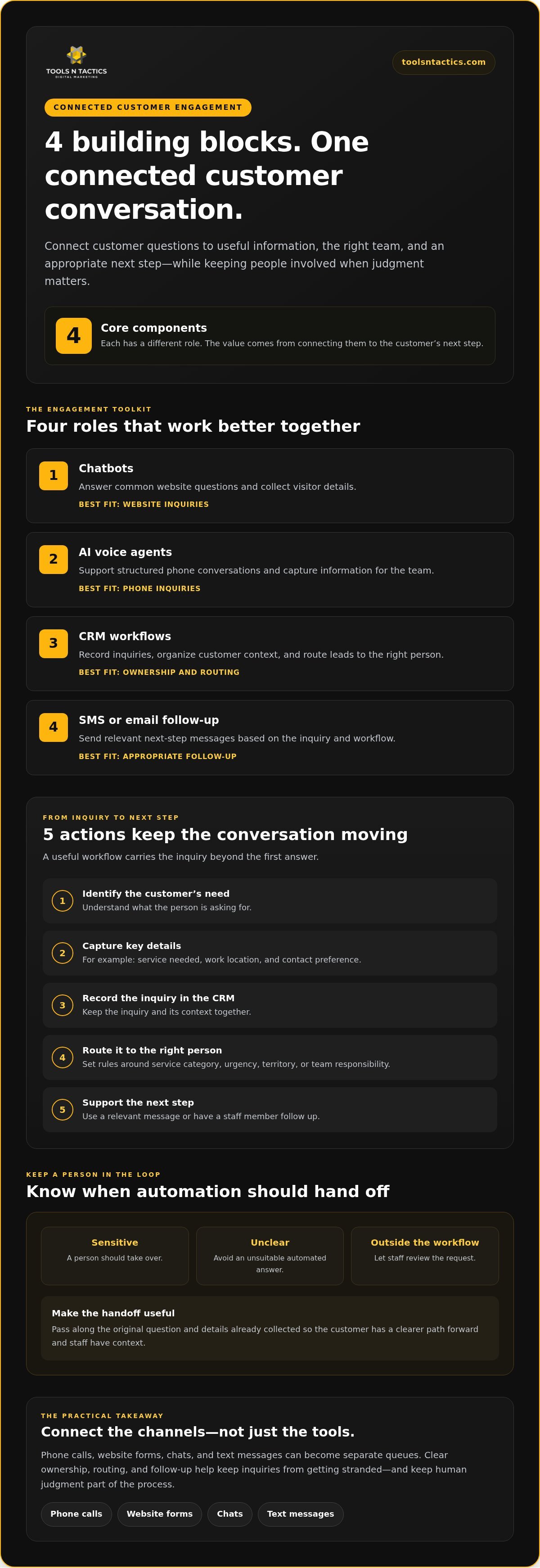
AI solutions for customer engagement can combine several tools, each with a specific role:
- Chatbots answer common website questions and collect visitor details.
- AI voice agents support structured phone conversations and capture information for the team.
- CRM workflows record inquiries, organize customer context, and route leads to the right person.
- SMS or email follow-up sends relevant next-step messages based on the inquiry and workflow.
Automation should support staff, not replace judgment. It can handle routine intake or pass along useful context, while a person takes over when a situation is sensitive, unclear, or calls for personal attention. A customer follow-up and routing workflow connects conversations to action while keeping people involved where they matter most.
How AI engagement connects conversations to the next business action
A useful engagement workflow carries an inquiry beyond the first answer. It identifies what the customer needs, captures key details, records them in the CRM, routes the request, and supports appropriate follow-up. A connected engagement workflow links customer intent, captured information, CRM records, lead routing, and follow-up messages so each inquiry has a defined next step. That structure helps teams manage conversations consistently, but it doesn’t guarantee a particular business result.
From first question to qualified lead routing
An AI assistant can ask which service the customer needs, where the work is located, and how they prefer to be contacted. Routing rules can then direct the inquiry by service category, urgency, territory, or team responsibility. Before launch, decide which answers are required and who owns each route. Clear rules help staff take over with useful information already in hand.
Scenario: A homeowner submits a request about a leaking roof. The assistant captures the service type, property location, and contact preference. The CRM records the inquiry, and the workflow routes it to the responsible team. If the request falls outside the usual process, staff can review it rather than relying on an unsuitable automated response.
Human handoffs, follow-up, and customer context
Requests that are sensitive, unclear, or outside the workflow should move to a person. Staff can handle them more effectively when the handoff includes the original question and information already collected. That context helps avoid asking the customer to repeat details and gives the team a clearer starting point.
SMS or email automation can support a next step, such as acknowledging an inquiry or requesting information needed to continue. The message should match what has actually happened and avoid suggesting a staff member has reviewed the request if they haven’t. The Automation Engine overview explains how Tools N Tactics connects conversations with CRM workflows, lead routing, and follow-up automation.
AI can also support personalization and data-informed decisions in marketing, as discussed by Harvard Division of Continuing Education in its overview of AI’s role in marketing. For service businesses, the practical priority is to turn useful customer information into clear actions while keeping human oversight in the process.
Tools N Tactics can help map the handoffs and follow-up in your workflow. Learn more about Tools N Tactics’ customer engagement services.
AI chatbots, voice agents, or automations: which solution fits?
There isn’t one best tool for every service business. A website chatbot helps with web inquiries, a voice agent supports phone conversations, and CRM or messaging automation keeps leads organized and follow-up moving. The right mix depends on where customers contact you, which tasks repeat, how much capacity your team has, and what customers expect from the interaction.
Quick fit: Use a chatbot for common website questions and lead capture, a voice agent for structured phone inquiries, and CRM or messaging automation to manage ownership and next steps. These AI solutions for customer engagement can work alone, but they’re more useful when customer context carries from one system to another.
| Solution | Customer channel | Best-fit task | Strengths | Limits | Handoff need |
|---|---|---|---|---|---|
| AI chatbot | Website chat | Answer common questions, capture inquiry details | Lets visitors share information through a chat interface | Can’t resolve every question or replace a full service conversation | Route unusual, sensitive, or detailed requests to staff |
| AI voice agent | Phone | Handle structured, repeatable call inquiries | Supports call intake and information gathering | May struggle with unclear requests or conversations that need judgment | Offer a path to a person when the call goes beyond its role |
| CRM or messaging automation | CRM, SMS, or email | Track lead ownership and send relevant next-step messages | Organizes inquiry status and supports consistent follow-up | Depends on clear workflows and useful customer information | Assign staff responsibility for review and personal follow-up |
When a chatbot or AI voice agent makes sense
A chatbot can handle recurring website questions, collect initial details, and capture a lead for the team. A voice agent may fit calls that follow a clear intake pattern, such as identifying a service request and gathering contact information. Set a boundary: if the customer is upset, the request is unclear, or a decision needs human judgment, transfer the conversation rather than stretching the automation. Before choosing either tool, list the common questions it should handle and the situations that require a person.
When CRM and follow-up automation matter more
Prioritize CRM workflows when inquiries lack clear ownership or staff can’t easily track their status. SMS or email automation can support a consistent next step, such as acknowledging an inquiry or requesting missing details, using information already recorded in the workflow.
A standalone chatbot can collect a name and question, but without a connection to routing and follow-up, staff may still need to find and act on that inquiry manually. Tools N Tactics’ Automation Engine connects customer conversations with CRM services, lead routing, and follow-up automation, while keeping staff involved where personal attention is needed.
How to evaluate AI customer engagement before implementation
Choose a workflow before choosing a tool. Start with a customer problem you can describe clearly, such as repeat questions that take staff away from scheduling or inquiries that reach the wrong team. Then decide what the system should handle, what information it must capture, and when a person should take over. This keeps AI solutions for customer engagement tied to business needs instead of features alone.
Questions to answer before choosing an AI solution
Use this checklist to set the operating rules:
- Goals and channels: Which customer interactions should improve, and do they start by phone, website, SMS, or email?
- Repeatable tasks: Which questions have clear, consistent answers that can be automated safely?
- Lead ownership: Who receives new inquiries, and who handles requests that don’t fit the usual path?
- Handoff details: What does staff need before taking over, such as service type, location, contact preference, or the conversation history?
- System fit: Can the workflow connect with your CRM, preserve useful context, and support clear records of lead status?
- Data and upkeep: Who controls customer information, who can access it, and who will review responses and maintain the workflow as services or processes change?
Set firm boundaries for automated replies. Routine questions may have an approved response, while sensitive, unclear, or out-of-scope requests should move to a person. Customers should have a clear way to ask for human help. Document these rules before launch so automation doesn’t improvise beyond its role.
How to measure engagement without chasing vanity metrics
Measure whether the workflow works for your business, not whether it beats an unsupported industry benchmark. Record a baseline before implementation, then compare the same measures over time. Useful measures include whether inquiries receive a clear next step, whether they reach the right team, how many are qualified, whether follow-ups are completed, and which situations need escalation.
Review the reasons behind the numbers. If staff often correct captured details, the intake questions may need work. If customers ask for a person at a particular step, adjust the handoff. Customer feedback can reveal friction that activity counts alone miss. Keep reporting tied to lead quality and process reliability, not just chatbot sessions or message volume.
A practical evaluation covers the whole path from customer question to staff action. Tools N Tactics can help map the goals, CRM fit, routing rules, and measures for your workflow. Read about Tools N Tactics’ approach to customer engagement workflows.
Build a connected customer engagement system with Tools N Tactics
Customer engagement works best as a system, not a collection of separate tools. Tools N Tactics helps service businesses plan and connect AI voice agents, chatbots, CRM services, lead routing, and SMS or email follow-up around the way customers actually reach out. The goal is to support qualified lead handling, customer trust, and smoother operations without removing human judgment or promising a specific result.
As an advisor and implementation partner, Tools N Tactics looks beyond whether a chatbot can answer a question. The work starts with the customer journey: where inquiries begin, what information staff need, and how each request should move toward a useful next step. The Growth Partner Program brings that broader strategic approach to business growth.
Connect AI tools to the customer journey
A local service business may attract customers through search, receive inquiries through its website or phone, and manage leads in a CRM. Those touchpoints should work together. Visibility helps customers find the business. Conversion tools support the next step, such as making an inquiry. Automation can then help route the request and organize follow-up.
For example, a North Texas contractor might receive a website inquiry while another customer calls the office. A connected process can capture the customer’s details, place the inquiry in the CRM, and direct it to the responsible team. Staff can then pick up the conversation with the relevant context. Tools N Tactics’ Conversion Engine focuses on turning customer interest into a clear next step, while connected AI solutions for customer engagement help carry that inquiry through the process.
Plan the next step around the real bottleneck
Don’t add tools everywhere at once. Start with one measurable problem, such as phone inquiries without clear ownership or web leads that lack a consistent follow-up process. Map how those inquiries arrive, identify where they stall or lose context, and design the routing and human handoff before selecting or expanding automation.
That practical sequence keeps the system tied to customer needs and staff capacity. It also gives the team a clear way to review whether inquiries reach the right person and receive an appropriate next step. Tools N Tactics helps service businesses build connected customer engagement workflows as part of its Growth Partner Program.
Make your next customer conversation count
The right AI solutions for customer engagement depend on where inquiries get stuck, not on which tool is newest. A chatbot can support website questions, a voice agent can assist with structured calls, and CRM workflows can connect captured details to lead routing and follow-up. Set clear handoff rules so staff can step in when a conversation needs judgment or personal attention.
Tools N Tactics brings these pieces together through AI voice agents, chatbots, custom automations, CRM services, lead routing, and SMS or email follow-up. The focus is a connected process that supports qualified lead handling, customer trust, and smoother operations, without removing people from the conversations that matter.
For service businesses across North Texas, including Plano, Dallas, Celina, Princeton, Melissa, Sherman, and Frisco, start with one bottleneck, map the next step, and build from there. Talk with Tools N Tactics about a customer engagement workflow for your business.
Frequently Asked Questions
What are AI solutions for customer engagement?
AI solutions for customer engagement use tools such as chatbots, voice agents, CRM workflows, and automated messages to support customer conversations and follow-up. They help move an inquiry from first contact to a clear next step, with staff stepping in when judgment is needed. For a North Texas contractor serving Dallas, Plano, Celina, Princeton, Melissa, Sherman, or Frisco, that could mean connecting a website question to lead routing and a relevant follow-up.
Can AI improve customer engagement for a small service business?
Yes, AI can support a small service business by organizing routine inquiries and helping staff follow a consistent process. For example, a home service company in Plano might use a chatbot to collect a customer’s service type and location, then pass those details into its CRM. The value depends on whether the workflow solves a real bottleneck. Automation should support customer care, not promise a particular number of leads or conversions.
Which is better for customer engagement: an AI chatbot or an AI voice agent?
Neither is universally better. A chatbot fits website conversations, such as answering common questions or collecting inquiry details. A voice agent fits structured phone intake, such as identifying a service request and capturing contact information. A Dallas business should consider which channel customers use and what its team can support. If a conversation becomes sensitive, unclear, or requires judgment, the system should make a human handoff straightforward.
How does AI connect to a CRM for customer follow-up?
An AI tool can capture details from a customer conversation and pass them into a connected CRM workflow. The CRM can store the inquiry, show its status, and route it to the responsible team. A follow-up workflow may then send an appropriate SMS or email based on the information collected. For a Frisco service business, preserving the original question and contact details helps staff continue the conversation without asking the customer to start over.
Will AI customer engagement replace human customer service?
AI customer engagement should support human service, not replace the judgment and personal attention people provide. Automation can handle routine intake or gather details, while staff take over when a customer has a complex question, a sensitive concern, or a request outside the workflow. North Texas businesses can set clear escalation rules so customers know how to reach a person and employees receive useful context before responding.
How do I measure whether AI customer engagement is working?
Measure whether inquiries receive a clear next step, reach the right team, and receive planned follow-up. Track qualified inquiries, completed follow-ups, handoffs to staff, and common reasons for escalation. Set a baseline using your own process before making changes, then compare the same measures over time. A business in Sherman can also review customer feedback and staff notes to spot friction that raw conversation counts won’t explain.
What should a service business automate first?
Start with a repeated task that has clear steps and creates friction for customers or staff. That might be collecting basic details from web inquiries, routing requests by service type, or sending a relevant follow-up message. A contractor serving Melissa or Princeton should first map who owns each inquiry and what exceptions need human review. Automate one workflow, check whether it works as intended, and adjust before expanding it.