
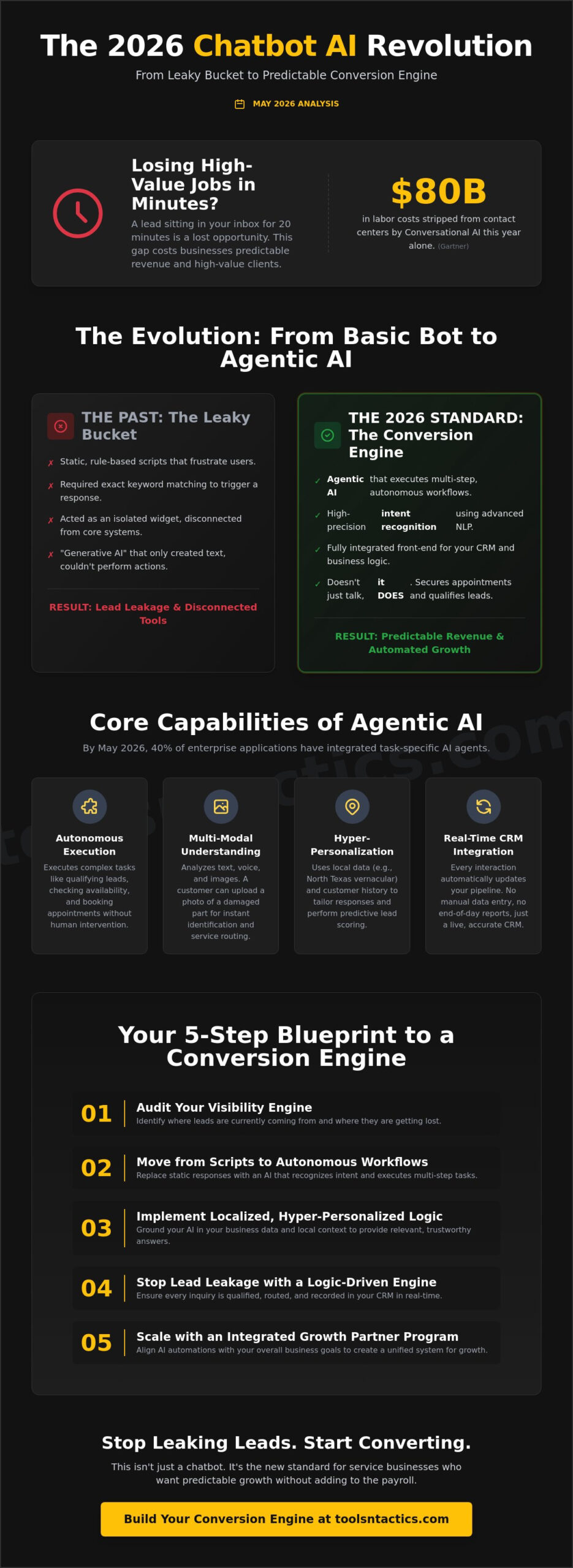
Why are you still losing high-value jobs because a lead sat in your inbox for twenty minutes? In May 2026, the gap between a basic script and a strategic chatbot ai is the difference between a leaky bucket and a predictable revenue stream. Gartner estimates that conversational AI will strip 80 billion dollars in labor costs from contact centers this year alone. You likely feel the frustration of disconnected marketing tools and the skepticism that AI sounds like a cold, lifeless machine. We’ve moved past that era.
Today, agentic AI models like GPT-5.5 Instant and Claude Opus 4.7 don’t just answer questions; they execute complex workflows and secure appointments. You’ll discover how the latest trends in chatbot AI are transforming lead conversion for service businesses and how to build a predictable growth system that functions as a true Conversion Engine. We’ll break down the shift toward per-resolution pricing and the new regulatory landscape, including California’s SB 243, to ensure your automated engagement feels human, stays compliant, and increases your conversion rates without adding a single person to your payroll.
Key Takeaways
- Move from basic scripts to a sophisticated chatbot ai that recognizes intent and executes multi-step workflows autonomously.
- Discover how Agentic AI uses multi-modal capabilities and local reputation insights to provide hyper-personalized experiences for your prospects.
- Identify the critical mistakes generic bots make in North Texas markets and why local geography is vital for effective lead routing.
- Follow a five-step blueprint to audit your Visibility Engine and build a logic-driven Conversion Engine that stops lead leakage.
- Learn to scale by integrating AI automations into a Growth Partner Program that aligns every gear of your business system.
What is Chatbot AI in 2026? Defining the New Standard
The era of the “clippy” style pop-up is dead. In 2026, chatbot ai has evolved from a static script into a sophisticated neural network built for high-precision intent recognition and autonomous task execution. We’ve moved beyond the primitive rule-based logic of the early 2020s, where a user had to guess the exact right keyword to trigger a helpful response. Today’s systems leverage advanced Large Language Models (LLMs) to interpret the subtle nuances of human conversation, allowing for a fluid interaction that feels less like a machine and more like a trained coordinator.
A critical distinction exists between the “Generative AI” that dominated headlines in 2023 and the “Agentic AI” we deploy today. While Generative AI is primarily focused on writing clever text or summarizing documents, Agentic AI is focused on doing. It doesn’t just offer information; it executes multi-step workflows across your business software. Understanding What is a Chatbot? in this new era requires looking past the chat bubble to the logic engine behind it. In 2026, chatbot AI is an autonomous system that manages the entire lead lifecycle from initial inquiry to final booking.
The Core Technology: LLMs and NLP
Natural Language Processing (NLP) has advanced significantly since the initial AI hype cycle. Modern models like GPT-5.5 Instant, released May 4, 2026, and Claude Opus 4.7 process information with near-zero latency. These systems understand North Texas context and local vernacular; they know how to handle specific service requests for homeowners in Plano or businesses in Frisco without missing a beat. By using Retrieval-Augmented Generation (RAG), these bots pull data directly from your specific business blueprints. This ensures every answer is factual, localized, and grounded in your actual service offerings rather than generic training data. It’s the difference between a bot that guesses and a system that knows.
Why Businesses are Moving Toward “Engines”
Service businesses are ditching isolated widgets in favor of integrated Conversion Engines. This isn’t just a “customer support” tool anymore. It’s a revenue generation system. Your chatbot ai now acts as the high-speed front-end for your CRM and lead routing architecture. It qualifies leads, checks your real-time availability, and pushes data directly into your pipeline. This shift moves your business from the frustration of disconnected tools to the security of a predictable lead flow. We build these systems to ensure your marketing isn’t just existing; it’s actively converting traffic into high-value jobs. The emotional focus has shifted from merely answering questions to securing the bottom line through structural integrity and automated precision.
2026 Trends: The Rise of Agentic AI and Autonomous Lead Routing
The landscape of chatbot ai has shifted from passive interaction to active orchestration. By May 2026, 40% of enterprise applications have integrated task-specific AI agents into their core operations. These aren’t just chat boxes; they’re multi-modal engines capable of switching between text, voice, and image analysis instantly. If a customer in Plano uploads a photo of a damaged HVAC unit, the system analyzes the image, identifies the part, and checks your inventory before a human ever sees the ticket. This seamless transition across media types removes the friction that typically kills a sale.
Hyper-personalization is no longer a luxury for service businesses. Modern systems ingest local reputation data and previous customer history to tailor every response. They know if a lead is calling from a neighborhood where you’ve recently completed high-value jobs. This allows for predictive lead scoring. The system identifies which leads are most likely to convert based on historical data, ensuring your team focuses on revenue rather than chasing noise. This level of improving customer experience with AI turns a simple inquiry into a structured business asset.
Real-time CRM integration is the final piece of the 2026 standard. Every interaction updates your pipeline automatically. You don’t have to wait for an end-of-day report or manual data entry. Your Conversion Engine handles the logistics so you can focus on the technical work. If you want to see how these tools fit into a larger strategy, our Growth Partner Program aligns these automations with your overall business goals.
From Chatting to Executing
Speed to lead is now measured in milliseconds. In 2026, waiting five minutes for a response is an invitation for your competitor to take the job. Agentic AI doesn’t just “talk” about booking; it connects directly to your calendar and secures the appointment. We’ve integrated AI voice agents with text-based chatbots to create a unified experience. A customer can start a chat on your website and finish the booking over a voice-synthesized call without repeating their information once. It’s a frictionless pipeline designed for maximum conversion.
The End of the “Robotic” Bot
The frustration of robotic, repetitive responses is a relic of the past. New emotional intelligence (EQ) models detect customer sentiment in real-time. If a user is frustrated, the bot shifts its tone or escalates to a human instantly. Brand-specific voice profiles ensure the AI sounds like your company, not a generic template. Security is also a top priority. With regulations like California’s SB 243 and the federal “Take it Down Act” active as of May 19, 2026, our systems prioritize transparency and data privacy. Your customers get the speed they want with the security they require.
Why Generic Chatbots Fail North Texas Service Businesses
In the competitive North Texas landscape, your response time is your reputation. If your chatbot ai is a generic, off-the-shelf product, it likely ignores the local geography that defines your business. A lead in Plano has different expectations than one in Frisco; a bot that can’t distinguish between these service areas creates immediate friction. Most basic tools often hallucinate pricing or service windows because they aren’t anchored to your specific business blueprint. This lack of precision makes you look like every other contractor in Dallas. You lose high-value jobs because your system lacks the structural integrity to hold a lead’s interest while you’re out in the field.
Generic bots also operate in a vacuum, completely disconnected from your reputation. If your automation can’t reference your local five-star reviews or project history, it isn’t helping you convert. It’s just a distraction. We’ve seen businesses settle for “chat” when they should be demanding a Conversion Engine. When a system guesses instead of knowing, it doesn’t just fail to close the lead; it actively damages the authority you’ve worked hard to build through your SEO and local presence.
The Problem with Disconnected Marketing
Disconnected marketing is a silent profit killer. You spend money on SEO services to drive traffic, but if that traffic hits a bot that doesn’t talk to your CRM, you have a leaky bucket. A chatbot ai should be a primary gear in your business system, not a standalone widget. The shift to per-resolution pricing in 2026 means every failed interaction is a literal waste of capital. While a chatbot interaction costs between $0.50 and $0.70, a human support interaction can soar to $15. If your bot fails to convert because it’s disconnected from your strategy, you aren’t just losing a lead; you’re paying for the privilege of losing them. Local business owners need a Growth Partner who understands how these systems align, not just another software login to manage.
Localized AI: The Tools N Tactics Advantage
We don’t do “one size fits all” solutions. We train our AI on specific North Texas service area data. This isn’t abstract; it’s tactical. We integrate your reputation management directly into the conversion flow. When a prospect asks about your quality of work, the bot doesn’t just offer a platitude. It pulls a recent five-star review from a neighbor in their specific zip code. This builds instant authority through social proof. One Plano-based service business reclaimed 30% of their lost after-hours leads by switching from a generic tool to our localized Conversion Engine. To understand exactly how this kind of AI chatbot for service business Plano transforms lead conversion in practice, our 2026 case study walks through the mechanics step by step. If you want to see how the top options stack up for your market, our AI chatbot for home service businesses Plano comparison guide breaks down the leading platforms side by side. We move the needle from the frustration of missed calls to the security of a predictable lead flow through structural integrity and local expertise.
Implementing a Conversion-First AI Strategy: A 5-Step Blueprint
The third step is deep integration. A standalone tool is a liability; a bot connected to your CRM and SMS follow-up automation is an asset. This ensures no lead falls through the cracks while your team is on a job site. Step four involves training the system on your unique brand voice and your specific “Toolbox” of services. We ensure the AI speaks your language and understands your specific service tiers. Finally, we implement a monitor and optimize phase. Using real-time tracking, we refine the system based on how North Texas homeowners actually interact with it. If you’re ready to stop guessing and start scaling, see how our Growth Partner Program builds these systems for you.
Mapping the Customer Journey
Success requires identifying high-intent questions that signal a ready-to-buy customer. We program the system to recognize these triggers and initiate an immediate booking sequence. Conversely, the AI handles low-value noise, such as “What are your hours?” or “Do you service my zip code?” This filtering keeps your human team focused on high-value sales calls rather than basic admin. When a high-value lead requires a personal touch, the system executes a seamless handoff, providing your team with the full transcript and lead context before they even pick up the phone.
Measuring Success Beyond the Click
Stop looking at “engagement” stats that don’t pay the bills. In 2026, success is measured strictly by revenue and pipeline health, not superficial clicks. We focus on three critical KPIs: Conversion Rate, Cost per Lead (CPL), and Pipeline Velocity. With an average chatbot interaction costing between $0.50 and $0.70 compared to a $15 human interaction, the ROI is measurable and immediate. By integrating your chatbot ai into a unified Automation Engine, you gain total visibility into your marketing spend. You’ll know exactly which tactics are driving profit and which are just creating noise.
Beyond the Bot: Scaling with the Growth Partner Program
A high-performance machine isn’t built from a single part. While a chatbot ai is a critical component for capturing leads, it’s ultimately just one gear in your business growth engine. If your Visibility Engine is driving traffic but your Conversion Engine is broken, you’re spinning your wheels. Tools N Tactics provides the structural integrity needed to scale by aligning your Visibility, Conversion, and Authority Engines into a single, unified system. We move you away from the disconnected marketing that plagues so many North Texas contractors and toward a no-guesswork model of predictable growth.
Investing in a tool gives you another login to manage. Investing in a partnership gives you an architect who ensures every part of your pipeline is optimized for revenue. We don’t just hand you a bot and walk away. We act as your Strategic Growth Partner, ensuring your technical SEO, local reputation, and AI automations work in perfect synchronization. This is how you win in a market as aggressive as Dallas-Fort Worth. You aren’t just buying software; you’re installing a revenue-focused blueprint designed to outperform the competition.
The Power of the Automation Engine
True scaling happens when your business is always on without you being always working. Our Automation Engine combines chatbot ai, AI voice agents, and automated SMS follow-up to create a 360-degree response system. By May 2026, the standard for service businesses has moved beyond simple text replies. We deploy custom-built AI architects that understand your brand’s unique voice and service toolbox. This ensures that whether a lead comes in at 2:00 PM or 2:00 AM, they receive a human-like, authoritative response that moves them toward a booking. You gain a massive competitive edge by responding in milliseconds while your competitors are still checking their voicemails.
Your Next Tactics: Getting Started
The digital landscape is moving fast. With 40% of enterprise applications already integrating task-specific AI agents as of early 2026, the window to gain an early-adopter advantage is closing. Now is the time to audit your lead routing systems and identify where you’re losing high-value jobs. Joining our Growth Partner Program isn’t about buying a service; it’s about installing a proven blueprint for long-term scaling. Don’t let another lead sit in your inbox for twenty minutes. Audit your business growth engine with Tools N Tactics today and start building a system that converts traffic into tangible outcomes.
Build Your Revenue Engine for 2026
The transition from basic scripts to autonomous agents is no longer a prediction; it’s a market reality. By May 2026, 40% of enterprise applications have integrated task-specific AI agents to handle complex business logic and multi-step workflows. If you’re still relying on a generic chatbot ai that doesn’t understand the difference between a lead in Plano and one in Frisco, you’re leaving high-value jobs to your competitors. We build systems that transform traffic into revenue using our proprietary Engine Framework.
Our North Texas roots mean we understand the local landscape better than any agency offering one-size-fits-all tools. We align your Visibility, Conversion, and Authority Engines to create a predictable lead flow that keeps your pipeline full while you focus on the work. It’s time to stop guessing and start scaling with a partner who values structural integrity and no-nonsense, revenue-focused results. Stop losing leads to competitors-Apply for the Growth Partner Program today. Your business deserves a growth system that works as hard as you do.
Frequently Asked Questions
What is the difference between a standard chatbot and AI chatbot in 2026?
Standard chatbots rely on rigid “if-then” logic; 2026 AI chatbots use Agentic AI and LLMs like GPT-5.5 Instant to execute complex workflows. Rule-based bots fail when a customer strays from a script. Modern agentic systems recognize intent and perform tasks like checking real-time inventory or booking appointments directly into your calendar without human intervention.
Can an AI chatbot really handle complex service requests for my Plano business?
Yes, modern systems use Retrieval-Augmented Generation (RAG) to access your specific business blueprints and North Texas service area data. Instead of providing generic answers, the bot pulls from your actual service history and local expertise. It recognizes specific Plano neighborhoods and technical requirements, ensuring much higher accuracy than the 2023 “hype” versions of AI. For a detailed breakdown of which platforms perform best for contractors in the area, see our 2026 comparison guide for AI chatbots serving Plano home service businesses.
How much does it cost to implement an AI chatbot for a small service business?
Basic SMB subscription models in May 2026 typically range from $30 to $150 per month, while custom builds start around $2,000. These figures are based on industry reports published in April 2026. Many platforms have shifted toward per-resolution pricing, meaning you pay for successful interactions rather than just a monthly seat or license fee.
Will an AI chatbot make my business feel less personal to my local customers?
No, 2026 emotional intelligence models prevent robotic interactions by detecting customer sentiment and using brand-specific voice profiles. By handling routine questions about hours or service areas, the chatbot ai frees your human team to focus on high-stakes, personal sales calls. It ensures your business stays “always on” without losing the neighborly reliability your customers expect.
How does chatbot AI improve my local SEO and Google Business Profile?
AI chatbots improve local SEO by increasing on-site dwell time and providing immediate answers that signal quality to search engines. When integrated with your Conversion Engine, these tools also automate review requests. This boosts your Google Business Profile visibility by generating consistent, fresh social proof from the specific North Texas zip codes you serve.
What happens if the AI chatbot makes a mistake or gives the wrong price?
We implement “Logic Blueprints” that act as structural guardrails to prevent hallucinations and pricing errors. If the AI detects a high-risk inquiry or pricing ambiguity, it executes a seamless handoff to a human team member. New regulations like the Colorado AI Act, effective June 30, 2026, also mandate “reasonable care” to ensure accuracy in high-risk interactions.
Do I need technical skills to manage an AI automation engine?
You don’t need technical skills when you work with a Strategic Growth Partner who manages the system’s structural integrity. We act as the architects of your Automation Engine, handling all CRM and SMS integrations. You focus on performing the high-value jobs while we ensure the technical gears of your pipeline are aligned for maximum revenue.
How long does it take to see an ROI from AI chatbot integration?
Most service businesses see a measurable ROI within 30 to 90 days of full implementation. Because a chatbot ai interaction costs $0.50 to $0.70 while human support ranges from $6 to $15, the labor savings are immediate. Combined with 24/7 lead capture, the system typically pays for itself by reclaiming jobs that would otherwise go to competitors. For a real-world look at how these numbers play out, our AI chatbot for service business Plano 2026 conversion case study documents the measurable outcomes from an actual North Texas implementation.