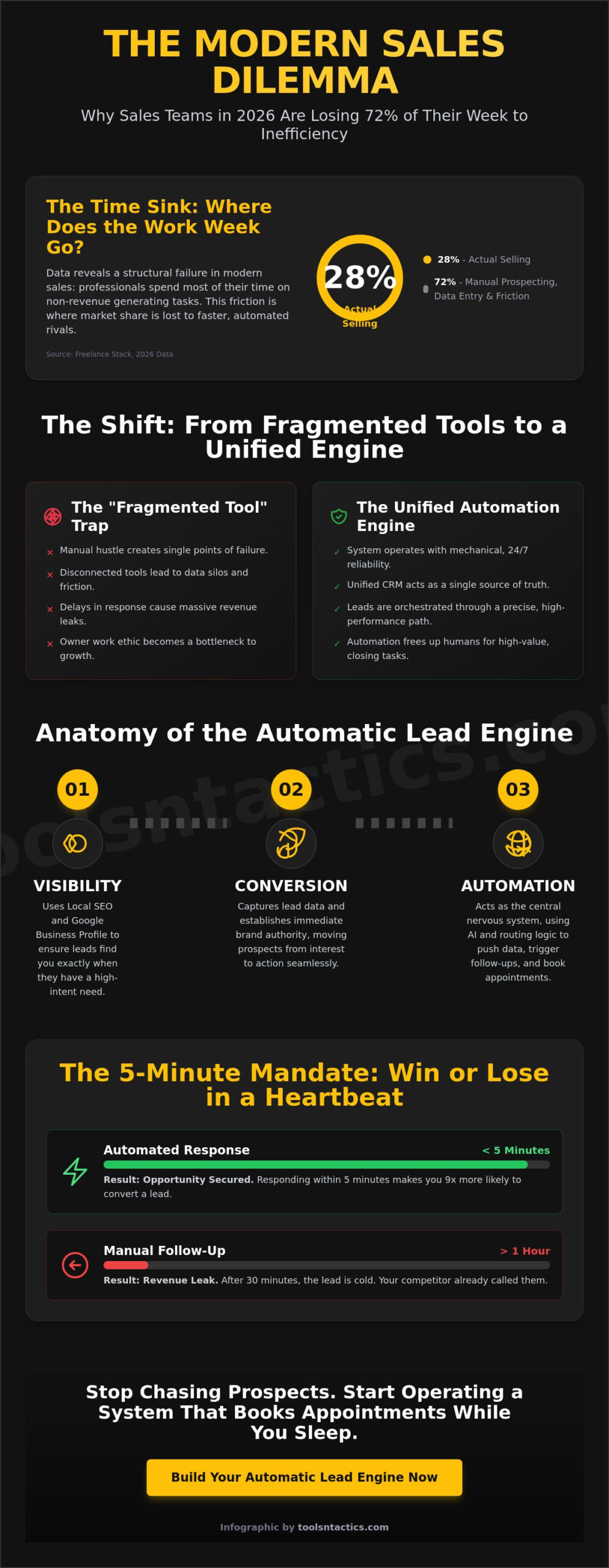
Sales professionals in 2026 spend only 28% of their workweek on actual selling, according to data from Freelance Stack. The rest of that time is swallowed by the friction of manual prospecting and data entry. If you’re a service provider in the Dallas-Fort Worth area, this inefficiency isn’t just a nuisance; it’s a structural failure that hands your market share to faster rivals. Building an automatic lead engine is no longer a luxury for the tech-savvy. It’s the mechanical foundation required to keep your business running while you’re focused on the high-value work that actually pays the bills.
You likely agree that the constant pressure to be “always on” is a recipe for burnout and lost opportunities. We’ll show you how to replace that fragmented effort with a unified system that handles everything from lead routing to SMS follow-ups. This guide provides the blueprint for an Automation Engine that works with mechanical reliability and stays compliant with the January 2026 CCPA updates. We’ll explore how to leverage AI voice agents and CRM services to secure a professional brand authority that dominates the local market. It’s time to stop chasing prospects and start operating a system that books appointments while you sleep.
Key Takeaways
- Shift your perspective from basic lead generation to Lead Orchestration to ensure every inquiry follows a precise, high-performance path.
- Master the “Speed to Lead” mandate by implementing automated routing that hits the critical five-minute response window every time.
- Build a robust automatic lead engine using a unified CRM that acts as a single source of truth for your entire sales operation.
- Identify and eliminate the friction points in your current Conversion Engine that are currently leaking revenue to your local competitors.
- Learn how a structured Automation Engine integrates into a wider Growth Partner Program to build sustainable, “hands-off” business authority.
What is an Automatic Lead System in 2026?
An automatic lead system is no longer just a collection of contact forms and email lists. In 2026, the industry has moved beyond simple lead generation into the territory of lead orchestration. This means your business doesn’t just find prospects; it manages their entire journey through a self-sustaining cycle of visibility and conversion. While old methods relied on manual hustle and individual effort, modern systems function like a high-performance engine. They operate with mechanical precision to ensure that no inquiry is ever ignored or lost in the shuffle.
To grasp the scale of this shift, it’s helpful to look at the foundational concepts of What is an Automatic Lead System in 2026? and how it has evolved into a complex, integrated framework. Manual hustle is now a structural flaw. If your growth depends on a human being manually checking an inbox or returning a call three hours later, your business has a single point of failure. In a competitive market like Dallas-Fort Worth, that delay is where your revenue disappears. AI voice agents have corrected this by providing an “always-on” front office that qualifies prospects and books appointments instantly, regardless of the hour.
The Anatomy of an Automated Engine
A truly automated system relies on three distinct mechanical components that must work in perfect synchronization:
- Visibility: This is your Visibility Engine. It uses local SEO and Google Business Profile optimization to ensure leads find you exactly when they have a high-intent need.
- Conversion: Once a lead arrives, the Conversion Engine takes over. This isn’t just a landing page; it’s the mechanism that captures data and establishes immediate brand authority.
- Automation: This is the routing logic. Our Automation Engine acts as the central nervous system, using lead routing systems to push data to the right place without human intervention.
Software vs. Systems: Why Tools Alone Fail
The Mechanics of Lead Routing and Follow-Up
Capturing interest is merely the ignition of your sales process. The real power of an automatic lead engine resides in the transmission; specifically, the routing and follow-up logic that moves a prospect from a click to a closed contract. If your lead generation is the fuel, then lead routing is the air traffic control. It dictates where every inquiry goes, who handles it, and how fast the response occurs. In 2026, the “Speed to Lead” mandate has tightened significantly. While a one-hour response was once acceptable, the current standard is five minutes. Any longer, and you risk the prospect moving to a competitor who was simply faster to the phone.
Multi-channel response is the only way to maintain a competitive edge. This involves a synchronized deployment of SMS and email follow-up that triggers the moment a form is submitted. AI Chatbots play a critical role here by qualifying leads before they ever reach your desk. They filter out the “tire kickers” and ensure your sales team only spends time on high-intent opportunities. This systematic filtering protects your team’s time and ensures your resources are focused on the most profitable work.
Building the Lead Routing Logic
Lead routing is the bridge between interest and transaction. By implementing automated lead distribution systems, you can apply conditional routing that sends specific inquiries to the most qualified technician or salesperson based on expertise or territory. Automated scheduling further optimizes this by removing the exhausting back and forth of booking appointments. The system presents your live availability, allows the lead to choose a slot, and updates your CRM services instantly. This eliminates the friction that typically kills a deal before it even starts.
AI Voice Agents: The 2026 Frontier
The most significant advancement in this engine is the integration of AI Voice Agents. These aren’t the robotic IVR systems of the past. They handle inbound calls with human-like precision, answering questions and qualifying leads at midnight just as effectively as they do at noon. They also manage outbound follow-ups for missed calls or abandoned forms, ensuring no potential revenue is left on the table. This level of instant, professional communication establishes immediate brand authority in the Dallas-Fort Worth market. If your current setup feels like a tangled mess of manual tasks, exploring a professional Automation Engine can bring the structural integrity your business requires to scale.
Speed to Lead: Why Manual Follow-Up is Costing You Growth
Most service business owners wear their “hustle” as a badge of honor. They pride themselves on being the one who answers the phone, but from an architect’s perspective, manual effort is a structural bottleneck. Relying on human memory and availability to handle inquiries creates massive friction in your sales process. When you treat follow-up as a task rather than a mechanical system, you’re building on a foundation of sand. The data-driven reality is brutal. Conversion rates drop steeply after just 10 minutes of silence. If you aren’t the first to respond, you’re likely not the one who gets the contract. This delay creates a “leaky bucket” where your hard-earned marketing spend evaporates because your response time can’t keep up with consumer expectations.
The “System” mindset replaces the “Hustle” mindset. Instead of working harder to catch every call, you install an automatic lead engine that handles the heavy lifting. This shift moves you from being a technician in your business to being a growth partner who oversees a high-performance operation. Manual follow-up isn’t just slow; it’s inconsistent. A system doesn’t have a “bad day,” and it doesn’t forget to check its voicemail. It operates with the same level of precision every time, ensuring that your Visibility Engine actually translates into revenue rather than missed opportunities.
The Cost of the “Leaky Bucket”
Calculating the ROI of your sales process requires looking at the gap between lead capture and lead contact. If your team takes 30 minutes to return a call, you’ve likely lost that prospect to a rival who responded in five. For businesses in Plano and across North Texas, this is where market share is won or lost. Automated response systems ensure that every inquiry is met with an immediate SMS or email, securing the prospect’s attention before they keep scrolling. You can read more about why your current approach might be failing in our guide on Lead Follow-Up Myths. Stop pouring money into a bucket that can’t hold water.
Building a Reputation Through Reliability
Consistency is the ultimate competitive advantage. When a lead receives an instant, professional response from your brand, you establish immediate authority. This isn’t just about speed; it’s about the psychological impact of reliability. An automated system that follows up 5-7 times over two weeks ensures your brand stays top-of-mind without you lifting a finger. This level of professional persistence often leads directly to 5-star reviews. By integrating review automation into your follow-up sequence, you turn every closed deal into a permanent asset for your brand authority. In the Dallas-Fort Worth market, a reputation for being the most responsive provider is worth more than any ad campaign.
5 Steps to Building Your Automatic Lead Machine
Constructing a high-performance automatic lead system requires more than just a software subscription. It requires a blueprint that aligns your marketing visibility with your operational capacity. Without a structured approach, most service businesses end up with a “Frankenstein” tech stack of disconnected tools that create more work rather than less. To move from manual hustle to mechanical precision, you must follow a disciplined implementation process that prioritizes structural integrity over temporary trends.
The following five steps provide the framework for building a system that captures, qualifies, and routes leads without human intervention:
- Step 1: Audit your “Conversion Engine.” Identify where prospects are dropping off. High-friction forms or slow-loading landing pages act as clogs in your sales funnel that must be cleared before you increase traffic.
- Step 2: Implement a unified CRM. Establish a single source of truth for all customer data. Disjointed spreadsheets and sticky notes are the enemies of scale; your CRM services must act as the central nervous system of your business.
- Step 3: Deploy AI capture tools. Integrate AI Chatbots and AI Voice Agents to provide a 24/7 “always-on” front office. This ensures that a lead searching for your services at midnight receives an immediate, professional response.
- Step 4: Configure lead routing logic. Establish the automated rules that push leads to the right technician or salesperson. This includes triggering multi-channel follow-up sequences across SMS and email to maintain momentum.
- Step 5: Monitor the Authority Engine. Use data-driven insights to optimize your reputation management. Automating the request for reviews ensures that every successful job strengthens your local brand authority in the North Texas market.
Phase 1: Capturing the Interest
Your Visibility Engine must feed the funnel with high-intent local searchers. This begins with optimizing landing pages for specific Dallas-Fort Worth service areas and ensuring your Google Business Profile is fully tuned for local SEO. A visitor should be able to move from a search result to a qualified data point in under sixty seconds. For a deeper dive into this structural philosophy, consult The Architect’s Guide to Automated Lead Systems. Building this foundation ensures your marketing spend actually converts into tangible business outcomes.
Phase 2: Closing the Loop
Once interest is captured, the system must close the loop through instant engagement. SMS triggers are the most effective tool for this, as they bypass crowded inboxes and land directly in the prospect’s hand. The perfect workflow moves from an initial click to an AI-qualified appointment and finally to an automated review request once the job is complete. This “Review Loop” builds long-term local authority, making your business the obvious choice for future prospects. If you’re ready to stop the manual prospecting grind, it’s time to install a professional Automation Engine that handles the heavy lifting for you.
Integrating Automation into a Growth Partner Program
Moving from simple lead generation to true business scaling requires a shift in how you view your technical stack. Most service providers are exhausted by the fragmented tool trap. They spend more time managing their software than they do managing their teams. By positioning ourselves as a steady hand in this chaotic landscape, we remove the technical burden from your shoulders. We manage the blueprints and the structural integrity of your systems so you can focus on high-level operations. This collaborative approach turns your technology from a source of friction into a permanent competitive asset.
Beyond the Tool: The Growth Partner Advantage
Service businesses in Dallas and Frisco operate in one of the most competitive markets in the country. In this environment, a generic CRM isn’t enough to secure market share. You need a deep synergy between your Local SEO efforts and your Automated Lead Follow-Up for Service Businesses. When your Google Business Profile is optimized to capture local intent and your automation is ready to respond in under five minutes, you create an unbreakable chain of conversion. This integrated strategy is what separates the industry leaders from the businesses that are perpetually just getting by.
Next Steps for North Texas Business Owners
It’s time to conduct a hard audit of your current sales process. Is your setup an asset that generates revenue while you sleep, or is it a liability that relies on your constant manual intervention? The transition from manual hustle to an automatic lead system doesn’t happen overnight, but it must begin with a decision to stop the leak. Start by identifying your biggest friction point, whether it’s missed calls or slow email replies, and install a mechanical solution. If you’re ready to stop the grind and start scaling with precision, it’s time to Partner with the architects of growth and build a system that lasts.
Secure Your Market Share with a Professional System
Manual hustle is a structural bottleneck that prevents scale. In the fast-moving North Texas market, relying on human availability to capture business is a high-risk strategy. Transitioning to an automatic lead engine replaces that friction with a predictable, mechanical process. By integrating AI voice agents and unified CRM automation, you ensure your business remains “always on” without the cost of burnout. You’ve seen how lead routing acts as your air traffic control and why speed is the ultimate competitive advantage.
True growth happens when your Visibility, Conversion, and Authority Engines work in perfect synchronization. This isn’t about buying another tool; it’s about installing a blueprint for long-term stability. As a dedicated growth partner, we specialize in building these systems for service businesses that value tangible outcomes over abstract trends. It’s time to stop chasing prospects and start operating a system that works for you. Your future business stability depends on the structural integrity of the systems you build today.
Build Your Automatic Lead Engine with a Growth Partner
The transition from manual effort to automated precision is the most significant upgrade you can give your operation. Start building a foundation that supports your goals and secures your local reputation for years to come.
Frequently Asked Questions
What is an automatic lead system exactly?
It is a self-sustaining cycle of visibility and conversion that operates without manual intervention. Unlike a simple contact form, this system captures data, qualifies the intent, and routes the information to the correct department instantly. It functions as a mechanical foundation for your business. This ensures that every prospect enters a predictable workflow that moves them toward a closed contract 24/7.
How does automated lead routing improve my sales?
Automated lead routing acts as air traffic control for your incoming inquiries. It applies conditional logic to send specific leads to the technicians or sales reps best suited for the job. This eliminates the exhausting back and forth of manual scheduling. By removing human error from the distribution process, your team can focus on closing deals rather than managing spreadsheets or checking voicemails.
Is lead automation too impersonal for a local service business?
Speed is the highest form of professional courtesy in 2026. While some fear automation feels cold, most customers view an instant, helpful response as a sign of a reliable brand. You can customize the messaging to reflect your local Dallas-Fort Worth roots while maintaining mechanical efficiency. Providing an immediate answer to a high-intent searcher builds more trust than a personal callback that arrives three hours too late.
Can I integrate lead automation with my existing website?
Yes, most modern automation engines are designed to bridge the gap between your current website and your CRM services. We focus on creating a unified system where your landing pages, AI chatbots, and follow-up triggers talk to each other seamlessly. This integration turns your existing site into a high-performance conversion engine. It prevents data silos and ensures that every automatic lead is tracked from the initial click to the final review.
How much time does it take to set up an automatic lead engine?
The timeline depends on the complexity of your current operational friction. A basic setup involving lead capture and SMS follow-up can often be deployed within a few weeks. More comprehensive systems that include AI voice agents and custom lead routing logic require a deeper architectural phase. We prioritize structural integrity over rushed implementation to ensure your system remains stable as your North Texas business scales.
Will AI voice agents replace my office staff?
AI voice agents are designed to augment your team by handling the repetitive, low-value tasks that lead to burnout. They manage after-hours inquiries and qualify leads so your staff can focus on high-level customer service and complex problem-solving. Think of them as an always-on front office that prevents missed opportunities. They provide the mechanical reliability needed to handle spikes in volume without increasing your overhead or administrative burden.
What is the “Speed to Lead” and why does it matter for local SEO?
Speed to Lead is the measurement of how quickly your business responds to a new inquiry. In the current landscape, responding within five minutes increases your conversion probability significantly. For local SEO, this matters because high conversion rates signal to search engines that your business provides a superior user experience. A fast response builds the brand authority necessary to dominate search results in competitive areas like Frisco and Plano.
How do I track the ROI of my automated lead systems?
Tracking ROI involves monitoring the cost per qualified lead against your final contract value within a unified CRM. By automating your analytics and tracking setup, you can see exactly which visibility efforts are feeding your automatic lead funnel. This data allows you to measure the efficiency of your sales process with mathematical precision. You’ll be able to identify where leads are dropping off and optimize your conversion engine for maximum profitability.