
Scaling your firm isn’t a hiring problem; it’s a structural engineering failure. Most business owners try to fix slow growth by adding more staff to handle phones, yet they still lose deals to a slow speed to lead. You’ve likely felt the frustration of fragmented tools that refuse to talk to each other, leaving your team to manage an inconsistent, manual follow-up process. It’s an exhausting way to run a business. This guide reveals how to transform that chaos into a high-performance automated lead system that functions as a conversion engine. Research from SQ Magazine shows that businesses automating lead management see a 10% or greater increase in revenue within nine months.
Key Takeaways
- Learn why responding to a prospect in five minutes instead of thirty increases your conversion rate by 391%.
- Identify how a Visibility Engine feeds your funnel while a Conversion Engine builds the technical pipes that move leads toward a scheduled call.
- Discover the distinct roles of AI Voice Agents for immediate phone follow-up and chatbots for high-volume website triage.
- Follow a five-step blueprint to map your current customer journey and eliminate the friction points where prospects are currently being dropped.
- Discover why an integrated automated lead system outperforms a collection of disconnected apps by creating a reliable, repeatable growth foundation.
Beyond the Form: Why an Automated Lead System is Your Growth Foundation
An automated lead system is not just a digital filing cabinet for names and numbers. It is a high-performance integrated workflow designed to capture, qualify, and route prospects without human intervention. Think of it as the structural plumbing of your business growth. If your pipes are cracked, it doesn’t matter how much water you pump through them. You are simply wasting resources on a foundation that cannot hold pressure.
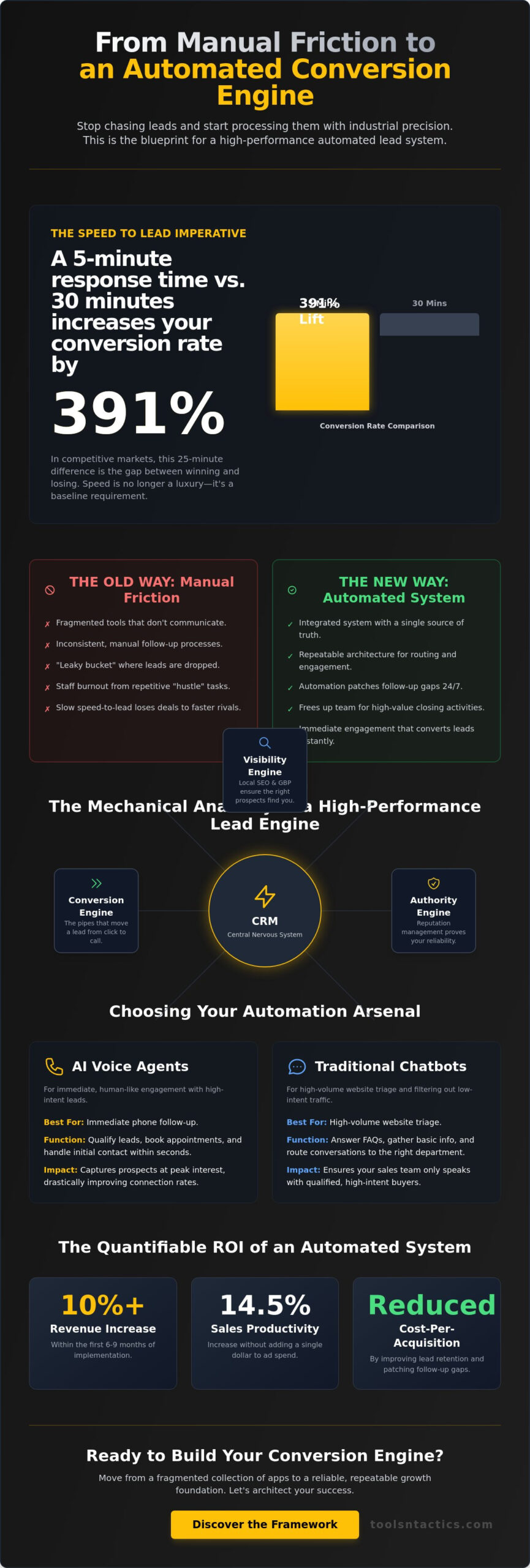
The “speed to lead” imperative is a mathematical reality that dictates your bottom line. Data shows that responding to a prospect in five minutes versus thirty minutes increases your conversion rate by 391%. In competitive markets like Dallas-Fort Worth, that twenty-five-minute delay is the difference between winning a contract and losing it to a rival who was faster on the draw. Speed is no longer a luxury; it is a baseline requirement for survival.
Manual follow-up is a silent killer of professional morale and profit. It creates a culture of “hustle” that leads to staff burnout and missed opportunities. While traditional lead generation focuses on the top-of-funnel visibility, an automated system focuses on the conversion. Getting seen is about marketing; getting paid is about systems. You need a mechanism that moves the needle from mere existence to high-performance functionality. If you’ve been relying on manual effort and wondering why inquiries keep going cold, the lead follow up myths costing Plano businesses growth are worth examining before you invest another dollar in visibility. Understanding how to build a structured automated lead follow up for service businesses is the critical next step toward turning your marketing spend into predictable revenue.
The Death of the Static Lead Form
Traditional “Contact Us” forms are relics of an older digital age. They are passive barriers that force the customer to wait for your convenience. Modern customers demand immediate, 24/7 acknowledgement. When a prospect reaches out, they don’t want to wait for a Monday morning callback. They want to know their problem is being solved now. Transitioning from passive collection to active engagement means replacing dead forms with an automated lead engine that initiates the conversation the second a click happens.
Quantifying the ROI of Automation
A systematic approach reduces your cost-per-acquisition (CPA) by improving lead retention without increasing your ad spend. For service providers in Plano, this stability is vital during seasonal shifts where call volumes fluctuate. It ensures your revenue remains consistent even when your staff is off the clock. The “leaky bucket” syndrome in lead management occurs when a business invests heavily in visibility but loses potential revenue through unpatched gaps in the follow-up process. Automation patches those holes, ensuring every dollar spent on visibility actually reaches the bottom line.
The Mechanical Anatomy of a High-Performance Lead Engine
A fragmented business relies on luck. A systematic business relies on architecture. To build a reliable automated lead system, you must look at your operation through the lens of mechanical components. The Visibility Engine is your fuel source; it uses local SEO and Google Business Profile optimization to ensure the right prospects find you. Without this, your automation has nothing to process. The Conversion Engine represents the pipes that transport a lead from a digital click to a confirmed calendar invite. To maintain structural integrity during this journey, the Authority Engine deploys reputation management and review automation to prove your reliability in real-time.
The central nervous system of this entire operation is the CRM. It doesn’t just store data; it triggers the logic that keeps your business running while you sleep. It coordinates the flow between your Visibility and Conversion engines, ensuring no prospect is left in a digital vacuum. If you want to see how these components fit your specific business model, you can explore our Conversion Engine framework for more detail. This integrated approach is what separates a high-performance business from a collection of disconnected apps.
Lead Capture and Qualification Layers
Not all leads are created equal. An effective system uses AI chatbots to triage incoming traffic, filtering out “tire kickers” so your team only speaks with high-intent buyers. This qualification layer is often supported by custom landing pages tailored to specific North Texas niches. By the time a lead reaches your CRM, automated data enrichment has already provided your staff with the context they need to close the deal. This ensures your automated lead process is high-quality, not just high-volume.
Routing Systems and Logic
Once a lead is qualified, the routing logic takes over. You can implement round-robin distribution to keep your sales team competitive or performance-based routing to reward your top closers. For businesses serving areas like Frisco, Celina, or Melissa, geographic routing ensures the closest technician is notified immediately. Time-based triggers are equally critical. If a lead arrives after hours, the system should instantly fire off an SMS or an AI-driven call to maintain engagement until your office opens. This level of precision prevents leads from cooling off while you’re off the clock. For a comprehensive walkthrough of how these routing components connect into a unified system, the 2026 guide to building an automatic lead engine for service businesses provides the full architectural blueprint.
AI Voice Agents vs. Traditional Chatbots: Choosing Your Automation Arsenal
Building a high-performance system requires the right tools for specific tactical objectives. You don’t use a sledgehammer for finish work. Traditional chatbots and AI voice agents serve different functions within your automated lead architecture. While 45% of marketing teams now use at least one AI agent system, many still struggle with proper deployment. A chatbot is your first line of defense for website triage. It handles low-complexity inquiries and filters traffic. An AI voice agent is the frontier for immediate phone follow-up. It provides a human-like experience that converts missed calls into booked appointments before the lead cools off.
Integration is the difference between a gadget and a system. Your AI agents and SMS triggers must be deeply embedded in your CRM. Standalone tools create data silos that lead to fragmented customer experiences. A unified automated lead engine ensures that every interaction is logged, every consent is tracked, and every appointment is synchronized. It’s about building a steady hand that manages your digital landscape with disciplined precision.
When to Deploy AI Voice Agents
Missed calls are lost revenue. An AI voice agent acts as your digital receptionist, catching every inbound call that your staff can’t reach. It executes a protocol within seconds of a form submission, ensuring you’re the first to respond. This is critical in North Texas, where competition is fierce and customers value professional reliability. By maintaining a local persona, these agents bridge the gap between high-tech efficiency and neighborly service. They don’t just talk; they schedule. This moves the emotional needle from the frustration of a missed connection to the security of a confirmed appointment.
The Strategic Role of SMS and Email Drip Campaigns
SMS automation is your highest-open-rate channel. It’s the most effective way to reach busy professionals in Frisco or Plano. However, you must respect the legal framework. The Telephone Consumer Protection Act (TCPA) prohibits automated marketing texts outside of “quiet hours,” which are 8 a.m. to 9 p.m. in the recipient’s local time zone. You also need prior express written consent to stay compliant and avoid penalties that range from $500 to $1,500 per message. Consumers can revoke this consent in any reasonable way, and you’re required to honor those requests within 10 business days.
The real power lies in the “Long Tail” of conversion. Your system should automate follow-ups at 30, 60, and 90-day intervals. This moves beyond simple name tags and uses data to provide personalized value at scale. SMS is also the engine behind review automation. By triggering a text request immediately after a service call, you build the local authority needed to feed your Visibility Engine. It’s a logical progression that turns a single transaction into a repeatable cycle of growth.
Architecting Your Blueprint: A 5-Step Lead Routing Implementation
Building a high-performance business requires more than just connecting a few apps with fragile DIY triggers. It requires a blueprint. A professional automated lead system is an architectural project that demands structural integrity. If your routing logic is weak, your growth will be stunted by operational friction. You need a unified strategy that moves beyond simple software selection and into the realm of system design.
- Step 1: Map the current customer journey. Trace the path from the initial search click to the final invoice. You must understand every touchpoint before you can automate it.
- Step 2: Identify friction points. Pinpoint where leads are currently being dropped. This is often the gap between a form submission and the first human contact.
- Step 3: Build the technical integration. Link your Visibility and Conversion Engines. Your Google Business Profile should feed directly into your CRM without manual data entry.
- Step 4: Script for local relatability. Refine your AI agents and SMS triggers. They should sound like a professional partner, not a generic algorithm.
- Step 5: Implement analytics. Measure your Lead-to-Close ratio. If you can’t measure the performance of your engine, you can’t optimize it for growth.
If you’re ready to stop managing fragmented tools and start building a systematic growth foundation, explore our Automation Engine to see how we architect these systems for scale.
Mapping the Service Business Journey
Visualizing the path from a Google Business Profile click to a booked service in Dallas is the first step toward efficiency. You need to define specific Lead Status milestones within your CRM, such as “Inquiry Received,” “Qualified,” and “Appointment Set.” This clarity allows you to trigger the right automation at the right time. In the context of lead automation, Conversion Rate Optimization is the systematic refinement of automated triggers and messaging to ensure the highest possible percentage of prospects move from a digital inquiry to a signed contract.
Localizing the Automation Experience
Your automated messages should reflect your local presence in North Texas. Referencing service areas like Frisco or local landmarks builds immediate trust with a prospect. It signals that you aren’t a faceless national chain, but a neighborly professional who understands the community. Balancing this efficiency with a grounded feel is essential. When a automated lead system feels personal, it stops being a “process” and starts being a premium customer experience. This moves the emotional needle from skepticism to the security of a professional partnership.
The Growth Partner Model: Why Systems Trump Software
Most business owners fall into the trap of hiring an agency for isolated tasks. They buy SEO from one provider, a website from another, and manual lead lists from a third. This fragmented approach creates a “Frankenstein” tech stack that requires constant maintenance and rarely delivers a unified result. A traditional agency focuses on deliverables like a blog post or a landing page. A Growth Partner focuses on the entire automated lead engine and the financial outcomes it generates. You don’t need more tools; you need a steady hand to architect a system that works while you’re in the field.
Transitioning from managing software to managing business outcomes is the hallmark of a mature operation. When you stop worrying about whether a lead was called and start reviewing your Lead-to-Close ratios, you’ve achieved structural integrity. Research from Digital Applied in April 2026 shows that marketing automation programs return 5.44 dollars for every dollar spent. This level of ROI is only possible when your Visibility, Conversion, and Authority engines are professionally synchronized. It’s the difference between a collection of parts and a high-performance automatic lead engine built for scale.
Integration Over Isolation
Disjointed systems are fragile. If your CRM doesn’t talk to your AI voice agents, you’re back to manual data entry and missed opportunities. Our Growth Partner Program provides a unified strategy for Plano businesses that eliminates these gaps. We build for scalability. A professional system must work as well for 10 leads as it does for 1,000. By centralizing your operations within an integrated Automation Engine, you remove the human error that typically throttles a growing service business. You gain the security of knowing your follow-up process is unbreakable.
Securing Your Competitive Advantage in North Texas
In the high-stakes North Texas market, the first business to respond is usually the one that wins the contract. Automating your follow-up isn’t just about efficiency; it’s about market share. As AI adoption grows, your competitors will eventually move toward these systems. Future-proofing your sales process now ensures you remain the dominant local authority. You can schedule a strategy session to see the Automation Engine in action and discover how a systematic approach can stabilize your revenue.
Your next step is a cold, analytical audit of your current lead flow. Look for the “dead zones” where a prospect waits more than five minutes for a response. Identify the manual tasks your staff repeats every day that could be handled by a trigger. If your current setup feels like a collection of isolated apps, it’s time to move toward a automated lead architecture. Building a repeatable, high-performance system is the only way to scale beyond the limitations of manual lead follow up that stalls Plano business growth.
Architecting Your Future: The Shift from Manual to Systematic Growth
Tools N Tactics specializes in building these frameworks for local professionals. We don’t just offer isolated software; we provide proprietary Visibility, Conversion, and Authority Engines designed for long-term stability. Our integrated AI Voice and CRM automations ensure your speed to lead remains elite while your competitors are still playing phone tag. It’s time to stop managing a chaotic tech stack and start managing business outcomes with industrial precision.
Build Your Automated Lead Engine with Tools N Tactics and secure your local market share. Your path to systematic growth begins with a single blueprint. We’re ready to help you build a foundation that lasts.
Frequently Asked Questions
What is an automated lead system?
An automated lead system is a technical architecture that captures, qualifies, and routes prospects without human intervention. It serves as the structural plumbing of your business growth. By replacing manual follow-up with a systematic engine, you ensure that every inquiry is processed with industrial precision regardless of the time of day.
How much does it cost to automate lead follow-up in 2026?
Software costs vary widely depending on the scale of your operation. As of May 2026, enterprise-level platforms like HubSpot Marketing Hub Professional start at $890 per month with a one-time onboarding fee of approximately $3,000. Mid-market businesses should also account for implementation costs and the potential need for specialized AI agent add-ons to achieve full functionality.
Can AI voice agents really sound like a local North Texas professional?
Modern AI voice agents are designed with high-level conversational capabilities that reflect a professional persona. They can be scripted to reference local landmarks or service areas in North Texas, such as Frisco or Celina. This bridges the gap between high-tech efficiency and the neighborly reliability that local service-based customers expect.
Will automated leads feel too impersonal for my service-based customers?
Automation often feels more personal than manual follow-up because it eliminates the “speed to lead” delay. When a customer receives an immediate, relevant response, they feel prioritized rather than ignored. A well-architected automated lead process uses data to provide hyper-personalized content, which research indicates can drive 30% higher conversion rates.
How does lead routing improve my sales team’s performance?
Lead routing logic removes the operational friction that slows down a sales team. By using round-robin or performance-based distribution, you ensure leads reach the right person instantly. Statistics from 2026 show that automation contributes to a 14.5% increase in sales productivity while reducing marketing overhead by 12.2%. For a deeper look at how these principles apply specifically to field-based companies, review our guide on automated lead follow up for service businesses to see the full 2026 compliance and conversion framework.
What happens if my CRM doesn’t support advanced automation?
If your current CRM lacks advanced capabilities, you may need to evaluate a platform migration. In 2026, 28% of mid-market companies are evaluating new automation platforms to gain access to AI agent systems. A Growth Partner can help you audit your existing tech stack and determine if your current software can be upgraded or if a new foundation is required.
Can I automate leads coming from my Google Business Profile?
You can absolutely automate leads originating from your Google Business Profile. This is a core component of a Visibility Engine. By integrating your profile with your CRM, inquiries from local searches move directly into your Conversion Engine for immediate follow-up via SMS or AI voice agents.
How long does it take to implement a full lead automation engine?
The timeline for implementing a full lead automation engine depends on the complexity of your current customer journey. A structured 5-step implementation process typically begins with mapping your existing workflow and identifying friction points. Most businesses start seeing a measurable increase in revenue within six to nine months of activating their new system.