
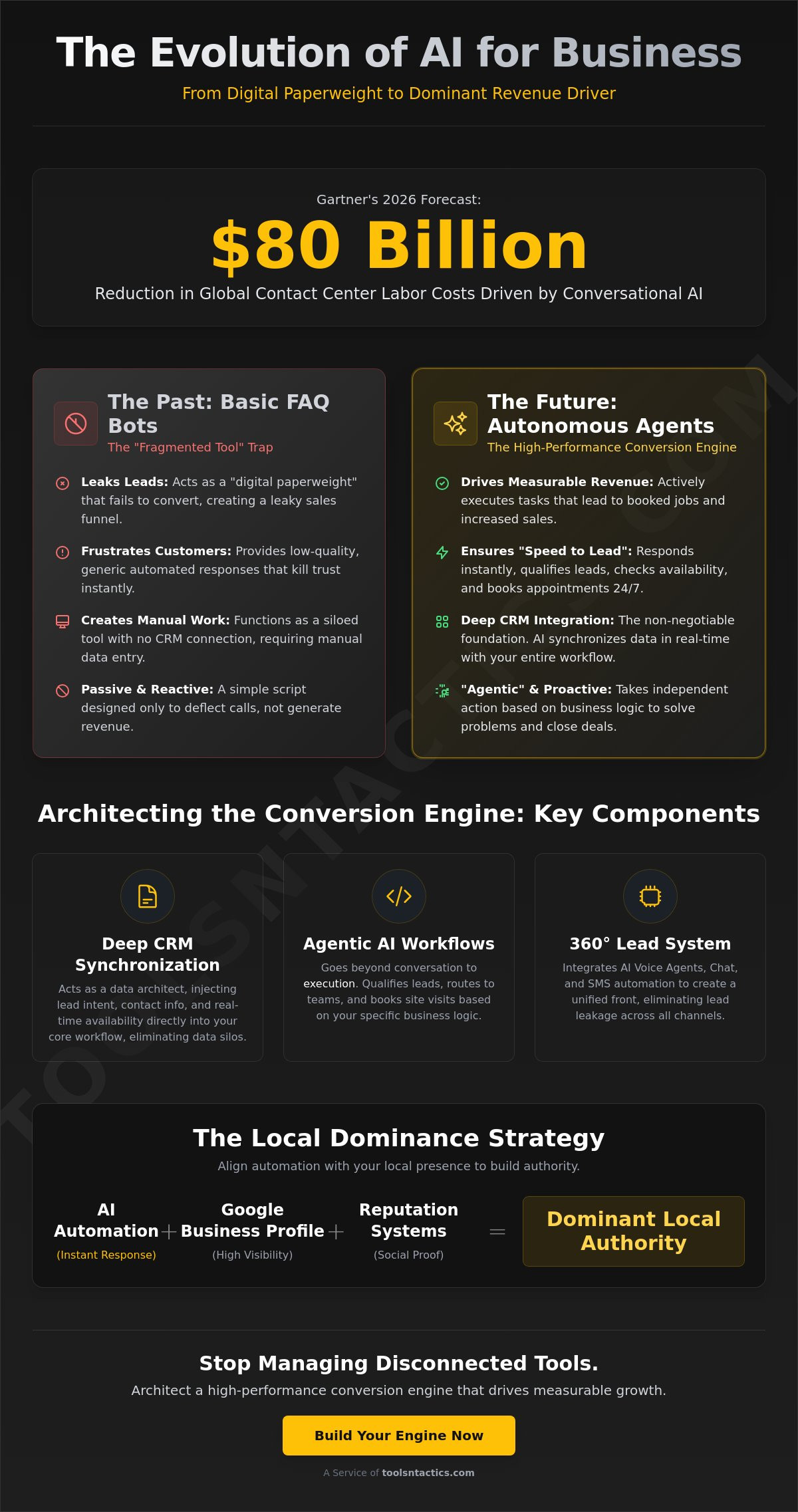
Gartner estimates that conversational AI will reduce global contact center labor costs by $80 billion by the end of 2026. For most North Texas service providers, however, a standard ai chatbot for business is often nothing more than a digital paperweight that leaks leads and frustrates customers with low-quality, automated responses. You’ve likely felt the sting of fragmented tools that refuse to talk to each other, leaving you to manually bridge the gap between a chat window and your CRM.
It’s time to stop treating automation as a bolt-on accessory and start viewing it as a mechanical component of your growth. In this guide, you’ll discover how to architect a high-performance conversion engine that moves beyond basic replies to drive measurable revenue. We’ll explore the latest 2026 regulatory shifts, including the Colorado AI Act, and provide the blueprint for a “set-and-forget” system that secures your local authority through superior response times. By the end of this article, you’ll know exactly how to turn a simple chat window into a dominant revenue driver.
Key Takeaways
- Transition from passive FAQ bots to autonomous agents that execute complex workflows and drive measurable revenue.
- Identify why deep CRM integration is the mechanical foundation for any high-performance ai chatbot for business in 2026.
- Use our comparison framework to choose between DIY platforms and integrated growth partners based on your specific scaling requirements.
- Architect a local dominance strategy by aligning AI automated responses with your Google Business Profile and reputation management systems.
- Build a 360-degree lead system by integrating AI Voice Agents with your chat and SMS automation engines to eliminate lead leakage.
The Evolution of AI Chatbots for Business in 2026
The digital landscape of 2026 has rendered the traditional FAQ bot obsolete. In previous years, a chatbot was a simple script designed to deflect customer service calls. Today, a high-performance ai chatbot for business functions as an autonomous agent. It doesn’t just talk; it executes. This shift represents a move from passive communication to active revenue generation. We categorize this as a core component of a Conversion Engine. It’s a mechanical upgrade that turns a website from a static brochure into a high-speed sales floor.
For service businesses in North Texas, the competition is no longer just about who has the best crew or the most experience. It’s about who responds first. When a homeowner in Plano or a business owner in Frisco reaches out, they don’t want a “we’ll get back to you” message. They want a solution. If your bot can’t provide that, you’re losing market share to rivals who have already architected their digital systems for speed. While the history of chatbot technology began with simple pattern matching, the modern version is a critical gear in your broader Visibility and Authority Engines.
Why Basic Chatbots Fail Service Businesses
Most business owners fall into the “fragmented tool” trap. They buy a standalone chat widget that lives on an island. It doesn’t talk to the CRM. It doesn’t update the calendar. It simply collects a name and email, then sits there. This creates more work for your team, not less. Lead leakage is the silent killer of local service trades. A generic, slow response kills trust instantly. By the time a human follows up, the customer has already booked with a competitor who answered in seconds. In 2026, customers expect instant, personalized routing. They want to know exactly when you can show up, and they want to book that slot without waiting for a callback.
The Rise of Agentic AI in Local Markets
The term “Agentic” is the new gold standard for automation. It refers to AI that takes independent action based on your specific business logic. Instead of just answering a question about pricing, an agentic bot can perform specific tasks. It qualifies a lead based on project scope. It checks your real-time availability in the CRM. It books a site visit. It routes the lead to the correct technician. This supports the “Speed to Lead” metric that defines success in the Dallas and Frisco markets. When you are the most responsive business in the area, you don’t just win the job; you build a reputation for reliability. You move from being a vendor to being a dominant local authority. This is the mechanical reality of a well-implemented Automation Engine.
Evaluating the Conversion Engine: Key Features for Service Businesses
Stop looking at feature lists and start looking at outcomes. For a service business owner, a tool is only as good as the revenue it generates. A standard ai chatbot for business might offer “24/7 availability,” but if it doesn’t result in a booked job, it’s just digital noise. To scale in a competitive market like North Texas, you need a system that functions as a high-performance conversion engine. This means moving beyond simple text replies to a mechanical infrastructure that handles complex customer journeys without human intervention.
CRM integration is the non-negotiable foundation of this engine. If your AI isn’t communicating with your database in real-time, you’re creating a data silo that leads to manual entry errors and missed opportunities. In 2026, professional-grade AI acts as a data architect. It captures intent, validates contact information, and injects that data directly into your workflow. If you’re ready to stop managing disconnected tools and start building a system, our Conversion Engine framework is designed for this exact level of integration.
Natural Language Processing (NLP) standards have reached human-level nuance. Your customers in Plano or Frisco shouldn’t feel like they’re talking to a machine. Modern engines detect urgency, frustration, and specific service needs with high precision. This intelligence must be synchronized across every channel. Whether a lead reaches out via SMS, your website, or social messaging, they should experience a unified front. A fragmented response across different platforms kills local trust and signals a lack of professional organization.
Lead Routing and CRM Synchronization
An integrated engine identifies “hot leads” by analyzing the depth of the inquiry and the intent behind the words. When a high-value project is identified, the system doesn’t just wait for a notification. It uses automated lead routing to push that data to your specific sales team members in Plano or Frisco immediately. This ensures data integrity by updating customer profiles instantly. No more lost sticky notes or forgotten emails; every interaction is logged and actionable.
Scheduling and Transactional Capabilities
The most significant shift in 2026 is the move toward direct calendar integration. Your engine should be able to check your real-time availability and book appointments on the spot. For many service trades, this includes handling deposits or service fees through secure payment processing within the chat interface. Transactional AI is the bridge between inquiry and revenue. By removing the “call back to schedule” step, you eliminate the primary point where leads leak to your competitors.
Best AI Chatbots for Business: A 2026 Comparison Framework
Choosing an ai chatbot for business in 2026 isn’t about finding the most popular app on a review site. It’s about structural alignment. Most business owners buy software based on a feature list, only to realize later that they’ve purchased a component that doesn’t fit their existing machinery. To avoid this, you must categorize the landscape into three distinct tiers: DIY SaaS, Enterprise Platforms, and Integrated Growth Partners. Each serves a different purpose, but only one is designed to function as a unified conversion engine for a local service company.
We evaluate these systems based on three critical pillars: speed of deployment, depth of integration, and the availability of local support. A tool that requires a six-month learning curve or a dedicated developer is a liability, not an asset. Furthermore, subscription fatigue is a real risk. When you buy a DIY tool, you aren’t just paying for the software. You’re paying for the time it takes to build it, the third-party apps required to connect it to your CRM, and the ongoing maintenance to keep it from breaking. The “best” tool is the one that fits your existing Authority Engine without adding more technical debt to your plate. For a deeper breakdown of how today’s leading solutions stack up, our ai powered chatbot platform comparison for service businesses analyzes the latest options including GPT-5.5 tiers and new disclosure regulations.
Top Tools for Internal Knowledge vs. Customer Conversion
Internal workflows and customer-facing conversions require different logic. Claude and ChatGPT have become the standard for internal knowledge management. They excel at document analysis and helping your team navigate internal SOPs. For high-volume customer support, legacy leaders like Intercom and Zendesk AI remain effective for enterprise-level ticket handling. If your goal is cross-app task automation, Lindy provides specific utility by connecting disparate software through agentic workflows. However, these tools often lack the localized, revenue-focused architecture needed by a Plano plumbing contractor or a Frisco roofing firm. If you’re operating a smaller operation and need a practical starting point, our guide on how to implement a chatbot for small business walks through the exact steps to build a revenue-generating system without enterprise-level complexity.
SaaS vs. Managed Growth Partners
Implementing AI Chatbots in North Texas: A Local Growth Strategy
A local ai chatbot for business is more than just a piece of software; it’s a digital extension of your physical storefront. In North Texas, your reputation is built on responsiveness and reliability. If a homeowner in Plano or a business owner in Frisco finds you on Google Maps, their first interaction often happens through your Google Business Profile (GBP). Aligning your chatbot with your GBP ensures that every “Message” click receives an immediate, intelligent response. This isn’t just about convenience. It’s about local dominance. Google’s 2026 algorithms reward businesses that maintain high interaction rates and fast response times with better search visibility.
Your bot also functions as a primary driver for reputation management. Review velocity is directly tied to customer experience. When a customer receives an instant answer to a complex question at 8:00 PM on a weeknight, they’re far more likely to leave a positive review. This creates a cycle of trust that rivals find difficult to break. Whether you’re an HVAC contractor in Dallas or a medical practice in McKinney, your bot must reflect “Neighborly Reliability.” It should sound like a professional partner who understands the specific needs of the North Texas community, not a cold, disconnected script from a Silicon Valley server.
The Visibility-Conversion Loop
Think of your digital presence as a series of interconnected gears. Your Visibility Engine (SEO) acts as the fuel, driving traffic to your site. The ai chatbot for business is the engine that converts that fuel into revenue. We use the data gathered from these chat interactions to inform your broader local content strategy. If customers in Dallas are constantly asking about specific storm damage repairs, that data dictates your next blog post or service page. Local search intent in the DFW metroplex is characterized by high urgency. Your chatbot persona must match this by being direct, professional, and focused on immediate action.
Case Study: Scaling a Service Business in Plano
Consider the trajectory of a Plano-based service provider that was struggling to manage lead flow. They were stuck at 10 leads per week because their office staff couldn’t keep up with incoming inquiries. By architecting an automated lead routing system, they scaled to 40 leads per week without hiring additional administrative help. The “Speed to Lead” was the deciding factor. In competitive markets like North Texas, the business that responds first wins the majority of the time. Integrated follow-up via SMS and email ensures that once a lead is captured, it moves through the conversion arc until the job is booked. If you want to build this level of structural integrity into your company, our Conversion Engine is the blueprint you need.
The Tools N Tactics Advantage: Beyond the Chatbot
Software vendors often sell you a tool and leave you with the burden of assembly. They provide a login, a basic manual, and a wish for your success. We don’t operate that way. An ai chatbot for business is a single gear in a much larger machine. If that gear isn’t connected to a high-performance Automation Engine, it won’t drive revenue. We don’t just sell software; we implement integrated Growth Engines designed for the specific demands of the North Texas service market. Our focus is on the structural integrity of your entire conversion process, ensuring that every digital interaction leads to a measurable business outcome.
Our strategy involves a 360-degree lead system that combines AI Voice Agents with intelligent chatbots. This ensures that no lead is left behind, regardless of how they choose to contact you. Whether a prospect in Dallas initiates a text conversation or a homeowner in Frisco makes a phone call, the response is instantaneous and the data is secured in your CRM. This unified approach eliminates the friction of fragmented tools. It moves your business from the frustration of manual follow-ups to the security of a scalable, automated system. We architect these components to work in harmony, focusing on the long-term stability of your Visibility, Conversion, and Authority Engines.
Our Systematic Approach to AI Automation
We follow a disciplined, logical framework to ensure your automation delivers results. It starts with Discovery, where we map your specific North Texas market and identify exactly where your local competitors are leaking leads. Next, we move to the Blueprint phase. We architect the lead routing and CRM flow to match your operational reality. Finally, we handle the Execution. We implement your Automation Engine and integrate your ai chatbot for business without distracting your team from their daily trade. This systematic process ensures that your new digital infrastructure is reliable, repeatable, and ready to scale.
Becoming a Growth Partner
The difference between a vendor and a partner is the level of investment in your bottom line. A vendor wants a transaction; a partner wants your long-term growth. We focus on revenue-driving SEO and automation because we understand that “clicks” don’t pay the bills. Our Growth Partner Program is built for the pragmatic business owner who values hard work and tangible outcomes. We challenge the status quo of inefficient, fragmented strategies by providing a steady hand in a chaotic digital landscape. We’re here to build a system that works as hard as you do.
Ready to architect your growth? See how our Growth Partner Program works.
Secure Your Local Market Dominance
The digital environment of 2026 leaves no room for fragmented strategies or passive tools. To remain competitive in Plano, Frisco, and the wider Dallas area, your business must transition from basic chat windows to high-performance conversion engines. You’ve learned that a properly architected ai chatbot for business is the key to maintaining “Speed to Lead” and ensuring no inquiry goes unanswered. By integrating your communication channels directly with your CRM, you eliminate the technical friction that stalls growth and frustrates customers.
Our Growth Partner Program is designed specifically for North Texas service providers who value structural integrity and tangible outcomes. We provide the steady hand needed to move from fragmented efforts to consistent, scalable results. We focus on the long-term scaling of your Visibility, Conversion, and Authority Engines. It’s time to stop fighting with disconnected software and start building a repeatable system for success.
Architect your business growth with our integrated AI Automation Engine.
Take the first step toward a more reliable, revenue-driven future today.
Frequently Asked Questions
How much does an AI chatbot for business cost in 2026?
Market pricing for a standard ai chatbot for business typically ranges from $20 to $50 per month for basic SaaS plans as of May 2026. These off-the-shelf costs don’t include the architectural work required for deep CRM integration or custom workflow automation. Most professional-grade systems are implemented as part of a managed growth strategy where the investment is measured by lead volume rather than a flat monthly software fee.
Can an AI chatbot integrate with my existing CRM like HubSpot or Salesforce?
Seamless integration with HubSpot, Salesforce, and other major CRMs is a non-negotiable requirement for any high-performance conversion engine. The system must be able to push lead data, update customer profiles, and trigger follow-up sequences in real-time. This mechanical connection eliminates the manual data entry that often leads to lead leakage. Without this link, your chatbot remains a fragmented tool rather than a functional part of your sales machinery.
Is an AI chatbot better than a human live chat agent?
AI chatbots provide superior “Speed to Lead” by offering instantaneous responses 24 hours a day. While human agents excel at solving complex or emotional problems, they’re often too slow for the initial inquiry phase where customers demand immediate answers. The most effective strategy uses a hybrid model. The AI functions as the first responder to qualify leads and book appointments, while your human team steps in only for high-level consultation.
Do I need technical skills to manage an AI chatbot?
You don’t need technical skills or coding knowledge to manage a professionally architected system. When you work with a growth partner, the heavy lifting of prompt engineering and API integration is handled for you. Your role is to monitor the outcomes and manage the high-quality leads that the system generates. This “set-and-forget” approach allows you to focus on running your business while the engine handles the digital logistics.
Will an AI chatbot work for a local service business in Plano or Dallas?
Local service trades in Plano and Dallas see the most significant impact from AI automation because their markets are highly competitive. Whether you’re in HVAC, plumbing, or legal services, being the first to respond to an inquiry often determines who wins the job. An integrated ai chatbot for business ensures that your company is always the first responder in the DFW metroplex, securing your position as the most reliable option in the community.
How does an AI chatbot improve my local SEO and Google Business Profile?
AI automation directly improves your local SEO by increasing your interaction rates and reducing response times on your Google Business Profile. Google’s algorithms prioritize businesses that demonstrate high engagement and reliability. By using an automated engine to handle GBP messages, you signal to search engines that your business is active and responsive. This results in better visibility in the local map pack and higher authority in your service area.
What is the difference between a basic chatbot and an agentic AI?
A basic chatbot is limited to answering pre-defined questions with static text responses. In contrast, agentic AI functions as an autonomous worker capable of executing multi-step workflows. It can check your real-time availability, book appointments into your calendar, and route leads based on project value. It moves beyond simple conversation to perform the mechanical tasks that actually move a prospect through your sales funnel and into your CRM.
How quickly can I expect to see an ROI from AI automation?
Most businesses begin to see a measurable return on investment within the first 90 days of implementation. The speed of ROI depends on your current lead volume and the efficiency of your existing manual processes. By eliminating lead leakage and reducing the labor costs associated with initial intake, the system typically pays for itself through the increased conversion of high-value inquiries that would have otherwise gone to a competitor. For a step-by-step roadmap on getting your system live quickly, our guide on implementing a chatbot for small business in 2026 covers the full deployment process from discovery to execution.