
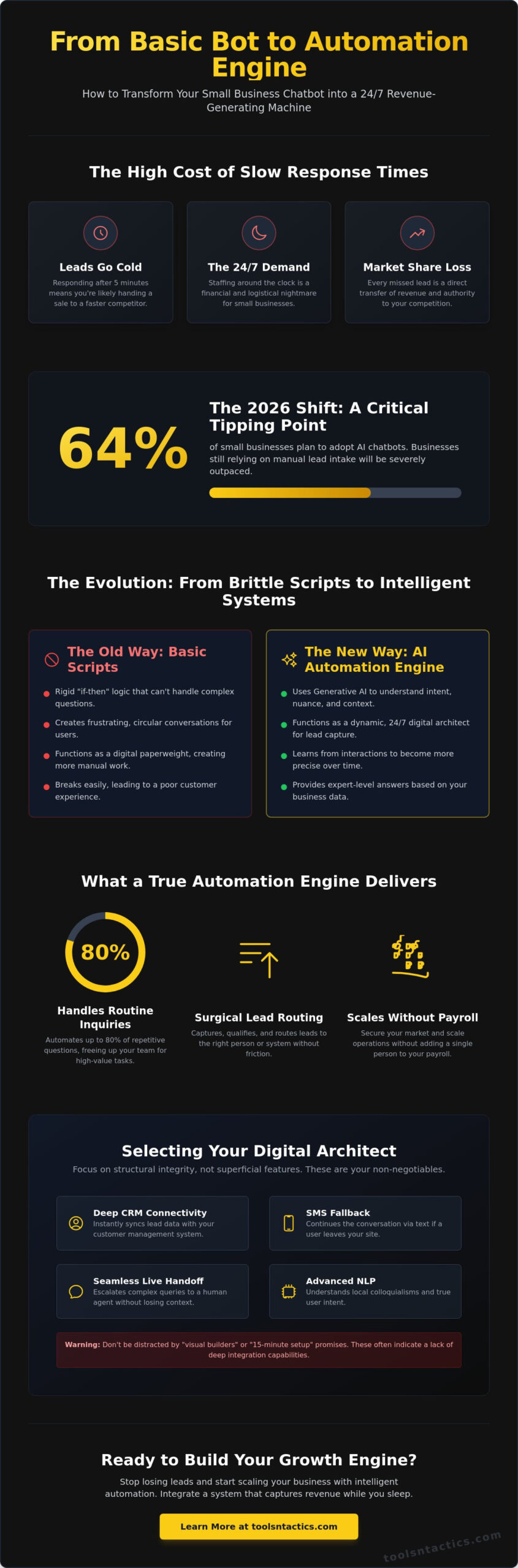
By the end of 2026, 64% of small businesses plan to adopt AI chatbots, but most will fail to move the needle on their bottom line because they treat automation as a toy rather than a tool. You’ve likely felt the frustration of watching a lead go cold because you couldn’t respond in five minutes, or the exhaustion of trying to staff a 24/7 operation on a local budget. It’s a common struggle for service providers who are tired of losing market share to competitors with faster response times. Implementing a chatbot for small business isn’t just about answering questions; it’s about building a reliable system that captures revenue while you sleep.
This guide shows you how to transform a simple bot into a sophisticated Automation Engine. You’ll learn to architect a system that handles up to 80% of routine inquiries and routes leads with surgical precision. This allows you to scale your operations and secure your local market without adding a single person to your payroll. We will break down the transition from basic scripted bots to agentic AI systems that integrate directly with your CRM to drive a measurable return on investment.
Key Takeaways
- Shift from rigid scripts to generative AI systems that act as 24/7 digital architects for your lead capture.
- Evaluate a chatbot for small business based on structural integrity, prioritizing deep CRM connectivity and SMS fallback over superficial ease of use.
- Blueprint your implementation by identifying the top 20 repetitive questions that drain your staff’s time and mapping them to a high-performance booking flow.
- Maintain a human-centric experience through absolute transparency and a distinct persona that reflects your local values and professional standards.
- Integrate your automation data into your Visibility and Authority Engines to turn every customer interaction into fuel for search performance and content strategy.
The 2026 Small Business Chatbot: From Basic Scripts to AI Growth Engines
The era of the frustrating, circular pop-up window is officially over. In 2026, a high-performance Chatbot is no longer a simple script; it’s a digital architect designed for lead capture. For years, service businesses relied on “if-then” logic that broke the moment a customer asked a complex question. Today, the technology has shifted toward Generative AI and Natural Language Processing. This allows a chatbot for small business to understand intent, nuance, and context, turning a basic chat window into a sophisticated Automation Engine that works while you’re on a job site or asleep.
This year represents a critical tipping point, especially for local North Texas service businesses. As 64% of small businesses move toward AI adoption, the competitive gap is widening. Companies that rely on manual lead intake are finding themselves outpaced by rivals who use AI to engage prospects instantly. Speed to lead is the primary currency of the modern market. If you aren’t responding within the first few minutes, you aren’t just losing a lead; you’re handing your local market share to a competitor with a better system.
The Evolution of Conversational AI
The transition from button-based bots to fluid AI agents marks a massive leap in structural integrity. Old systems felt like rigid machines that forced users down a pre-set path. Modern AI agents function as dynamic consultants. They analyze your specific document databases and past interactions to provide expert-level answers in real time. Through machine learning, these systems improve their accuracy with every conversation. They learn your business’s specific vocabulary and customer needs, ensuring the “machine” becomes more efficient and precise over time.
Why ‘Good Enough’ is Losing You Market Share
Selecting Your Digital Architect: How to Evaluate Chatbot Platforms
Choosing a platform based on a “visual builder” or a “15-minute setup” promise is like hiring a contractor because they have nice paint swatches. It looks good on the surface, but it doesn’t tell you if the structural integrity of the system will hold under pressure. When evaluating a chatbot for small business, you must look past superficial ease of use. You need depth of integration. A bot that sits on your website but cannot communicate with your back-office systems is nothing more than a digital paperweight. It creates more work for your team instead of reducing it.
Your non-negotiables for a 2026 growth strategy include CRM connectivity, SMS fallback, and seamless live-agent handoff. If a bot captures a high-intent lead but fails to push that data into your lead routing system instantly, you’ve built a fragmented workflow. High-performance systems also require advanced Natural Language Processing (NLP). In the Dallas-Fort Worth market, your bot needs to understand local colloquialisms and specific service intent. A bot that can’t distinguish between a request for an “emergency repair” and a “general estimate” will frustrate your customers and bleed market share to faster competitors.
Cost is often a distraction from value. Many business owners gravitate toward “free” or entry-level tools to save on overhead. However, a “free” bot that fails to convert a single high-value lead costs you thousands in lost revenue and wasted traffic. While industry reports from sources like Forbes highlight the best chatbots for small business, your final selection must align with your specific operational blueprints. You aren’t just buying software; you’re commissioning a digital architect to manage your front-end sales funnel.
Integration: The Backbone of Your Automation Engine
Your chatbot must talk directly to your CRM and calendar systems to be effective. This connectivity ensures that every interaction is logged and every appointment is booked without human intervention. Seamless integration is the connection between lead capture and database entry. Without API flexibility, your system remains stagnant. You cannot scale a service business on rigid, isolated software that refuses to play well with your existing tech stack.
User Experience and Brand Voice Alignment
The persona of your bot should reflect the disciplined, analytical, and collaborative nature of your business. We call this the “Architect” persona. It balances helpfulness with systematic efficiency, moving the customer toward a resolution without unnecessary fluff. Customization is critical here. White-labeling your bot ensures your local brand authority remains intact. If you’re ready to move beyond basic tools, exploring a custom Automation Engine can help you secure your local market with a system built for long-term stability.
Step-by-Step: Implementing a High-Conversion Chatbot System
Implementing a chatbot for small business is not a one-click affair. It requires a rigorous architectural blueprint. Most business owners fail because they deploy a bot without mapping the customer journey first. You must start with a Discovery Phase. Identify the top 20 repetitive questions that drain your staff’s time every week. These are your primary friction points. By architecting a flow that addresses these queries immediately, you transform your website from a static brochure into a high-performance Conversion Engine.
Before going live, you must utilize a “Sandbox” approach. This involves testing the bot in a controlled environment to ensure zero-error deployment. You’re looking for logic gaps where a customer might get stuck or receive an inaccurate response. Once calibrated, the launch is just the beginning. You must use real-time analytics to refine the system, ensuring the bot remains a steady hand in your digital sales process. This systematic optimization secures your long-term stability and keeps your bottom line protected from operational waste.
Phase 1: Mapping the Lead Routing Logic
Your system must instantly differentiate between routine support queries and high-stakes sales opportunities. A customer asking about your service area in Plano or Frisco follows a different “Golden Path” than someone reporting a service failure. When the bot captures a high-intent lead, the system should trigger an automated SMS follow-up. This ensures the prospect stays engaged with your brand while your team prepares to take over. This level of Conversational AI ensures that no revenue-generating opportunity is ignored or delayed.
Phase 2: Training the AI on Your Authority
To move beyond generic responses, you must feed the AI your proprietary authority content. This includes your specific service guides, detailed FAQs, and North Texas service area nuances. You’re building a custom brain that understands exactly how your business operates. Knowledge injection is the systematic process of uploading your service manuals and price sheets to create a custom brain for your AI agent. This ensures your chatbot for small business provides expert-level answers that reflect your professional standards and local expertise.
Phase 3: The Human-in-the-Loop Handoff
Automation doesn’t mean removing the human touch; it means protecting your team’s time for high-value interactions. You must set up triggers for immediate human intervention when a conversation turns “hot” or involves a complex sales negotiation. Your team should receive an instant notification via a mobile app the moment the bot identifies a high-stakes lead. During this transition, the tone must remain that of a reassuring partner. This seamless handoff maintains the structural integrity of your sales funnel while providing the personal connection that local clients value.
Overcoming the ‘Robotic’ Barrier: Ensuring a Human-Centric Experience
The fear that a chatbot for small business will alienate your customers is a common objection. It’s usually based on experiences with outdated, rigid systems that feel like a dead end. However, 88% of consumers have had at least one conversation with a chatbot in the past year, and 62% would actually rather interact with a bot than wait for a human agent. The risk isn’t the technology itself; it’s the lack of structural integrity in the conversation design. To succeed, you must adopt a ‘Transparency First’ rule. Never pretend your bot is a human. Customers value honesty and efficiency over a deceptive simulation of humanity.
A high-performance system uses contextual awareness to remember previous interactions. If a customer returns to your site, the bot shouldn’t ask for their name a second time. It should recognize them and pick up where the last session ended. This creates a sense of momentum and stability. By injecting your local values into the bot’s persona, you move the emotional needle from the frustration of being “brushed off” to the security of being handled by a disciplined, digital architect. You aren’t just deploying software; you’re extending your professional standards into a 24/7 environment.
Empathy in Automation
Modern systems use natural language to acknowledge urgency. If a prospect mentions a “burst pipe” or an “emergency,” the bot must shift its tone to reflect that priority. You must also design clear ‘Escape Hatches.’ These are simple commands or buttons that allow a user to bypass the bot and request a human at any time. When you integrate your bot with AI Voice Agents, you create a multi-modal experience. A customer might start a chat on their phone and finish it through a voice call without repeating their information. This unified approach is the hallmark of a true Automation Engine.
The ‘Local Expert’ Persona
If you are ready to build a conversion system that respects your customers’ time while protecting your bottom line, consider our integrated AI Automations and Chatbots to lead your market.
Beyond the Bot: Integrating Chatbots into Your Total Growth Engine
A chatbot for small business is a single gear in a much larger machine. It doesn’t just answer questions; it feeds your Visibility Engine by increasing user dwell time and engagement metrics. Search engines interpret these active interactions as a signal of high-quality, relevant content. This directly boosts your local search performance. When a prospect engages with your bot instead of bouncing to a competitor, your “Speed to Lead” performance improves your standing in the local North Texas market. Faster response times lead to higher engagement signals, which are critical for dominating the local map pack.
The real power lies in multi-modal alignment. When you combine AI Chatbots with AI Voice Agents, you create 360-degree coverage for your sales funnel. A customer might start a query on your website during their lunch break and follow up with a voice call later that evening. Because these systems are integrated into a single Automation Engine, the data remains consistent. This structural integrity ensures that your brand appears as a steady, reliable hand throughout the entire customer journey. You aren’t just providing a tool; you’re building a comprehensive conversion system.
Data-Driven Scaling
Your chatbot transcripts are a goldmine for market research. They reveal exactly what homeowners in Plano or business owners in Frisco are searching for in real time. If your logs show a recurring spike in questions about a specific service nuance, you’ve identified a new growth opportunity. You can turn these common questions into high-ranking blog posts for your Visibility Engine. This creates a feedback loop where your bot informs your content strategy, which then drives more qualified traffic back to your site. Tracking ROI becomes a transparent process of measuring how many chat-initiated leads convert into bottom-line revenue.
The Partnership Advantage
See how our Growth Partner Program integrates AI chatbots to scale your business and secures your position as a leader in the North Texas market.
Securing Your Local Market with an Integrated Automation Engine
We’ve established that a chatbot for small business is no longer an optional add-on; it’s a structural necessity for maintaining market share. By moving from rigid scripts to agentic AI, you secure your lead intake and protect your staff’s time. You’ve seen how a local persona and deep CRM integration turn a simple chat window into a high-performance conversion engine. The shift toward automation is the only way to scale your operations without sacrificing the quality of your customer interactions or increasing your headcount.
At Tools N Tactics, we specialize in building these systems for North Texas service businesses. We don’t rely on speculative paid advertising or temporary trends. Instead, we architect integrated Visibility, Conversion, and Authority Engines that deliver consistent, measurable growth through structural integrity. If you are ready to stop losing leads to faster competitors and want to move toward a more predictable bottom line, it’s time to audit your current workflow. Schedule your free AI Automation Audit with Tools N Tactics today. Let’s build a repeatable system that secures your long-term stability and local authority.
Frequently Asked Questions
Is a chatbot for small business worth the investment in 2026?
Yes, it’s a high-yield investment that secures your local market share. Companies report an average 340% ROI in their first year of using this technology. With 64% of small businesses adopting AI by the end of 2026, implementing a chatbot for small business is the only way to maintain a competitive response time. It protects your bottom line by capturing leads that would otherwise go to faster rivals.
How do I make sure my chatbot doesn’t sound like a robot?
You prevent a robotic tone by utilizing Generative AI and Natural Language Processing instead of rigid scripts. Modern systems understand intent and nuance, allowing them to engage in fluid conversations. By training the AI on your specific service guides and North Texas local values, you create an “Architect” persona. This ensures the bot speaks with the professional authority and neighborly reliability your customers expect.
Can a chatbot actually book appointments on my calendar?
A properly architected bot integrates directly with your CRM and calendar systems to manage bookings without human intervention. This is a core component of a high-performance Automation Engine. It moves the prospect from a simple query to a confirmed appointment in seconds. This systematic approach eliminates the friction of manual scheduling and ensures your sales funnel remains open even when your office is closed.
Do I need to know how to code to set up a small business chatbot?
You don’t need coding skills to deploy a basic interface, but building a robust system requires architectural expertise. While many platforms offer visual builders, achieving deep integration with your lead routing and conversion engines often requires a professional partner. This ensures your system has the structural integrity needed for long-term stability and doesn’t become another fragmented, broken tool in your tech stack.
What happens if the chatbot can’t answer a customer’s question?
The system triggers an immediate human-in-the-loop handoff when it encounters a query beyond its current knowledge base. Your team receives an instant mobile notification to step in and provide a personal touch for complex issues. This “escape hatch” prevents customer frustration. It ensures that high-stakes sales opportunities are always handled with the necessary level of expertise and care.
How does a chatbot help with my local SEO and Google Business Profile?
Chatbots improve your local SEO by significantly increasing website engagement and dwell time. Search engines view these active interactions as proof of content relevance, which can boost your ranking in the local map pack. By providing instant answers, you also improve the user experience signals that Google uses to determine authority. This makes your chatbot for small business a vital part of your Visibility Engine.
Can a chatbot handle multiple languages for my diverse North Texas customer base?
Modern AI agents natively support dozens of languages, allowing you to serve the diverse demographics of the Dallas-Fort Worth community. This inclusivity expands your market reach without the high cost of hiring multilingual staffing. It ensures every prospect feels understood and valued. You can provide a consistent, high-quality experience to every neighbor in your service area regardless of their primary language.
What is the difference between a basic chatbot and an AI agent?
Basic chatbots follow rigid “if-then” scripts and often fail when a user deviates from a pre-set path. AI agents are agentic systems that can perform complex tasks and manage entire workflows. An AI agent integrates with your CRM to qualify leads, book appointments, and trigger follow-ups. It functions as a digital architect for your business growth rather than just a simple, reactive FAQ responder.