
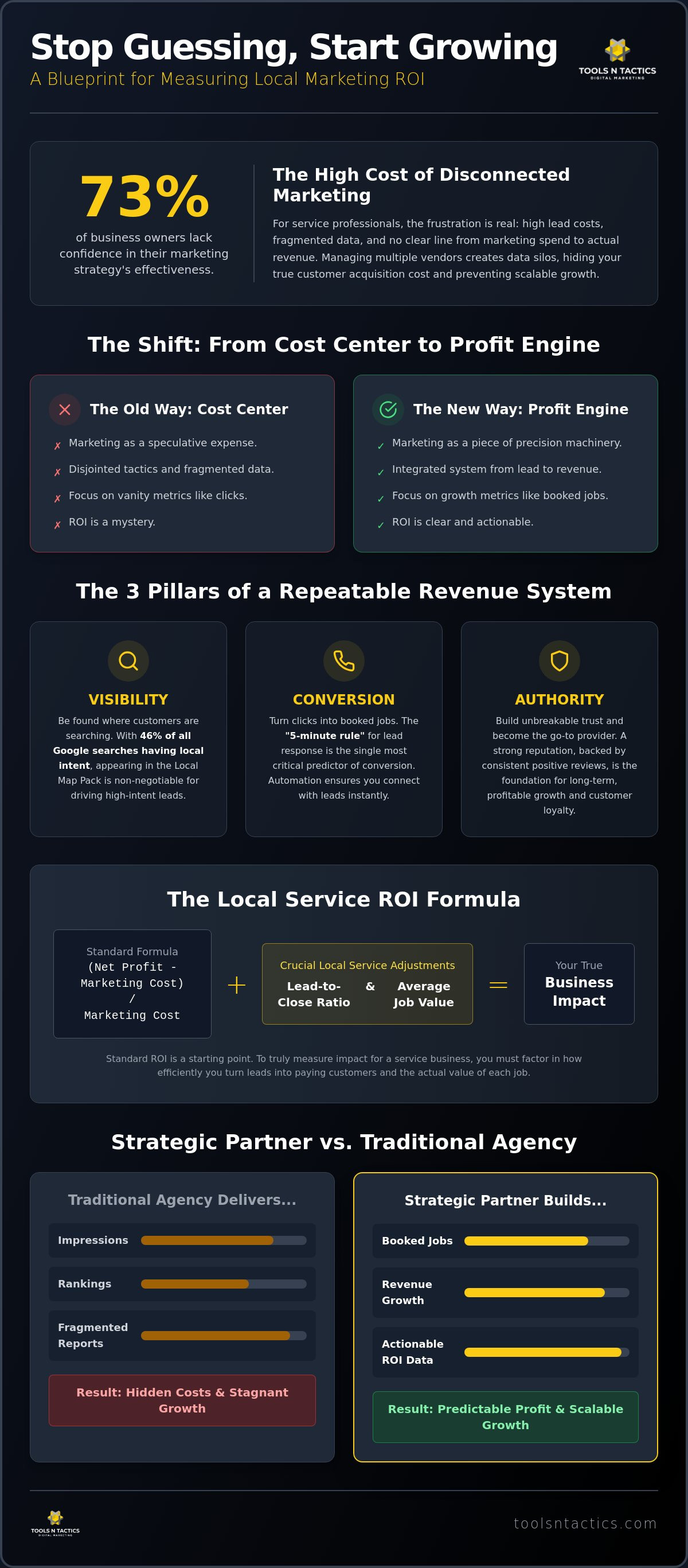
According to recent industry data, 73% of small and medium-sized business owners aren’t confident that their marketing strategy is actually working. For a service professional, there is nothing more frustrating than seeing high lead costs and fragmented tracking data without knowing which channel actually made the phone ring. You shouldn’t have to wonder how to measure local marketing ROI while your capital is tied up in systems that don’t talk to each other. It’s time to treat your marketing like a piece of precision machinery rather than a speculative expense.
We understand that you value hard work and tangible outcomes over abstract concepts. This article will teach you how to stop the guesswork and start measuring the real revenue impact of your local efforts using a systematic growth framework. We will preview a blueprint for connecting lead-to-revenue tracking and using automation to lower your acquisition costs. This system provides the structural integrity your business needs to scale spend based on hard evidence instead of gut feelings.
Key Takeaways
- Learn the specific “Local Service” adjustment to the ROI formula that accounts for lead-to-close ratios and average job values instead of just clicks.
- Discover how to measure local marketing ROI by accurately attributing phone calls and website visits directly to your Visibility Engine and search efforts.
- Understand why the “5-minute rule” for lead response is the most critical predictor of your conversion rate and overall profitability in 2026.
- Identify the three core components—Visibility, Conversion, and Authority—required to build a repeatable revenue system rather than a collection of disjointed tactics.
- See why a strategic growth partner focuses on integrated revenue outcomes while traditional agencies often stop at delivering impressions.
What is Local Marketing ROI and Why Does It Matter in 2026?
In the construction and home services industries, profit isn’t just about how many jobs you book. It’s about how much it cost you to get those jobs on the calendar. At its core, ROI measures the net profit you generate compared to every dollar you spend on marketing. For a local service business, this calculation must include your investment in SEO, Google Business Profile (GBP) management, and reputation building. Understanding Return on Marketing Investment (ROMI) is the difference between running a predictable growth engine and just hoping the phone rings.
By 2026, the digital landscape has become too competitive for guesswork. Simply existing online is no longer a viable strategy. You need a system that measures performance with mechanical precision. If you ignore how to measure local marketing ROI, you risk dumping your budget into high-volume keywords that look good on paper but never result in a service call. High-intent search terms are what drive revenue; vanity keywords just drive up your bill and waste your time.
The Cost of Fragmented Marketing Efforts
Many contractors manage five different vendors for five different tasks. This creates data silos where nobody knows which specific effort actually closed the sale. When your workflows are disconnected, your true customer acquisition costs stay hidden. If you are running a roofing company in Dallas or an HVAC shop in Plano, you can’t afford invisible ROI. A fragmented list of providers leads to operational friction. You get a report from your SEO guy, a different one from your website host, and another from your lead gen service. This fragmented approach turns your marketing into a cost center. A strategic growth partner treats marketing as a profit center by integrating every tool into a single, visible system.
Moving From Vanity Metrics to Growth Metrics
Impressions and clicks are often misleading for service-based businesses. Data shows that 46% of all Google searches have local intent. This means nearly half of your potential customers are looking for immediate solutions nearby. An HVAC company doesn’t need a thousand people to look at a photo of a furnace; it needs ten people to click “Call Now” because their heat went out. We start with the Visibility Engine to ensure you appear in the Local Map Pack when it matters most. To understand how to measure local marketing ROI, you must focus on high-intent actions. These include direction requests, phone calls, and form submissions. These are the metrics that actually move the needle on your bottom line. Everything else is just noise that distracts you from scaling your business.
The Local ROI Formula: Calculating Real Business Impact
Calculating your return isn’t just about looking at a spreadsheet once a year. It’s a process of ongoing measurement that requires mechanical precision. The basic formula is simple: (Net Profit from Marketing – Marketing Cost) / Marketing Cost. However, for a roofing or HVAC company, this math needs a “local service” adjustment. You must factor in your lead-to-close ratio and your average job value to see the full picture. Evaluating local marketing campaigns requires you to look past the total number of leads and focus on the quality of those leads.
Your CRM data is the ultimate source of truth for your business. If your marketing reports show fifty leads but your CRM only shows five booked jobs, you have a leaky bucket. This revenue disappearance often happens during the intake process or through poor lead routing. You can’t fix a structural issue you haven’t identified. Learning how to measure local marketing ROI means finding these gaps where potential profit evaporates before the sale is ever made.
Vanity Metrics vs. Growth Metrics
Many agencies will brag about ranking you #1 for a specific term, but rankings don’t pay the bills. Website traffic in Plano or Frisco is useless if those visitors don’t have a high intent to buy. We focus on the Conversion Engine to move people from “just looking” to “booked on the calendar.” Use the table below to shift your focus toward metrics that actually drive revenue.
- Vanity Metric: Ranking #1 in Search / Growth Metric: Cost Per Booked Job
- Vanity Metric: Total Monthly Clicks / Growth Metric: Lead Conversion Rate
- Vanity Metric: Social Media Impressions / Growth Metric: Revenue Per Lead
Factoring in Customer Lifetime Value (CLV)
An emergency repair lead is a great foot in the door, but it’s worth significantly less than a long-term maintenance contract. When you calculate ROI, you should weight your leads based on the type of service. A one-time fix has a high acquisition cost. A recurring client provides stability and higher margins over several years. Our Growth Partner Program is designed to maximize this lifetime value by turning single transactions into long-term relationships. If you’re ready to stop guessing which channels are working, we can help you audit your current tracking systems to find your most profitable opportunities.
By understanding how to measure local marketing ROI through the lens of lifetime value, you can confidently scale your marketing spend. You’ll know exactly how much you can afford to pay for a new customer because you know what that customer is worth over the next five years. This is the structural integrity required for long-term business stability.
Tracking the Local Customer Journey: From Search to Sale
Tracking a customer journey in the service industry is different than tracking a simple online purchase. Your customers don’t just click a button and buy a new roof. They search, they compare, and they eventually invite you into their homes. To understand how to measure local marketing ROI, you have to follow this path from the initial search query to the final signed contract. This requires a system that connects digital touchpoints to real-world revenue.
Most service businesses live and die by the phone. This is why call tracking is a non-negotiable component of your measurement system. By using unique tracking numbers, you can attribute specific phone calls directly to your search visibility efforts. This data allows you to see which keywords are actually driving high-intent homeowners to pick up the phone. Without this link, your ROI calculations are just guesses based on incomplete information.
Your reputation acts as a multiplier for every other marketing effort. Research shows that 91% of consumers read online reviews before visiting a local business. A strong review profile functions as a component of your Conversion Engine. It builds the trust necessary for a homeowner to move from “searching” to “calling.” When you integrate your reputation data with your CRM, you can see how positive feedback directly impacts your lead-to-close ratios and overall profitability.
The Role of the Visibility Engine
The journey begins when a prospect sees your business in the Local Map Pack. High-performance Local SEO focuses on capturing these high-intent leads at the exact moment they need a solution. Optimization of your Google Business Profile (GBP) is the foundation of this visibility. In North Texas, we are also seeing a rise in voice-activated searches. Tracking these “Answer Engine” results ensures you are visible whether a customer is typing on a laptop in Celina or asking a smart speaker for a plumber in Frisco.
Converting Clicks into Local Appointments
Visibility is only half the battle. You need a Conversion Engine to act as the bridge between that initial click and a booked appointment. This bridge is built using high-converting landing pages tailored to specific service areas. A page designed for a homeowner in Frisco should feel local and relevant to their specific needs. Clear messaging and professional branding reduce the friction in the hiring process. This systematic approach ensures that the traffic you worked hard to get actually results in a measurable business outcome. This is the only way to truly master how to measure local marketing ROI in a competitive market.
The Automation Factor: How Speed to Lead Explodes ROI
The “5-Minute Rule” is the most critical benchmark in local service marketing. Research shows that responding to a lead within five minutes increases your chances of conversion by nearly 400% compared to waiting even half an hour. In a competitive market, homeowners call the top three names they see on Google. They hire the professional who answers the phone first. This is why how to measure local marketing ROI must include your response efficiency. If your visibility is high but your response is slow, you are effectively paying to send leads to your competitors.
Our Automation Engine is designed to stop this revenue leak. It uses AI voice agents and SMS follow-ups to engage prospects instantly, even when your crew is busy on a job site. These “Recovered Leads” represent pure profit for your business. You already paid for the visibility that brought the prospect to your website or Google Business Profile. Automation ensures you actually capture the value of that investment. When you calculate how to measure local marketing ROI, you must compare the cost of the automation tool against the total revenue of jobs that would have otherwise been “ghosted.”
Eliminating Operational Friction with AI
Operational friction occurs when a lead gets stuck in a manual process, such as a paper log or an unmonitored inbox. AI Chatbots act as 24/7 sales reps for your Plano business, qualifying leads and booking appointments while you sleep. Automated lead routing ensures that every inquiry goes to the right technician without delay. Speed to Lead is the time elapsed from the initial inquiry to the first contact by either a human or an AI agent. By reducing this time to seconds, you maximize the efficiency of your sales team and drastically lower your customer acquisition costs.
Review Automation as an ROI Driver
Positive reviews function like compound interest for your business visibility. Online Reputation Management lowers your future customer acquisition costs by building immediate trust with new prospects. Automating the feedback loop helps you gather consistent social proof in Dallas and Frisco without manual follow-up. A strong reputation makes your marketing spend work harder because your conversion rates naturally increase as your local authority grows. If you want to see how a systematic approach to automation can fix your leaky sales bucket, schedule a strategy session with our team today to build your custom growth blueprint.
Building Your Growth Engine: Why a Partner Beats an Agency
Most marketing agencies operate like parts stores. They sell you a spark plug here and a belt there, but they never check if the engine actually runs. When you are trying to figure out how to measure local marketing ROI, this fragmented approach is your biggest obstacle. A strategic growth partner doesn’t just sell you a list of tasks. We build an integrated revenue system where every component works in sync to drive measurable profit. This moves the needle from the frustration of disconnected efforts to the security of consistent, scalable outcomes.
The Tools N Tactics methodology replaces the chaos of multiple vendors with a unified framework. We combine the Visibility, Conversion, and Authority Engines to ensure your business isn’t just seen, but chosen. For a contractor in Dallas or a roofer in Frisco, this integrated approach is the only way to gain a competitive advantage. Recent data shows that 62% of local businesses report that competition has increased in the past year. You can’t afford to waste budget on disjointed tactics that don’t talk to each other.
The Growth Partner Program Framework
Our Growth Partner Program is a long-term scaling blueprint. It moves you away from the “pay-to-play” trap of constant ad spend. By focusing on technical SEO and automation, we help you achieve “zero-ad-spend” growth. This approach establishes you as the Architect of your local market. You aren’t just reacting to the latest trend; you are building a structural foundation that produces repeatable results. Understanding how to measure local marketing ROI becomes second nature when your system is designed for transparency and structural integrity.
Next Steps for Your North Texas Business
The first step toward a reliable system is identifying where your current engine is failing. We provide a Free SEO Audit to find the hidden gaps in your search visibility. Additionally, a GBP Audit identifies missed call opportunities on your Google Business Profile. These aren’t generic reports; they are data-driven insights for service professionals who value proof over promises. Stop guessing about your marketing performance. Contact Tools N Tactics to start building your custom growth engine today.
Build a Predictable Revenue Machine
Success in the North Texas service industry requires more than just showing up. It demands a system that attributes every dollar spent to a specific job booked. You’ve seen how tracking the customer journey from the first local search to the final invoice eliminates the “leaky buckets” in your sales process. By using an AI-driven Automation Engine, you can capture leads that your competitors are ghosting; this ensures no opportunity is wasted. Mastering how to measure local marketing ROI is the final step in turning your business into a high-performance machine.
Tools N Tactics provides the localized expertise and integrated Growth Partner Program needed to move you from fragmented tactics to a unified system. We don’t just deliver clicks. We architect long-term stability and profit. It’s time to stop guessing and start scaling with confidence. Take the first step toward total visibility and operational efficiency today.
Start Your Growth Journey with a Free SEO Audit
We are ready to help you build a business that is built to last.
Frequently Asked Questions
How do I calculate marketing ROI for my local business?
You calculate ROI by subtracting your total marketing costs from your net profit and then dividing that number by the marketing costs. For a service business, you must look beyond simple clicks and factor in your lead-to-close ratio and average job value. This formula provides a clear blueprint of your financial health. It helps you see which campaigns are driving real revenue and which are just wasting your capital on low-intent traffic.
What is a good ROI for local SEO services?
A strong local SEO campaign can deliver a return of $13 for every $1 invested in the long term. Businesses that maintain continuous search investment for 24 months or more report an average ROI of 3.2 times their total spend. While results aren’t overnight, the structural integrity of a well-built Visibility Engine provides a steady stream of leads. This leads to a lower customer acquisition cost compared to traditional advertising methods.
Can I track ROI without a complex CRM system?
You can track basic results using spreadsheets and manual call logs, but this often leads to “leaky buckets” where data disappears. Without an integrated system, you’ll struggle to see the full path from a search query to a signed contract. Manual tracking lacks the mechanical precision needed to scale your business with confidence. A central source of truth is required to stop the guesswork and ensure every lead is accounted for.
Is Google Business Profile performance included in marketing ROI?
Yes, your Google Business Profile is a core component of your marketing ROI because 72% of consumers use it to evaluate local professionals. Actions on these profiles, such as calls and direction requests, increased by 41% between 2025 and 2026. Understanding how to measure local marketing ROI requires tracking every high-intent action on your profile. These metrics directly correlate to local appointments and booked jobs in your specific service area.
How much should a local service business spend on marketing?
The U.S. Small Business Administration recommends that businesses with revenue under $5 million allocate 7-8% of their gross revenue to marketing. However, data shows that 66.3% of small businesses currently spend less than $1,000 per year. Underspending often leads to a loss of market share to more aggressive rivals. You should view this spend as an investment in your business infrastructure rather than a simple monthly expense.
What happens if my marketing ROI is negative?
A negative ROI indicates a failure in either your Visibility Engine or your Conversion Engine. You might be targeting keywords with low buyer intent, or your intake process might be failing to close the leads you generate. It’s time to audit your entire system to find the operational friction. Once you identify the structural issues, you can realign your strategy to focus on the high-margin services that drive profit.
How does speed-to-lead impact my overall ROI?
Responding to a lead within five minutes is the single most important predictor of your conversion rate. If you wait too long, the prospect will simply call the next contractor on the list. Using an Automation Engine to send an immediate SMS or AI-driven response captures revenue that would otherwise go to a competitor. Faster response times naturally lead to a higher ROI by maximizing the value of every lead you generate.
Why is attribution so difficult for local service companies?
Attribution is complex because customers interact with your brand across several platforms, like search results and review sites, before calling. This fragmented journey makes it hard to know how to measure local marketing ROI without an integrated tracking system. Most prospects need several touchpoints to build trust before they invite a technician into their home. A professional growth partner uses call tracking and CRM integration to connect these digital dots to your bottom line.