
Is your sales team actually “cherry-picking” the easy jobs while your marketing budget bleeds out into the gutter? You likely know the frustration of watching a high-value lead sit in an inbox for hours, only to find the prospect already signed with a competitor who called them back immediately. This happens when you lack a high-performance automated lead routing system to bridge the gap between a form fill and a live conversation.
We agree that your hard-earned leads shouldn’t depend on a salesperson’s mood or a manual spreadsheet. Verified industry data indicates that responding to an inbound lead in under five minutes makes you 100 times more likely to get a response, yet manual handoffs often take hours. This article will show you how to eliminate revenue leakage and connect with every prospect in seconds. We’ll break down the mechanical components of a system that guarantees 100% lead coverage, slashes your response times, and builds the structural integrity your bottom line needs to scale through 2026.
Key Takeaways
- Stop losing high-value jobs to faster competitors by mastering the five-minute response rule that dictates modern service sales.
- Learn how an automated lead routing system acts as a digital traffic controller to eliminate manual data entry and prevent sales reps from cherry-picking easy jobs.
- Discover the mechanical differences between Round Robin and Territory-based routing to ensure fair lead distribution and optimized technician travel times.
- Follow a five-step framework to audit your lead sources and sync your CRM for seamless, 100% lead coverage across your entire service area.
- Understand why software tools alone fail without the strategic alignment of a dedicated Automation Engine and a long-term growth partner.
The Cost of Slow Response: Why Manual Lead Routing Fails in 2026
Manual lead routing is a silent profit killer for service based businesses. You spend thousands of dollars on local SEO and Google Business Profile optimization to generate interest, only to let those leads rot in an unmonitored inbox. When a homeowner in North Texas has a pipe burst or a roof leak, they aren’t looking for a pen pal. They are looking for the first professional who answers the phone. If your process relies on a manager manually checking emails and then texting a sales rep, you’ve already lost the job.
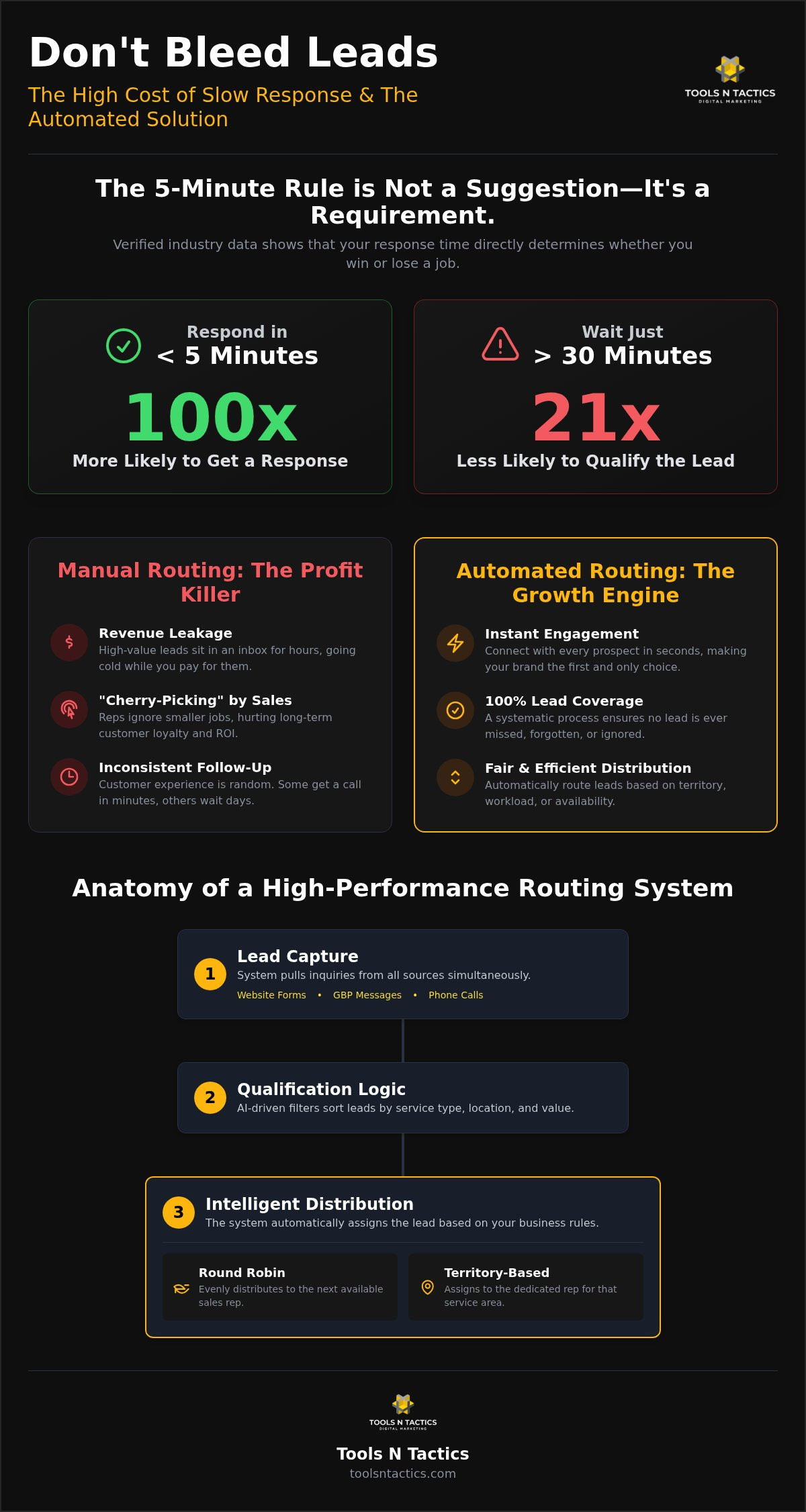
Revenue leakage occurs in the “dead zones” created by these manual handoffs. These are the gaps of time where a prospect is ready to buy, but your team is busy or distracted. Research shows that waiting more than 30 minutes makes you 21 times less likely to qualify that lead. Even worse, responding to an inbound lead in under five minutes makes you 100 times more likely to get a response compared to waiting just 30 minutes. An automated lead routing system eliminates these dead zones by moving the lead from the source to a live person in seconds, not hours.
Manual systems also encourage a toxic habit: cherry-picking. Without a structured distribution process, sales reps often scan a list of leads and only grab the ones that look “easy” or high-value, such as a full HVAC system replacement. They ignore the smaller repair calls that often build long-term loyalty and recurring maintenance contracts. This fragmented approach, often managed through sticky notes and messy spreadsheets, leaves your marketing ROI in shambles. You need a systematic Automation Engine to ensure every lead is treated with the same level of urgency.
The ‘Speed to Lead’ Competitive Advantage
In the competitive North Texas market, speed is your shield. Being the first to call doesn’t just win the job; it builds immediate trust. A prospect who receives a call within 60 seconds of submitting a form feels prioritized. This instant response signals that your company is organized, reliable, and ready to work. By removing human error from the initial contact phase, automation ensures your brand is always the first one in the door while your competitors are still finishing their lunch break.
Common Signs Your Routing System is Broken
If you aren’t sure if your current process is failing, look at your data. A broken system usually leaves a clear trail of missed opportunities:
- High volume, low appointments: You’re getting plenty of clicks and form fills, but your calendar remains empty.
- The “Bad Lead” Myth: Your sales reps constantly complain that leads are “bad,” when the reality is that the leads were high-quality but went cold because the follow-up took two hours.
- Inconsistent patterns: Some customers get a call in ten minutes, while others wait until the next business day.
These symptoms indicate that your business lacks the structural integrity required to scale. You don’t have a lead problem; you have a distribution problem.
Anatomy of a High-Performance Automated Lead Routing System
Think of an automated lead routing system as the digital traffic controller for your business operations. It doesn’t just sit there; it actively directs the flow of potential revenue to the right place at the right time. In the past, you might have relied on a dispatcher’s intuition or a simple call list. Today, this system acts as a mechanical pillar within your Conversion Engine. It ensures that no prospect is left idling at a red light while your competitors move ahead.
A high-performance system isn’t a single tool. It’s a synchronized combination of lead capture, qualification, and distribution machinery. This shift from manual sorting to AI-driven growth engines is what separates the market leaders in North Texas from the companies that are barely surviving on referrals. If you want to see how these systems fit your specific workflow, you can speak with a growth partner to map out your structural blueprint.
Key Components of the Automation Engine
The first stage is Lead Capture. Your system must pull data from every direction simultaneously to be effective. This includes website forms, Google Business Profile messages, and incoming phone calls. If these sources aren’t synced, your data remains fragmented and your response times will suffer. Once captured, the Qualification Logic acts as a filter. It sorts the “ready to buy” homeowners from the “just looking” tire-kickers instantly. By using pre-set criteria, the system identifies high-intent leads before a human ever touches the file.
The mechanical heart of the process is the Distribution Rules. This is where the system decides which team member is best suited for the job. It uses logic such as technician proximity, current workload, or specific expertise to assign the lead. This removes the friction of manual decision-making and ensures the right person gets the lead every time. Consider these core functions:
- Unified Capture: Consolidating leads from GMB, LSA, and your website into one stream.
- Instant Qualification: Identifying the service type and urgency level automatically.
- Precision Distribution: Routing the lead based on real-time availability and location.
The Role of AI Voice and Chatbots
AI agents are now the frontline of the “first touch” in a modern Automation Engine. While a prospect is still browsing your site, AI chatbots engage them immediately. These bots don’t just provide generic answers; they gather critical routing data such as the homeowner’s zip code and the specific problem they need solved. This data allows the automated lead routing system to make an intelligent decision in milliseconds.
This technology facilitates a seamless transition to your human team. Once the AI qualifies the prospect, it executes a handoff. Your sales rep receives a notification with all the context they need to close the deal. This isn’t about replacing your staff; it’s about using machinery to make your people more effective and your revenue more predictable.
Choosing Your Logic: Round Robin vs. Territory-Based Routing
The logic you program into your automated lead routing system acts as the mechanical brain of your sales operation. It determines who gets the opportunity to close a deal and how fast that deal moves through your pipeline. Without clear rules, your office environment becomes chaotic. Reps might fight over the “good” zip codes; or high-value jobs might accidentally land on the desk of an entry-level tech. Choosing the right logic ensures your Automation Engine functions with structural integrity.
A high-performance system doesn’t just guess. It uses specific frameworks to match the lead with the best possible resource. Beyond basic distribution, you must consider skill-based routing and capacity routing. Skill-based routing ensures that a complex, high-ticket HVAC installation goes to your most seasoned pro, while a standard maintenance call goes to a junior tech. Capacity routing adds another layer of protection by checking rep calendars in real-time. This prevents burnout and ensures that leads aren’t assigned to someone who is already stuck on a job site for the next four hours.
When to Use Round Robin for Service Teams
Round Robin logic is the ultimate equalizer for high-volume service calls. It assigns leads to available reps in a fixed, repeating order. This ensures every salesperson gets a fair share of “at-bats,” which is critical for building a culture of healthy competition. It also eliminates “favorite rep” syndrome, where a dispatcher might subconsciously funnel better leads to certain people. For businesses in North Texas dealing with high-demand seasons, Round Robin keeps the momentum steady and the workload balanced across the entire team.
Strategic Territory Routing in North Texas
Territory routing is often the most pragmatic choice for contractors managing teams across the DFW metroplex. Assigning leads based on geography is a mechanical necessity to keep your technicians profitable. If a tech is finishing a job in Celina, your automated lead routing system should prioritize giving them the next lead in Frisco or McKinney rather than sending them all the way to Dallas. This optimization slashes drive time and fuel costs while increasing the number of jobs a single tech can complete in a day.
Setting up zip-code-based rules in your CRM allows you to create these boundaries with surgical precision. This logic also helps you balance the load when one specific area is booming. For example, if a storm hits Plano and leads spike, your system can automatically shift the territory borders to pull in techs from surrounding areas. This level of flexibility ensures you never lose a job because your local tech was “too busy” while another sat idle thirty minutes away.
Implementing Automation: 5 Steps to Sync Your Routing with Your CRM
Building a high-performance automated lead routing system requires more than just installing software. It is a structural project that demands a clear blueprint. If your CRM isn’t synced correctly with your lead sources, your data will become a jumbled mess of missed opportunities. To ensure your business operates with mechanical precision, you must follow a disciplined implementation process.
- Step 1: Audit your current lead sources. Identify every door a customer uses to find you. This includes your Google Business Profile (GBP), website forms, and Local Services Ads (LSA).
- Step 2: Clean your data. Ensure your Automation Engine understands the incoming data. Standardize fields like phone numbers and zip codes so the system can read them instantly.
- Step 3: Define your qualification ‘gates’. Create automated questions to filter out tire-kickers. If a lead doesn’t meet your minimum job requirements, the system should route them to a nurture sequence rather than a live sales rep.
- Step 4: Map your distribution logic. Sync the routing rules with your team’s actual work schedules. This prevents leads from being assigned to technicians who are off-duty or already booked.
- Step 5: Layer in SMS and email follow-up. Program the system to send an immediate confirmation to the prospect. This keeps the lead “warm” until your rep can make the call.
Integrating SMS/Email Follow-Up Automation
Your routing system must do more than just assign a lead; it must engage the customer. In 2026, consumers expect a text response within 60 seconds of reaching out to a service provider. If you wait five minutes, they have already moved on to the next roofer in Frisco or HVAC pro in Plano. By triggering an instant SMS, you lock the prospect into a conversation with your brand. For leads that don’t book immediately, the system should trigger “nurture” loops. These automated check-ins keep your company top-of-mind without requiring manual effort from your office staff.
Connecting to Your Growth Partner Program
Technology is never a “set it and forget it” solution. Moving beyond one-off setups to a Growth Partner Program provides the continuous monitoring needed to prevent your automation from breaking. We act as the architects who ensure your technical SEO is feeding high-quality data into your routing system. This integrated approach ensures that as your North Texas business scales, your operational machinery remains stable and profitable. If you are ready to stop the revenue leakage, contact us today to audit your lead flow.
Beyond Software: How a Growth Partner Optimizes Your Automation Engine
Buying a tool is easy. Building a system that generates predictable revenue is much harder. Many service business owners treat an automated lead routing system as a simple software purchase. This is a mistake. Without strategic alignment, even the best routing logic will fail if the rest of your operational machinery is out of sync. You need more than a dashboard; you need a partner who ensures every mechanical component of your sales process is working in harmony.
A true growth partner looks at the entire blueprint. For instance, we integrate reputation management into the routing process. When a lead is routed to a technician, the system can automatically send the homeowner a link to your five-star reviews or a brief bio of the professional arriving at their door. This builds authority before the truck even pulls into the driveway. It makes routed leads significantly easier to close because the trust has already been established. This is how you scale revenue without spending an extra dime on lead generation ads. Efficiency becomes your primary driver of profit.
At Tools N Tactics, we take a “steady hand” approach to your business growth. We manage the technical complexity of the Automation Engine so you can focus on managing your crews and completing jobs. We don’t just hand you a login and wish you luck. We act as the architects who monitor your system for stability. This ensures that as your team grows, your lead distribution remains fair, fast, and focused on the bottom line.
Predictable Outcomes vs. Disjointed Tactics
There is a sharp contrast between a standalone lead routing tool and a comprehensive Conversion Engine. Disjointed tactics lead to “leaky buckets” where leads fall through the cracks during busy seasons. An integrated marketing engine provides long-term stability by connecting your search visibility to your sales team with zero friction. We recently saw a service business in Plano double its booked jobs simply by fixing its response machinery. They didn’t need more leads. They needed a better way to handle the ones they already had.
Next Steps for North Texas Service Leaders
Becoming a market leader in your city requires a shift from reactive habits to proactive systems. Your competitors are likely already looking for ways to beat you on speed. Don’t let them. The first step toward structural integrity in your sales process is understanding where you currently stand. We recommend starting with a Free SEO Audit to see how your visibility is feeding your current funnel.
Once you have the data, schedule a consultation to map out your custom automated lead routing system. We’ll help you design a blueprint that fits your specific team size and service area. Whether you are in McKinney, Frisco, or Dallas, we are ready to help you build a repeatable system for growth. Your revenue potential shouldn’t be a guessing game. It should be a predictable outcome of a well-oiled machine.
Build Your Structural Blueprint for Predictable Growth
Success in the North Texas service industry no longer depends solely on how many leads you can generate. It depends on how many you can actually capture and convert before a competitor beats you to the punch. By implementing a high-performance automated lead routing system, you replace the chaos of manual dispatching with a disciplined, mechanical process that ensures 100% lead coverage. You’ve seen how precision distribution and instant SMS follow-up create a conversion engine that operates with structural integrity.
Don’t let your marketing budget continue to bleed out through slow response times or disorganized sales reps. Tools N Tactics specializes in the HVAC and roofing industries, providing the integrated AI and Automation Engines necessary for long-term ROI. We act as your growth partner, managing the technical complexity so you can focus on the jobs that build your business. It’s time to move from disjointed tactics to a steady, scalable system that guarantees results.
Ready to stop leaking revenue? Partner with Tools N Tactics today.
Your business has the potential to lead the local market. We have the blueprints to help you get there.
Frequently Asked Questions
What is an automated lead routing system?
An automated lead routing system is a digital traffic controller that instantly assigns inbound leads to the correct salesperson based on pre-set logic. Instead of waiting for a dispatcher to check an email, the system identifies the lead source and pushes the contact information directly to a rep’s phone. This eliminates manual data entry and ensures that high-intent prospects are never left idling in an unmonitored inbox.
How does lead routing improve my speed to lead?
It removes the human bottleneck from the initial contact phase. By triggering an instant handoff from your website or Google Business Profile to a live agent, you can respond in under 60 seconds. Research confirms that calling back within five minutes makes you 100 times more likely to get a response. This mechanical speed ensures you’re always the first professional to reach a homeowner in distress.
Can automated lead routing work with my existing CRM?
Yes, most modern systems are designed to sync directly with major CRMs like ServiceTitan, HubSpot, or Salesforce. The automation acts as a bridge between your marketing channels and your database. It cleans the incoming data, tags the lead source, and ensures the sales rep has the full context of the customer’s problem before they even dial the number.
Is lead routing only for large sales teams in Dallas?
Not at all. Even a small shop with two technicians in McKinney can benefit from structural integrity in their lead flow. Automation prevents cherry-picking and ensures that every lead is handled with the same level of urgency. For smaller teams, it acts as a virtual office manager that never sleeps, making sure you don’t lose jobs to larger competitors just because you were out on a site.
How do AI voice agents fit into lead routing?
AI voice agents act as the frontline of your automated lead routing system. They can answer calls instantly, qualify the homeowner’s needs, and then execute a live transfer to the appropriate technician. If the tech is busy, the agent can schedule the appointment directly in your CRM. This ensures your Automation Engine provides 100% lead coverage regardless of the time of day.
What happens if a lead is routed to a rep who is unavailable?
High-performance systems use capacity routing to check rep calendars in real-time. If a salesperson is already on a job or off-duty, the system automatically skips them and moves to the next available pro. If no one is reachable, the system triggers an instant SMS nurture sequence. This keeps the lead warm and prevents them from calling the next contractor on the list.
Will this system help reduce my cost per lead?
While it doesn’t change what you pay for the lead itself, it significantly reduces your cost per acquisition by increasing your conversion rate. When you stop leaking revenue through slow response times, your existing marketing spend goes much further. You’re essentially getting more jobs out of the same number of clicks, which maximizes the ROI of your Visibility Engine.
How do I know which routing logic is right for my HVAC business?
The right logic depends on your team’s size and service area. If you manage techs across North Texas, territory-based routing is usually best to minimize drive times between Frisco and Plano. For a centralized sales team, Round Robin ensures a fair distribution of opportunities. We help you audit your current workflow to build a custom blueprint that fits your specific business model.