
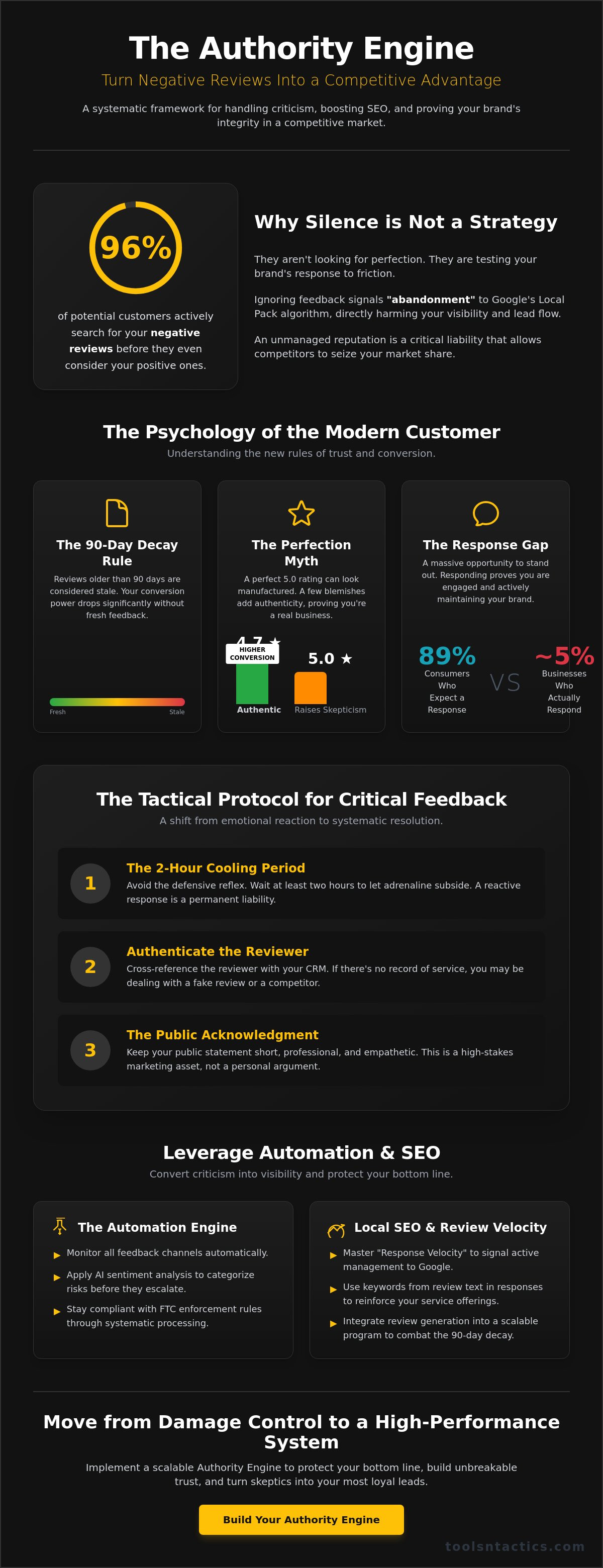
96% of your potential customers are actively searching for your negative reviews before they even look at your five-star praise. They aren’t seeking a perfect track record; they’re looking for proof of how you handle friction. It’s frustrating to watch a single unfair comment or a fake review threaten your ranking in the Google Local Pack. You’ve likely spent hours drafting manual responses, only to feel like you’re losing ground to competitors. Learning how to handle negative online reviews isn’t just about damage control anymore. It’s about building a repeatable system that proves your brand’s transparency and structural integrity.
We agree that your time is too valuable to spend arguing with digital ghosts or unfair critics. This guide will show you how to transform damaging feedback into a tangible competitive advantage using our Authority Engine framework. You’ll learn to neutralize the SEO impact of criticism while leveraging AI-driven reputation management to stay compliant with the latest FTC enforcement rules. We’ll provide the blueprint for an automated response protocol that protects your bottom line and turns skeptics into loyal leads. It’s time to move from fragmented damage control to a scalable, high-performance reputation system.
Key Takeaways
- Replace manual damage control with a systematic Authority Engine that converts negative feedback into proof of brand integrity.
- Implement a tactical 5-step protocol for how to handle negative online reviews to stop defensive reflexes and identify fake competitors.
- Use an Automation Engine to monitor feedback and apply AI sentiment analysis to categorize risks before they impact your reputation.
- Optimize your Local Pack ranking by mastering “Response Velocity” and using review text to reinforce your specific service offerings.
- Combat the 90-day decay rule by integrating review generation into a scalable Growth Partner Program for long-term stability.
The High Cost of Silence: Why Negative Reviews Sink Plano Service Businesses
Silence isn’t a strategy; it’s a structural failure. In the DFW metroplex, local service businesses are competing in one of the most aggressive markets in North Texas. To win, you need an Authority Engine. This isn’t just a collection of stars. It’s a high-performance system where reviews act as the primary fuel source. Every piece of feedback, whether it is positive or critical, powers your visibility. If you aren’t feeding the engine with fresh data, the machinery grinds to a halt. In a landscape where competitors are fighting for every inch of the Google Local Pack, an unmanaged reputation is a liability you can’t afford to carry.
By 2026, the “90-day decay” rule has become the standard for conversion. Consumers are smarter and more impatient. A review from six months ago is considered stale machinery. Research shows that review volume grew by 30.7% in 2025, meaning the market is louder than ever. If your most recent feedback is older than 90 days, your conversion power drops. Potential leads in Plano or Frisco assume your service standards have shifted or that you’ve simply stopped paying attention. Freshness is the lubricant that keeps your sales funnel moving.
There’s a common misconception that a 5.0 rating is the gold standard. It isn’t. In fact, a 4.7 rating often converts better than a perfect 5.0. A flawless score looks manufactured and raises red flags. With 62% of consumers worried that AI is impersonating individuals to leave fake reviews, a few blemishes actually add authenticity. It proves you’re a real operation dealing with real humans. The goal isn’t perfection; it’s knowing how to handle negative online reviews with a systematic precision that builds trust. Online reputation management is about showing the work behind the scenes, not hiding the mistakes.
The Psychology of the 2026 Consumer
Today’s consumer is a skeptic by default. 96% of customers specifically look for negative reviews to see how a business addresses issues. They aren’t looking for the mistake; they’re looking for the resolution. Recency is the new currency of trust. If you haven’t secured a new review in the last few weeks, you’re invisible to the 41% of consumers who “always” read reviews before browsing. Reputation Authority is the intersection of visibility and trust.
Lead Flow and the Google Local Pack
Google’s algorithm is an efficiency machine. When a negative review sits without a response, it signals “abandonment” to the Local Pack. It tells the algorithm that the business owner is no longer maintaining the digital property. Statistics show that 89% of consumers expect businesses to respond, yet only about 5% of businesses actually do. This gap is where you can seize market share. Effective Online reputation management directly impacts your cost-per-lead. An ignored review is a silent endorsement of the customer’s complaint. Every unaddressed comment is a leak in your conversion pipe, driving up the cost of every lead you manage to acquire.
The 5-Step Tactical Protocol for Responding to Critical Feedback
Responding to a scathing review feels like a personal attack, but in the Authority Engine framework, it is simply a maintenance task. You need a precise blueprint to ensure the response doesn’t cause more structural damage than the original complaint. Unlike generic advice that suggests you just “be nice,” this tactical protocol treats every response as a high-stakes marketing asset. Learning how to handle negative online reviews requires a shift from emotional reaction to systematic resolution.
- Step 1: The 2-Hour Cooling Period. Avoid the defensive reflex at all costs. A reactive response is a liability that can haunt your brand for years. Wait at least two hours to let the adrenaline subside so you can speak as a professional brand rather than a frustrated individual.
- Step 2: Authenticate the Reviewer. Before drafting a word, cross-reference the reviewer with your CRM records. In the North Texas market, “review bombing” from competitors is a documented risk. If there is no record of service, you are likely dealing with a bot or a fake account.
- Step 3: The Public Acknowledgment. Keep your public statement short, professional, and empathetic. Acknowledge the customer’s frustration without admitting legal fault. This strategy mirrors the SBA’s guide to handling negative reviews, which emphasizes maintaining professional composure to protect your business reputation.
- Step 4: The Offline Pivot. This is the most critical mechanical move in the process. Provide a direct phone number or email address for a manager. You want the granular details of the conflict moved away from public view and into a private channel immediately.
- Step 5: The Resolution Loop. Once the issue is fixed, follow up. Ask the customer if they would be willing to update their review to reflect the resolution. A “resolved” negative review is often more persuasive than a standard five-star rating because it provides tangible proof of your accountability.
Drafting the Perfect Public Response
When you are refining your approach to how to handle negative online reviews, remember the “Future Customer” rule. You aren’t writing for the person who complained; you’re writing for the thousands of leads who will read your response later. Never use the customer’s name in a negative response to protect their privacy and your professional standing. Use templates that focus on your high service standards for legitimate complaints. For unreasonable expectations, state your company policy clearly and firmly to set boundaries for future clients.
Managing Fake and Defamatory Reviews
Fake reviews are a form of industrial sabotage. If you identify a non-customer or a defamatory attack, flag it immediately through your Google Business Profile for a policy violation. For businesses in Plano and the surrounding DFW area facing systematic attacks, documentation is your primary defense. Keep detailed service logs and communication records. If the volume of fake feedback becomes a threat to your stability, it might be time to work with a Growth Partner to deploy more advanced reputation safeguards and automated monitoring tools.
Leveraging AI and Automation to Neutralize Reputation Risks
Manual review management is a slow, grinding process that costs you more than just time; it costs you market share. By 2026, relying on manual labor to monitor your reputation is like trying to build a skyscraper with a hand-saw. It’s inefficient and dangerous for your structural integrity. The Automation Engine replaces the guesswork of manual replies with a high-speed diagnostic system that monitors your digital presence 24/7. This isn’t just about speed; it’s about maintaining a consistent, high-performance standard that manual efforts simply cannot match.
The core of this system is AI sentiment analysis. This technology scans incoming feedback for high-risk keywords like “broken,” “rude,” or “never showed up” before a human ever sees the notification. By categorizing reviews based on emotional intensity and specific service issues, the system allows you to prioritize critical threats to your local ranking. This automated triage ensures that you aren’t wasting energy on low-impact comments while a major reputation risk sits unaddressed. Knowing how to handle negative online reviews in a high-volume environment requires this level of mechanical precision.
AI Voice Agents and automated SMS loops act as the first line of defense in your Authority Engine. These agents can initiate a resolution protocol the moment a job is completed in your CRM. If a customer expresses dissatisfaction through a follow-up text, the system can trigger a phone call or a private feedback form immediately. This proactive approach catches friction in a private channel, preventing a minor service hiccup from escalating into a public 1-star review. It’s a systematic way to drown out occasional negatives with a steady stream of fresh, verified positives.
AI Response Drafting: Efficiency vs. Authenticity
Efficiency shouldn’t come at the cost of your brand’s voice. We implement AI guardrails to ensure that every drafted response sounds like a local Plano business, not a cold algorithm. By integrating your CRM with your review platform, the system can pull specific details—like the service date or the technician’s name—into a draft for your final approval. This level of personalization is a core component of Automated Lead Follow-Up for Service Businesses, ensuring your communication remains grounded and community-focused while operating at scale.
Pre-emptive Strike: The Feedback Loop
The most effective way to manage a bad review is to ensure it never gets published. Automated internal surveys act as a pressure valve, catching “1-star experiences” before they reach Google. The system only sends a public “Request for Review” link once a high satisfaction score is confirmed internally. This creates a filtered funnel that protects your public rating while providing you with the raw data needed to fix internal operational friction. AI sentiment analysis reduces response time by 80%, allowing you to address customer concerns while the service experience is still fresh in their minds.
Local SEO and Review Management: Converting Criticism into Visibility
Google doesn’t just read your reviews to determine your star rating; it digests the text to map your business relevance. Every comment is a data point that helps Google’s crawlers understand exactly what you do and where you do it. When a customer leaves a complaint about an “AC repair in Frisco,” the algorithm still associates your profile with that specific service and location. By mastering how to handle negative online reviews, you can turn a moment of friction into a signal of authority. You aren’t just managing a PR crisis; you’re feeding your Visibility Engine the localized data it needs to dominate the North Texas service area map.
Response Velocity is a critical performance metric in 2026. While consumers expect a reply within hours, Google’s algorithm uses your response speed to measure business activity. A fast, professional response to a critical review signals to Google that your Google Business Profile (GBP) is a well-maintained property. This activity directly influences your ranking in the Local Pack. We recommend a strategic approach to keyword placement within your responses. By naturally mentioning the service provided and the city—without resorting to keyword stuffing—you reinforce your relevance to local search queries.
Ignoring feedback is a mechanical failure that tells Google your operation is stagnant. Instead, use every response as an opportunity to signal structural integrity. If you’re ready to stop losing market share to more responsive rivals, you can optimize your Visibility Engine today to ensure your reputation remains a high-performance asset.
The Google Business Profile (GBP) Optimization Connection
Your GBP acts as the front door to your business. It’s the first thing a lead sees when searching for services in the DFW metroplex. Owner responses are one of the few ways you can directly signal activity to search crawlers. Implementing a systematic approach to Online Reputation Management for Service Businesses in Plano ensures that your GBP remains an active, high-converting asset rather than a neglected digital storefront.
Review Velocity: The Secret Ranking Factor
Google prioritizes consistency over intensity. Securing 50 reviews over the course of a year is significantly more valuable for your SEO than receiving 50 reviews in a single week. A sudden spike often triggers spam filters, whereas a “steady drip” of feedback suggests a reliable, ongoing operation. Through our Growth Partner Program, we help businesses maintain this momentum. Encouraging customers to include localized mentions of Plano, Celina, or McKinney in their feedback further anchors your business to the specific communities you serve, making you the logical choice for local searchers.
Implementing a Growth Engine: From Manual Response to Automated Authority
Tools N Tactics integrates reputation management directly into our Growth Partner Program. We don’t just hand you a software login and expect you to do the work. We act as the architects of your digital presence, ensuring that your Authority Engine is fueled by a steady drip of fresh, localized feedback. This integrated approach moves your business from a state of fragmented efforts to a state of consistent, scalable outcomes. When you stop worrying about how to handle negative online reviews on a case-by-case basis, you free up the mental bandwidth to focus on scaling your actual service operations.
Service businesses in North Texas don’t need another subscription; they need an integrated partner. A software tool can’t understand the nuances of a specific neighborhood dispute in McKinney or a competitor attack in Plano. An integrated partner provides the human oversight and mechanical precision necessary to protect your bottom line. We move your brand from the frustration of manual responses to the security of an automated, proactive system that dominates the local map.
The Growth Partner Advantage
Fragmented tools often fail because they operate in isolation. A review tool that doesn’t talk to your CRM or your Visibility Engine is a broken link in your growth chain. This is why we are positioned as the Best SEO Company Plano TX for service-based industries. We align your reputation with your search visibility and conversion metrics to ensure every digital component is pulling in the same direction. The ROI of this approach isn’t just a better star rating. It’s a lower cost-per-lead and a more resilient brand that rivals cannot easily displace.
Next Steps for North Texas Service Leaders
Stability begins with an audit. You need to understand your current review-to-lead conversion rate and identify where the leaks are in your reputation funnel. If you’re tired of manual firefighting and ready for a repeatable system, it is time to see the Conversion Engine in action. We provide the blueprints and the machinery; you provide the service excellence. Build your Authority Engine with Tools N Tactics today.
Securing Your Digital Infrastructure
A single bad review shouldn’t be a structural threat. Your online reputation is a mechanical component of your overall growth strategy. You’ve seen how a tactical response protocol and an automated Authority Engine can transform friction into visibility. Transitioning from manual firefighting to proactive brand dominance is the only way to protect your market share. Mastering how to handle negative online reviews is no longer a luxury; it’s a core requirement for local dominance in 2026. By integrating your Visibility Engine with specialized automation, you ensure your brand remains a steady hand in a chaotic digital landscape.
You don’t have to manage these fragmented efforts alone. Our AI-driven systems and specialized focus on North Texas service industries ensure your blueprints are built for long-term stability and bottom-line growth. It’s time to stop reacting and start building. Scale your service business with the Growth Partner Program today. Your future leads are looking for proof of your integrity; give them a system that delivers it every time. You have the tools and the tactical blueprint to lead your market; now it is time to execute.
Frequently Asked Questions
Can I delete a negative review on Google if it’s unfair?
You cannot manually delete a negative review simply because it feels unfair. Google only removes content that violates specific policies, such as harassment, hate speech, or spam. If the review is a legitimate expression of a customer’s opinion, it will remain on your profile. Your best strategy is to address the feedback professionally and drown it out with a consistent stream of new, positive reviews.
How long should I wait before responding to a bad review?
We recommend a two-hour cooling period to avoid a defensive reflex, followed by a response within 24 hours. Speed is a critical component of your Response Velocity metric, which Google uses to measure business activity. Waiting too long signals abandonment to the algorithm and frustration to the customer. A prompt, systematic response shows you are an active partner in the community and value professional accountability.
Do negative reviews hurt my SEO ranking in Plano?
Negative reviews can damage your ranking in the Google Local Pack if they lead to a high abandonment rate or a significant drop in your overall star rating. However, the text within these reviews helps Google understand your service offerings in the DFW metroplex. Learning how to handle negative online reviews effectively ensures that these data points signal brand transparency rather than operational failure, protecting your visibility in local search results.
Should I offer a refund in a public review response?
You should never offer a refund or specific financial compensation in a public response. Doing so sets a dangerous precedent and may encourage bad actors to leave critical feedback just to secure a payout. Instead, acknowledge the frustration and move the conversation to a private channel. Once you are offline, you can discuss a resolution loop that includes a refund or credit if the situation warrants it.
How do I handle fake reviews from competitors?
Flag fake reviews immediately as a “conflict of interest” through your Google Business Profile dashboard. You need to maintain clear documentation, such as CRM service logs, to prove the reviewer was never a customer. If you are facing a systematic “review bombing” attack, consult with a growth architect to deploy advanced reputation safeguards. Systematic monitoring is the primary defense against industrial sabotage in the North Texas market.
Is it worth using AI to write my review responses?
Using AI to draft responses is highly efficient, provided you maintain strict guardrails for authenticity. AI can reduce your response time by 80% and ensure a consistent professional tone across hundreds of reviews. However, the final output must be reviewed by a human to ensure it reflects your specific brand voice. An Authority Engine uses AI for the heavy lifting while keeping the local, neighborly feel intact.
What happens if a customer refuses to take the issue offline?
If a customer continues to argue publicly after you have offered an offline pivot, stop responding. Your goal is to show future leads that you were reasonable and professional, not to win a public debate. The “Future Customer” rule dictates that your composure is more important than having the last word. A single, calm invitation to call your office is enough to prove your structural integrity to onlookers.
How many positive reviews do I need to offset one 1-star review?
It typically takes about 10 to 12 five-star reviews to neutralize the mathematical impact of a single 1-star rating on your average. This is why a “steady drip” of feedback is more effective than a sudden spike in volume. Understanding how to handle negative online reviews involves building a repeatable system that secures these positives automatically. Consistency ensures that one bad experience doesn’t derail your conversion engine or your local ranking.