Every hour you spend on the phone with a “tire-kicker” who can’t afford your services is an hour stolen from a high-profit installation. It’s frustrating to watch your team’s energy get burned on low-value calls while serious prospects slip through the cracks because they didn’t get an answer fast enough. With 77% of U.S. small businesses now using AI to streamline their work, an AI chatbot for lead qualification has become the standard for protecting your time and acting as a 24/7 gatekeeper for your business.
You likely agree that manual lead follow-up is a bottleneck that keeps you from scaling your operations and hitting your revenue goals. We promise to show you how to use these automated filters to stop wasting time and start prioritizing high-value service calls automatically. This guide covers the specific mechanics of lead routing, how to slash your response times from 42 hours to under 3 seconds, and the best way to keep your CRM data consistent. By the end, you’ll have a clear blueprint for an automation engine that keeps your schedule full of profitable jobs and your technicians focused on the work that matters.
Key Takeaways
- Stop losing revenue to slow response times by engaging every prospect in under three seconds instead of waiting hours for a manual call back.
- Deploy an AI chatbot for lead qualification to act as a 24/7 gatekeeper that filters out tire-kickers and protects your team’s schedule.
- Discover why interactive, dynamic conversations build more trust and capture more accurate project data than traditional, static contact forms.
- Learn the “Big Four” questions every service business should use to verify a lead’s budget and timeline without sounding corporate or pushy.
- Integrate your chatbot into a unified Conversion Engine to ensure every qualified lead is routed directly to the right technician in your CRM.
Why Your Current Lead Intake is Costing You Revenue
Your business is likely suffering from a “leaking bucket” problem. You spend thousands of dollars on marketing to get people to your website, but the moment they arrive, the system breaks down. A standard contact form is no longer enough for 2026 customers who expect instant gratification. When a prospect fills out a form and waits hours for a call, they don’t sit by the phone. They click the next result on Google and hire your competitor in Frisco or Dallas who answers first.
Relying on manual intake is a structural flaw in your business model. Every minute a lead sits unaddressed, the likelihood of closing that job plummets. In the fast-paced North Texas market, being “good at what you do” isn’t enough if you’re slow to talk. If you aren’t using an AI chatbot for lead qualification, you’re essentially leaving the door to your shop unlocked and letting revenue walk out.
The Speed to Lead Factor in Service Industries
The first five minutes after an inquiry are the “golden window.” If you miss this window, your chances of qualifying the lead drop significantly. For a Plano HVAC contractor, Speed to Lead is the measurement of how many seconds pass between a homeowner’s AC unit failing and your business providing a helpful response. Modern Chatbot technology allows you to hit this window every single time without hiring more office staff.
Delayed responses do more than just lose the immediate job; they damage your authority. Prospects assume that if you’re too busy to answer a sales inquiry, you’ll be too busy to show up for the actual repair. An automated system ensures that your brand remains the steady hand in a chaotic situation. It provides immediate reassurance to the customer while your competitors are still checking their email.
The Hidden Cost of Tire-Kickers
Not all leads are created equal. Some are “time vampires” who want free advice or have a budget that doesn’t align with your high-quality standards. When your team spends hours on the phone with these unqualified prospects, they are being pulled away from high-profit jobs. This friction in your sales process leads to burnout and inconsistent revenue. It clogs your internal systems and makes it harder to see the real opportunities.
An Conversion Engine solves this by acting as a mechanical filter. By using an AI chatbot for lead qualification, you can automatically sort inquiries based on project size, location, and urgency. This ensures your technicians are only routed to the jobs that actually move the needle for your bottom line. This systematic approach removes the emotional toll of chasing dead-end leads and lets you focus on building a scalable, profitable business.
How an AI Chatbot Qualifies Leads for You 24/7
An AI chatbot for lead qualification is far more than a simple chat box on your website. It’s a programmable assistant designed to act as a mechanical filter for your sales pipeline. Unlike basic “button-bots” that only offer a few rigid options, modern conversational AI uses advanced logic to determine a lead’s value in real time. This ensures that your team only spends energy on prospects who fit your specific business profile.
This system works through the “Conversion Engine,” a framework of logic branches that sorts inquiries based on their potential. By understanding how an AI chatbot qualifies leads, you can see how it identifies high-intent customers while they’re still on your page. The bot asks the right questions at the right time, moving beyond simple contact info to uncover the actual project needs and urgency.
The Mechanism of Automated Filtering
The core of this system relies on Natural Language Processing (NLP). This allows the bot to understand the intent behind a user’s typed message. For example, if a homeowner mentions a “leaking roof” versus “thinking about a new roof next year,” the bot recognizes the difference in urgency. It can also instantly verify geographic fit. If you only service Plano and Dallas, the bot can politely redirect a prospect from outside your service area before they ever reach your inbox.
Budget and project scope are determined before a human ever picks up the phone. The bot can ask about the size of the job or the desired timeline in a way that feels like a natural conversation. This removes the friction of manual intake and ensures that the data entering your CRM is accurate and actionable. It’s about building a system that works while you sleep, keeping your revenue engine running without constant supervision.
Beyond Simple Questions: Assessing Authority and Need
A sophisticated AI chatbot for lead qualification identifies the decision-maker automatically. It can ask if the user is the homeowner or a tenant, which is a critical distinction for contractors. By scoring leads based on these answers, the system prioritizes follow-up for your sales team. A high-priority lead in your service area with an immediate need and a matching budget gets moved to the front of the line.
This data doesn’t just sit in the chat history. It flows directly into your lead routing systems to ensure the right technician gets the notification. Learn how our Automation Engine handles lead routing to see how we connect these conversations to your daily operations. If you’re ready to stop chasing every notification and start focusing on profit, you can talk to our team about building your custom blueprint today.
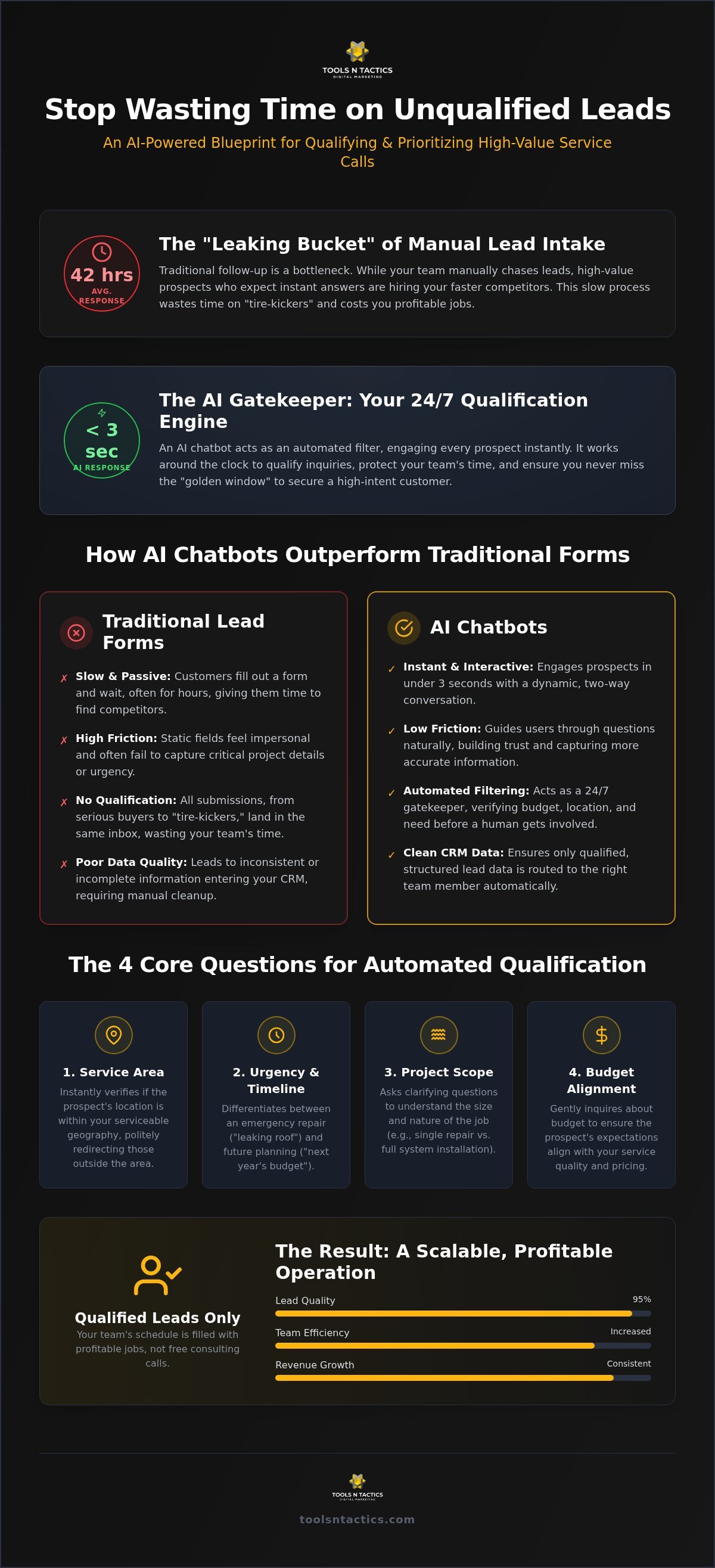
AI Chatbots vs. Traditional Lead Forms
Static lead forms are the silent killers of conversion. Most business owners view them as a necessary tool, but in reality, they act as a barrier between you and your next high-profit job. A standard contact form is passive and cold; it feels like homework for the customer. An AI chatbot for lead qualification transforms this experience into a dynamic consultation. Instead of staring at a wall of empty boxes, the prospect enters a guided conversation that builds trust from the first second.
Data accuracy is significantly higher with conversational AI. People are prone to providing “placeholder” information on forms just to get to the next page. In a chat, the interaction feels personal and helpful, which encourages users to provide real project details. This frictionless approach meets the customer where they already spend their time, whether that is on your website, via SMS, or through Facebook. By removing the technical hurdles of traditional intake, you ensure that every serious prospect has a clear path to your door.
The Conversion Gap: Why Forms Are Failing
Long forms often scare away the exact high-value leads you want to attract. Busy homeowners and commercial property managers don’t have the patience to fill out 10 fields before knowing if you can even help them. Chatbots solve this by breaking down complex questions into bite-sized, interactive steps. This method keeps the user engaged without overwhelming them.
While a 10-field static form often sees users drop off before the third box, a 10-question conversational bot maintains engagement by revealing questions one at a time based on previous answers. This logical progression ensures a higher completion rate. According to industry data from the 2026 research brief, AI chatbots convert 10 to 15 percent of visitors into leads, which is a massive leap over the 1 to 3 percent conversion rate seen with traditional forms.
Operational Efficiency and ROI
Implementing an AI chatbot for lead qualification isn’t just about better marketing; it is a structural improvement to your business. It reduces the heavy overhead of a dedicated intake coordinator who would otherwise spend hours manualy filtering calls. Your team can stop acting as switchboard operators and start acting as technicians and sales leaders. This system allows you to scale your intake volume without adding a single person to your office staff.
The financial impact is clear. Research shows the average cost per lead can be reduced from 45 dollars for live chat down to just 12 dollars when using an automated system. This efficiency allows you to reinvest those savings back into your core services. To see how these systems fit into a complete business blueprint, explore our Growth Partner Program for integrated scaling. Building a reliable revenue engine requires moving away from fragmented forms and toward a unified, automated intake system.
Building Your Qualification Script: What to Ask Every Prospect
A script is the blueprint for your automated sales process. Without the right questions, your AI chatbot for lead qualification is just a digital ornament. It needs to act as a disciplined consultant that gathers specific, tactile data before your team ever sees the lead. By capturing contact information early in the conversation, you enable automated lead follow-up that keeps your business top-of-mind even if the prospect leaves the site.
Asking about budget is often the hardest part for service owners. You don’t want to sound pushy or corporate, but you need to know if the job is worth your time. Instead of asking for a flat number, have the bot offer price ranges or ask what they have set aside for the project. This feels less like an interrogation and more like a professional assessment. Determining urgency is equally vital. Your system should be able to distinguish between a 2:00 AM emergency pipe burst and a homeowner looking for a kitchen remodel quote for next summer.
The Essential Qualification Checklist
To keep your revenue engine running smoothly, every interaction must clear a set of structural hurdles. These “Big Four” questions ensure that your technicians are only routed to high-profit opportunities within your specific operational footprint. If a lead doesn’t meet these criteria, the system identifies the friction point immediately.
- Service Type: Does the prospect need a simple repair, a full installation, or ongoing maintenance?
- Location: Are they located within your North Texas service area, such as Plano, Dallas, or Frisco?
- Timing: Is this a “need it now” emergency or a project planned for the coming months?
- Authority: Is the person chatting the actual homeowner or a tenant who cannot authorize work?
Handling Common Objections via AI
People often lead with the question, “How much do you charge?” A well-programmed bot doesn’t dodge this. It provides a range or explains that an exact quote requires a site visit, immediately positioning your business as an authority. You can even set the bot to provide instant value, such as a PDF maintenance guide, while the prospect waits for a technician to call. This keeps them engaged and prevents them from calling the next contractor on the list.
When a lead is unqualified, the bot should “reject” them gracefully. If they live outside your service area, the bot can point them toward helpful resources or other local providers. This keeps your pipeline clean without damaging your reputation. If you want to see how these automated scripts can transform your daily operations, request a custom automation blueprint for your business today.
Integrating AI Chatbots into Your North Texas Growth Engine
Installing a standalone tool is a fragmented effort that usually fails to produce long-term stability. A chatbot sitting in isolation is like a high-performance engine without a fuel line; it might look impressive, but it won’t move your business forward. To achieve scalable outcomes, an AI chatbot for lead qualification must be deeply integrated into your overall system. This means connecting it to your Visibility Engine to capture traffic and your Authority Engine to reinforce trust through social proof.
Our approach at Tools N Tactics is to act as the architect of your business growth. We build systems where local search signals trigger specific chatbot behaviors. If a prospect finds you through a search for “emergency AC repair in Frisco,” the bot should recognize that intent immediately. This level of precision ensures your Conversion Engine is always tuned for the highest possible performance. By treating automation as a core structural component rather than an optional add-on, you position your brand as a steady hand in a chaotic digital landscape.
The Local Advantage: Plano and Dallas Specifics
Trust in the home services industry is built on local reliability. In North Texas, your business lives and dies by its response to specific regional challenges. You can customize your qualification scripts to address current weather events, such as the spring hail season or the extreme summer heatwaves that strain HVAC systems. Mentioning local landmarks or specific neighborhoods like Legacy West or the Bishop Arts District helps build neighborly trust that corporate, out-of-state competitors cannot match.
This localized strategy proves to your prospects that you aren’t just another service provider; you are a community partner who understands the specific needs of North Texas homeowners. Many Plano companies choose a growth partner specifically to bridge this gap between high-tech automation and local expertise. When your system speaks the language of your community, you remove the friction that often kills a sale before it starts.
Your Next Steps: From Friction to Scalable Outcomes
The first step toward building a reliable system is to audit your current intake process. Identify where you are losing people. Are you missing calls after hours? Is your team spending too much time on the phone with tire-kickers? These are signs of structural weakness in your operations. You can start with a Free SEO Audit to see how your current visibility stacks up against your rivals in Dallas and Frisco.
Once you understand the gaps in your current blueprint, it’s time to consult an architect of growth. We help you design and deploy a custom AI chatbot for lead qualification that integrates seamlessly with your CRM and lead routing systems. Stop settling for fragmented marketing tactics that leave your revenue to chance. If you’re ready to build a repeatable, automated system that protects your time and grows your bottom line, talk to our team today.
Turn Your Intake Process into a Revenue Engine
Your time is your most valuable asset. Spending it on unqualified calls isn’t just a nuisance; it’s a structural failure that stops your business from scaling. By deploying an AI chatbot for lead qualification, you move from a reactive “leaking bucket” model to a proactive, automated system. This shift ensures that your technicians only focus on high-profit jobs while the bot handles the gatekeeping 24/7.
We don’t use generic stock photos or abstract theories. We build real systems for real trades across Plano, Dallas, and Frisco. Our focus remains strictly on your revenue and operational efficiency. You’ve seen how dynamic conversations outperform static forms and how a well-crafted script can filter out “time vampires” automatically. It’s time to stop the manual friction and start building for long-term stability.
Build Your High-Converting Lead Engine Today
You have the blueprint for success. Let’s work together to build the system that keeps your schedule full and your business growing in the North Texas market.
Frequently Asked Questions
Is an AI chatbot better than a human for qualifying leads?
An AI chatbot is better for initial intake because it responds in under three seconds, 24/7. While humans are essential for closing complex deals, they often can’t match the speed required to win leads in a competitive market. By letting the bot handle the repetitive filtering, your team stays focused on high-profit jobs. This system ensures no prospect is left waiting while your office is closed or your staff is busy.
How much does it cost to set up an AI chatbot for lead qualification?
Setup costs depend on the complexity of your logic branches and how many systems you need to connect. Instead of looking at it as a one-time fee, view it as a structural investment in your Conversion Engine. This automation reduces the need for a full-time intake coordinator, lowering your overall operational costs significantly. Most service-based businesses find that the revenue from just a few high-value jobs covers the initial implementation.
Will an AI chatbot work with my current CRM system?
Yes, seamless integration with your current CRM is a core requirement for any reliable system. Whether you use Salesforce, HubSpot, or a trade-specific platform, the bot routes qualified data directly to your sales team. This prevents fragmented data and ensures your technicians have all the project details before they arrive at the job site. We specialize in connecting these engines to create a unified, scalable workflow for North Texas contractors.
Can a chatbot handle complex questions about my specific services?
Modern conversational AI can handle a wide range of specific service questions when programmed with your business data. It can explain your service footprint in Plano and Dallas or provide basic pricing ranges for common repairs. By training the bot on your specific trade expertise, it acts as a knowledgeable gatekeeper. It provides immediate value to the prospect while filtering out those whose needs don’t align with your standards.
What happens if the chatbot can’t answer a prospect’s question?
If the bot encounters a question it hasn’t been trained to answer, it transitions the conversation to a human team member. The system captures the lead’s contact information first, ensuring you never lose the opportunity to follow up. It can then send an immediate notification to your phone or CRM. This approach means your prospects always feel heard, even if the automation needs a steady hand to step in for complex scenarios.
How do I know if my business is ready for AI automation?
Your business is ready for automation if you’re currently losing revenue to slow response times or spending hours on the phone with unqualified prospects. If your team feels overwhelmed by manual intake, an AI chatbot for lead qualification provides the structural integrity you need to scale. It’s the right choice for North Texas owners who want to grow their bottom line without constantly adding more administrative overhead to their office.
Can I use an AI chatbot for lead qualification on my Facebook page?
Yes, you can deploy these bots across multiple channels, including your website, SMS, and Facebook page. This frictionless approach allows you to meet your customers exactly where they prefer to communicate. Whether a prospect finds you through a local search or a social media post, the automation engine provides a consistent, professional experience. This multi-channel presence is essential for maintaining market share against competitors who only offer a traditional contact form.
Will an AI chatbot sound like a robot to my customers?
No, modern AI uses Natural Language Processing to create fluid, helpful conversations that feel very professional. It avoids the rigid, frustrating experience of old-fashioned “button-bots.” Your customers will appreciate the instant answers and the guided process rather than feeling like they’re talking to a machine. The goal is to provide a reassuring partnership from the first click, establishing your authority as a top-tier service provider in the Dallas-Frisco area.