
Start with one clear business goal and one or two core marketing channels. Make sure your website is easy to use on mobile and easy to find in search. If you’re feeling overwhelmed by small business marketing, use that as your filter: focus on what helps the right customers find you and take the next step. Don’t try to fix every channel at once.
It’s easy to feel pulled in every direction when marketing advice adds another platform, tactic, or tool to your list. But more activity isn’t always more useful. A clear message and a website that answers customers’ questions can give your marketing a stronger foundation.
This article will help you choose a useful first step, clarify what your business offers and who it serves, and decide what to delegate. You’ll also learn how to improve your website without chasing perfection, then build a steady routine around work that supports visibility and qualified leads.
Key Takeaways
- Choose one business goal and a small number of marketing channels so your effort has a clear direction.
- Build your message around the customers you want to reach and the questions they need answered.
- Delegate repeatable administrative work to protect time for decisions and tasks that need your expertise.
- Improve your website’s mobile experience and search visibility before adding more marketing activity.
- Use a steady, manageable routine and adjust it based on what helps qualified customers find and contact you.
Building clear messaging and helpful content
Low-cost marketing ideas include answering customer questions on your website, keeping your Google Business Profile useful, and sharing helpful updates on a channel your customers already use. Start with one practical task: write down a common customer question and answer it clearly.
- Choose one customer and one clear message. Start with one ideal customer profile, not several. For example, an HVAC company might focus first on homeowners who need help understanding repair options. Write a plain-language message that explains who you help, what problem you solve, and what the customer can do next. Clear wording matters because vague claims leave visitors unsure whether your business fits their needs.
- Collect real questions for useful content. Each week, spend 10-15 minutes reviewing your calendar, customer messages, and notes. Record questions customers asked before booking, during a job, or after receiving an estimate. A roofer might note questions about inspection findings or repair choices. Turn one question into a short website answer, social post, or email. This gives your content a practical job: helping a potential customer make a decision.
- Build a story bank instead of starting from scratch. Keep one document with customer questions, common concerns, project lessons, and service explanations. Add a brief example after a job, such as how a clear estimate helped a customer compare repair options. Remove private customer details. When you need a post or web update, choose one entry and shape it around a useful lesson. A small story bank makes a constant stream of new ideas less necessary.
- Start with one small task, then protect the important work. If you’re feeling overwhelmed by small business marketing, finish one manageable action, such as answering a customer question on your website. That quick progress can help you start, but don’t fill the day with only small tasks. Set a clear next step too, such as reviewing whether the page explains your service and how to contact you.
- Leave room for delays in your schedule. A service call can run long, or an estimate may need another review. Avoid scheduling every open moment for marketing. Keep a flexible block for follow-up or content work, then move the task when a job takes priority. This buffer helps you keep a realistic publishing rhythm without letting one unexpected delay derail the whole plan.
For a simple starting point, choose one customer question, answer it clearly, and save the idea in your story bank. Repeat the process next week, then use customer responses to decide what to explain next.
Delegating administrative and marketing work
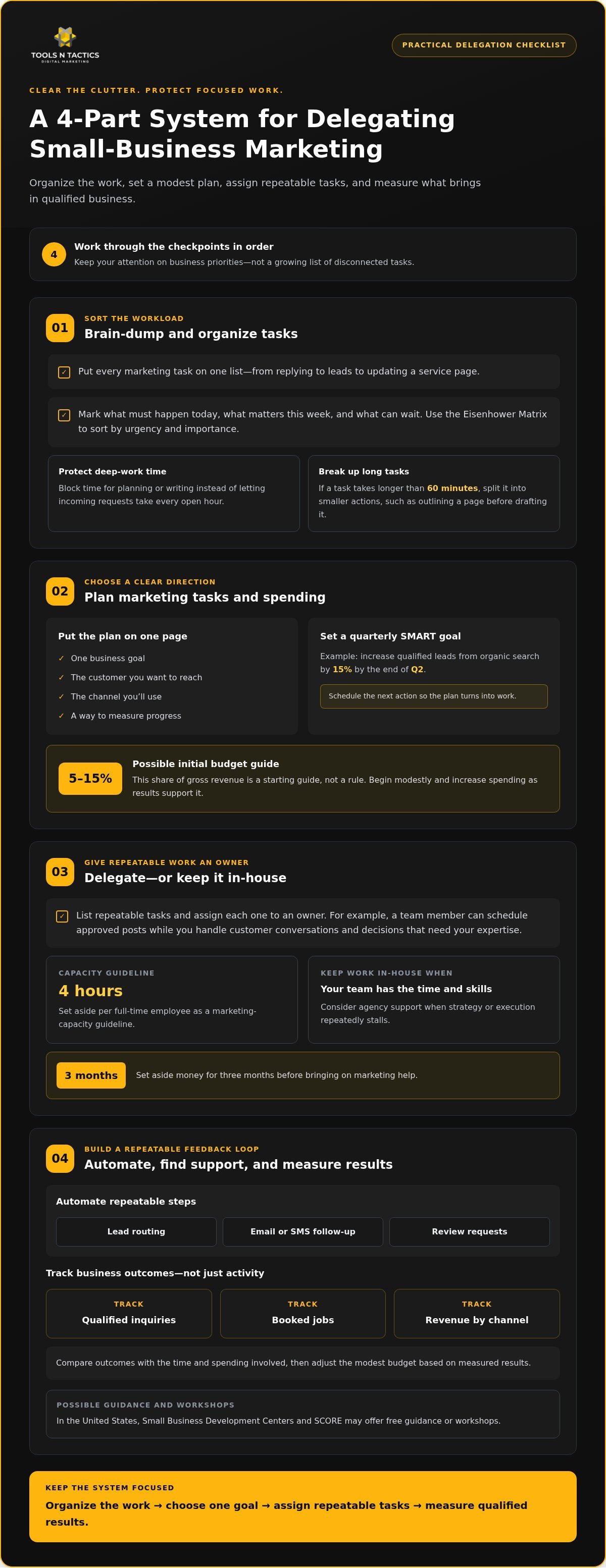
Use these four steps to clear mental clutter, protect focused work, and decide what to delegate.
Brain-Dump and Organize Work
Write every marketing task on one list, from replying to leads to updating a service page. Then mark what must happen today, what matters this week, and what can wait. The Eisenhower Matrix can help sort tasks by urgency and importance. Block time for deep work, such as planning or writing, instead of letting incoming requests claim every open hour. Divide tasks longer than 60 minutes into smaller actions, such as outlining a page before drafting it.
Plan Marketing Tasks and Spending
Create a one-page plan with one business goal, the customer you want to reach, the channel you’ll use, and a way to measure progress. Set quarterly SMART goals, such as increasing qualified leads from organic search by 15% by the end of Q2. How can a small business create a simple marketing plan? Put those pieces on one page, then schedule the next action. A 5-15% share of gross revenue can be an initial budget guide, not a rule; begin modestly and increase spending as results support it.
Delegate Work or Choose In-House Marketing
List repeatable tasks, then assign each one to an owner. A team member might schedule approved posts while you handle customer conversations and decisions that need your expertise. Use four hours per full-time employee as a marketing-capacity guideline. Should a small business hire a marketing agency or handle marketing in-house? Keep work in-house when your team has the time and skills. Consider agency support when strategy or execution repeatedly stalls. Set aside money for three months before bringing on marketing help.
Automate Tasks, Find Support, and Measure Results
Automate repeatable steps such as lead routing, email or SMS follow-up, and review requests. How can small businesses measure marketing results and ROI? Track qualified inquiries, booked jobs, and revenue connected to each channel, then compare outcomes with the time and spending involved. How much should a small business spend on marketing? Start with a modest budget tied to one goal, then adjust based on measured results. In the United States, Small Business Development Centers and SCORE may offer free guidance or workshops.
If recurring follow-up is taking time away from customer work, discuss a more manageable marketing workload.
Common causes of overwhelm in small business
Find the source of the friction before changing your marketing plan. These checks can help separate real business problems from avoidable noise.
- Review platform changes before rebuilding your approach. Marketing platforms change over time, and a feature that once reached customers may become less useful. Before reacting, compare recent results with your business goal. For example, a local photography studio might notice fewer inquiries from a social platform as its audience shifts elsewhere. Check whether inquiries have changed too, then adjust the channel or format that affects bookings. Don’t treat every platform update as a reason to replace the entire plan.
- Count the upkeep behind each channel. Every channel brings its own work: updating profiles, preparing content, responding to comments, and checking inquiries. A solo bookkeeping practice that opens accounts on several platforms may spend more time maintaining profiles than speaking with prospective clients. List the upkeep each channel requires, including who handles it. Without a clear owner, a channel can become a recurring source of unfinished tasks.
- Set a filter for outside advice. Advice often conflicts because it serves different audiences, budgets, and business models. A consultant who hears “publish more video” at one event and “focus on referrals” at another can end up with two new projects and no decision rule. Before adopting a tactic, write down the customer problem it addresses and the evidence you’ll use to assess it. If neither is clear, leave the idea off your current workload.
- Separate visible activity from useful business signals. Likes and views can feel rewarding, but they don’t show whether the right people are taking action. A private tutoring business might get strong engagement on general study tips while prospective families still struggle to understand its programs. Compare channel activity with relevant signals, such as requests for a specific service or conversations with suitable customers. This helps you distinguish attention from progress without dismissing useful brand awareness.
- Check whether the plan fits your actual workweek. Marketing can become another source of stress if it assumes uninterrupted time that business owners don’t have. A small accounting firm may face a heavy client workload during tax season, making its usual publishing schedule unrealistic. Look at upcoming busy periods and decide which tasks can pause, shift, or continue. A plan that ignores service demands often slips, leaving owners feeling behind before the next week begins.
Consistency over perfection
Choose a repeatable pace, publish useful work, and review what happened before changing your plan.
- Pick one channel and set a realistic rhythm. Choose a platform your customers already use, then set a schedule you can maintain. For example, a contractor might publish one useful LinkedIn update each week instead of immediately planning daily posts. If you choose LinkedIn, spend two to three weeks building the habit of logging in, reading posts, and connecting with people. Once that routine feels comfortable, post every day if possible. A steady pace moves your work forward without turning every day into a content deadline.
- Give new marketing activity time to work. New marketing efforts can take about six weeks before results start to appear. Use that period to keep the chosen activity going and note early signals, such as customer questions or website inquiries. Avoid replacing a channel after one quiet post. A roofer who shares regular project lessons can assess the pattern over time instead of treating each update as a separate verdict on the strategy.
- Choose an email schedule you can keep. Sending three or four emails in one month, then leaving the list untouched for eight months, creates an uneven experience. Set a repeatable cadence that fits your business and gives customers useful updates. For example, a home service company could send seasonal maintenance advice and explain relevant services. Keep each message focused so customers know why it matters and what step they can take next.
- Set a manageable publishing target. Two blog posts per week is one possible marketing pace, but it may not fit every team’s workload. Start at a pace you can sustain while answering customer questions accurately. A single well-planned article can support a service page, an email, and social updates. Build from real customer needs, not a quota that leaves no time for quality or follow-up.
- Review the week and adjust one thing. Set aside time to note what went well, what remains undone, and what you’ll change next week. Check whether your chosen channel received consistent attention and whether customers responded. Then choose one way to handle overwhelm and practice it for a month before adding another. This keeps the plan manageable and replaces scattered thinking with a clear record of what your business tried and learned.
Prioritize consistent activity on the channel your target audience uses, and respond to social media comments each day to keep conversations moving.
Website and search optimization
Your website connects search visibility to customer action. Improve its basic structure before adding more channels.
- Check the mobile experience first. Open your website on a phone and test the path from the homepage to a service page and contact option. Can visitors read the text, understand what you offer, and find how to call or request an estimate? A basic website should work well on mobile devices and be optimized for search. If a page is hard to use on a phone, social media activity may send visitors to a dead end.
- Give each service a clear page. Create a focused page for each core service instead of putting every detail on one crowded page. For example, a roofing company can explain roof repairs separately from roof replacement. Describe the customer’s problem, the service, and the next step in plain language. This structure helps visitors find relevant information and gives search engines clearer context about your business.
- Write for the questions customers actually ask. Use calls, estimate requests, and job conversations to identify what people need to know before contacting you. Answer one question on the most relevant service page. An HVAC company might explain what information helps schedule a service visit. Specific answers build trust and help searchers decide whether your business fits their needs, rather than leaving them to guess from a broad marketing claim.
- Choose one search goal and measure it. Set a target that connects website activity to business growth. For example, aim to increase qualified leads from organic search by 15% by the end of Q2. Another measurable example is increasing website traffic by 20% in 3 months. These are examples, not universal targets. Track the same measure over time, then inspect which pages bring relevant visits and inquiries before changing the plan.
- Fix the weakest step in the customer path. Follow one route from a search result to a completed inquiry. Check whether the service page answers the visitor’s question, the contact option is easy to find, and the form asks only for useful details. If visitors reach a page but don’t contact you, improve its message or next step before publishing more content. If qualified visitors aren’t finding the page, focus on search visibility first.
Use this sequence to improve the foundation before chasing every new platform. If your website needs a focused review, discuss website and search priorities with a growth partner.
Tools N Tactics | Local SEO & Digital Marketing Solutions: Growth Partner Program
Tools N Tactics | Local SEO & Digital Marketing Solutions can help service businesses turn scattered marketing tasks into a coordinated growth plan through its Growth Partner Program. If your team knows what needs attention but lacks time or direction to connect the work, the program brings visibility, conversion, and authority efforts into a clearer system.
The Visibility Engine supports search discovery, while the Conversion Engine helps visitors take the next step. The Authority Engine strengthens the trust signals customers use to assess your business. Together, these components help clarify priorities across visibility, website performance, and customer confidence.
Explore a growth partnership if you need strategic direction and implementation support, rather than another disconnected tactic. Contact Tools N Tactics to discuss your marketing priorities.
Make Your Next Marketing Decision With Confidence
If you’re feeling overwhelmed by small business marketing, make your next move a decision, not another commitment. Choose one change that addresses a real obstacle, such as unclear service information or missed inquiries. Give it a clear purpose, then watch how customers respond. You’ll learn more from a focused adjustment than from adding several tactics at once.
Set a regular time to decide what to keep, improve, or stop. For example, if a page brings relevant visitors but few inquiries, review its explanation and next step before creating more pages. If a channel draws attention but not suitable prospects, reconsider whether it deserves your time. This gives your marketing a practical feedback loop instead of an endless task list.
When you want help connecting those decisions to a workable growth plan, Tools N Tactics can help you identify priorities and put them into action. Talk with Tools N Tactics about your marketing priorities, and take the next step with a clearer plan.
Frequently Asked Questions
What Marketing Activity Actually Matters at the Start?
Start by identifying which service you most need to sell and who typically buys it. Review recent booked jobs and note which service types fit your business goals and available capacity. For example, a professional services firm may find that one specialized offering leads to stronger client relationships than a broad list of services. Focus your early marketing on making that offering easier for suitable customers to recognize.
Where Should You Focus Your Effort First?
Focus first on the business constraint that limits growth, not the marketing task that looks easiest. If your schedule is already full, attracting more inquiries may create pressure instead of value. If a key service has open capacity, promoting it may make more sense. Review your current workload, service mix, and business priorities together before choosing where to direct your effort.
Why does small business marketing feel overwhelming?
Marketing can feel overwhelming when no one knows who makes the final decisions. One person may want frequent social posts, while another expects more website leads, leaving tasks to compete without a shared priority. Set a clear decision-maker and agree on what success means for the current effort. This reduces conflicting requests and helps the team make changes for a reason, rather than reacting to every new suggestion.
Which marketing channels are most effective for small businesses?
The most effective channel depends on how customers discover, evaluate, and return to your business. A referral may introduce a professional service, while search can help someone actively comparing local options. Email may suit a business that regularly serves repeat customers. Map each channel to a specific customer stage, then assess whether it supports that stage. This makes comparisons more useful than judging channels by activity alone.
How can small business owners prioritize marketing tasks?
Prioritize tasks by business impact, prerequisites, and timing. For example, a new service announcement should wait until staff can deliver the service and handle related inquiries. A task that removes a blocker may need to come before promotional work. Write down the next action, its owner, and what must happen first. This simple sequence helps prevent incomplete campaigns and work that cannot yet produce a useful result.
What are common small business marketing mistakes and risks?
A common risk is promoting work the business cannot deliver consistently. A seasonal campaign may create demand when staffing or scheduling is already tight. Before launching, match the offer and timing to your service capacity. Also avoid judging marketing only by attention: a busy social post can attract people outside your service area. Consider whether the response fits your intended customers and the work your team can take on.