
Dallas SEO and lead generation services help local businesses improve their visibility in Google Maps and local search, so potential customers can find them when they need a service. A strong approach connects useful content, a clear keyword strategy, and credible links with a website that makes it easy to call or submit an inquiry. Visibility matters most when it brings the right people to a clear next step.
If your website isn’t generating steady inquiries from search, the problem may extend beyond rankings. Your pages might not match what local customers need, or visitors may not find enough information to feel confident reaching out.
This article explains how local SEO can support lead generation in Dallas, how content, keywords, and links contribute, and how to improve the path from search to inquiry. It also covers what to look for in an SEO strategy and how to measure progress beyond traffic alone. The goal is a connected system: local customers find your business, understand what you offer, and know what to do next.
Key Takeaways
- Start with an SEO audit to find gaps in your website, local listings, and search visibility, then prioritize fixes that can help nearby customers find you.
- Build service and location pages around the questions potential customers ask, and make the next step to call or inquire clear.
- Choose keywords by service, location, and customer intent so your content can attract people looking for the work you actually provide.
- Use relevant, trustworthy links to strengthen your site’s authority, and focus on useful content that gives other local sources a reason to reference your business.
- Review agency case studies for the work performed and the outcomes measured, then track your own qualified inquiries alongside search traffic.
HOW CAN MY BUSINESS IMPROVE VISIBILITY IN GOOGLE MAPS AND LOCAL SEARCH RESULTS IN DALLAS?
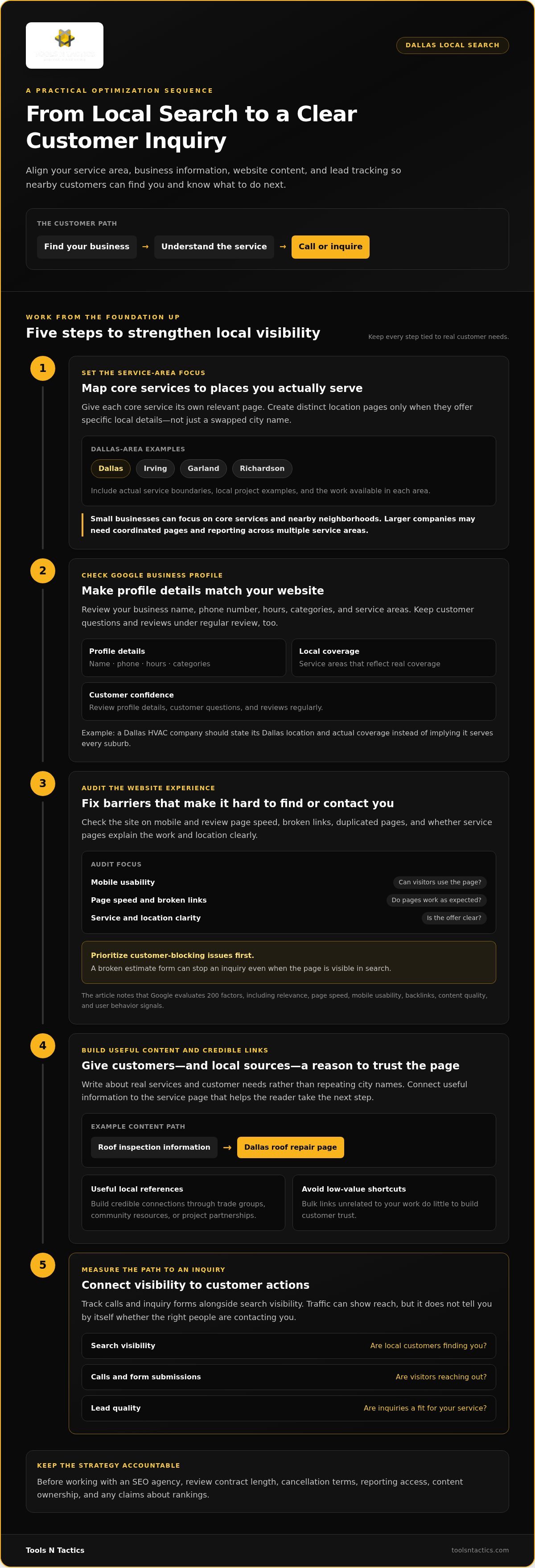
Small businesses can focus on core services and nearby neighborhoods, while larger companies may need coordinated pages and reporting across multiple service areas. Before engaging an SEO agency, review the contract length, cancellation terms, reporting access, content ownership, and any claims about rankings.
Google Maps Visibility
Start with your Google Business Profile. Confirm that the business name, phone number, hours, categories, and service areas match your website. A Dallas HVAC company, for example, should clearly state its Dallas location and actual coverage instead of implying it serves every suburb. Review profile details, customer questions, and reviews regularly. Accurate information helps searchers decide whether your business fits their needs before they call.
SEO Audits and On-Site Optimization
An SEO audit checks how search engines and visitors experience your site. Review mobile usability, page speed, broken links, duplicated pages, and whether each service page explains the work and location clearly. Google evaluates 200 factors, including relevance, page speed, mobile usability, backlinks, content quality, and user behavior signals. Prioritize fixes that block customers from finding or contacting you, such as a broken estimate form.
Content Marketing and Link Building
Create useful pages around your actual services and customer needs, not repeated city names. A roofing contractor could explain roof inspections and link that information to its Dallas roof repair page. Relevant links from local organizations can also support visibility. Build credible connections through trade groups, community resources, or project partnerships. Bulk links unrelated to your work do little to build customer trust.
Local targeting should match where crews can realistically serve customers. Build distinct pages for Dallas and nearby cities such as Irving, Garland, and Richardson only when each page offers specific service details. A page that swaps city names but repeats the same text gives readers little reason to choose you. Include local project examples, service boundaries, and a clear contact step. A broader digital marketing plan for Dallas-area businesses can align local search with website content and lead tracking.
Use this sequence to keep optimization focused on customer needs:
- Map each core service to its own page and relevant Dallas-area locations.
- Check Google Business Profile details against the website before changing local targeting.
- Track calls and inquiry forms alongside search visibility, so traffic connects to business outcomes.
Agency case studies and reported campaign results
Case studies can show how an agency connects SEO work to business outcomes, but a headline percentage needs context. A Dallas plumbing campaign reported 344% more search traffic and 148% more online leads. Those figures describe one campaign, not a result every business should expect. Look for the starting point, campaign period, work completed, and the difference between traffic, inquiries, and booked jobs.
Other reported Dallas examples show why the measured outcome matters. Qualis Roofing & Construction gained 2,000 organic conversions and 224% more new organic users. A Dallas land-clearing and site-preparation provider reported 372% more new organic users and 291% more organic conversions. These results point to separate measures: users indicate reach, while conversions indicate actions. Ask whether a case study tracks qualified inquiries or only website activity.
Compare directories with care
Directory size is not a quality score. One Dallas SEO-firm directory lists 739 companies, while a displayed ranking shows 25 companies among 139 matches. A separate listing reports an average of 4.9 contacts per company as of September 29, 2026. Treat contact counts as listing details, not proof of expertise. A marketing agency’s fit depends more on relevant experience, clear reporting, and work aligned with your service area.
Some rankings now assess AI SEO capabilities alongside traditional search performance. One methodology weights AI visibility at 60% and tracks 200 prompts over the past year. Google search performance accounts for 10%, while reviews and experience each account for 5%. These weights describe that methodology, not a universal standard. Ask what prompts were tested, how visibility was scored, and whether the findings connect to local seo and qualified leads.
Read the evidence behind the result
Before comparing an SEO company, match its case studies to your business model. A roofing contractor should look for home-service examples, while a professional firm may need evidence about inquiry quality and longer decision cycles. Check which channels were included, such as social media or advertising, to understand what SEO contributed. Then ask for a straightforward reporting plan that covers rankings, organic visits, calls, form submissions, and lead quality.
- Compare the same outcome across examples, such as qualified inquiries rather than traffic alone.
- Check whether the campaign’s location, service, and starting conditions resemble yours.
- Review directory rankings as a shortlist, not a final hiring decision.
If you’re weighing agency evidence against your Dallas growth goals, discuss your SEO priorities and the outcomes you need to measure.
Content writing and website conversions
Search visibility brings people to a page. Useful content and clear next steps help turn visits into inquiries. For a Dallas contractor, each service page should address a customer’s concern and make contacting the business straightforward.
Content Management and Creation
Keep website information accurate as your services, service areas, and customers’ questions change. Assign someone to review pages, update outdated details, and organize drafts before publication. An HVAC company, for example, can maintain separate pages for system repairs, seasonal maintenance, and replacements. Each page should describe the work the company does and guide readers to a relevant next step.
Set a consistent review process. Check that phone numbers, hours, service descriptions, and calls to action still reflect current operations. Reputation management can also address recurring customer feedback, such as questions about estimates or how to prepare for an appointment. A clear response can build trust and help future customers understand what to expect.
SEO Content Development
SEO content should answer a real search need, not simply repeat a service phrase. A Dallas roofer might explain how an inspection works, what signs could point to damage, and what information helps prepare an estimate. Use clear headings to make the page easy to scan, then link related explanations to the relevant service page. This gives search engines useful context and helps visitors understand the topic.
Plan content around service, location, and intent. A page about kitchen remodeling in Dallas should offer details specific to the work, not copy a template and swap city names. Organic visibility is more useful when the page also helps visitors decide whether to call, request an estimate, or explore another service.
Content alone won’t solve a website that makes inquiries difficult. Review the conversion path on a phone: can visitors find the phone number, understand the service area, and submit a short form easily? A landing page for emergency plumbing, for example, should clearly show the service, coverage, and contact option. Remove competing calls to action that distract from the main next step.
Measure content by the actions it supports. Track organic visits alongside calls, form submissions, and the service pages those inquiries came from. If a page attracts visits but few inquiries, check whether its content matches the search intent and whether the contact option is easy to find. If visitors leave after reading, offer a relevant next step, such as linking information about roof damage to an inspection request page.
- Give every page a clear audience, purpose, and next step.
- Review business details and service descriptions before publishing updates.
- Compare page visits with inquiry quality to guide revisions.
Keyword research and strategy
Keyword research helps a Dallas business decide which searches merit a dedicated page or service description, and which aren’t a priority. Start with actual services, customers’ language, and the areas the business serves. A commercial electrician, for example, might compare “commercial electrician Dallas” with “electrical panel upgrade near Lakewood.” The first suggests a broad service need; the second points to a specific job and location.
Group keywords by intent before planning content. Someone searching for “emergency drain repair” needs a direct service page, while someone asking how drain cleaning works may need an explanatory article. Map each group to one strong destination. This helps prevent pages from competing for the same phrase and gives visitors a clearer route from question to inquiry.
Prioritize searches that match the work you want and can take on. Review inquiry records, estimate requests, and customer conversations for recurring service language. Compare those phrases with your current pages to identify gaps. If a Dallas remodeling firm wants more kitchen projects, for example, assess whether its site explains the work, design scope, and project steps. Traffic alone doesn’t show a keyword’s business value; lead relevance matters.
Technical SEO supports your keyword plan by helping search engines access and understand the right pages. Check that important service pages can be crawled, load correctly on mobile, and have clear titles and headings. Review duplicate pages, broken internal links, and indexing issues before adding more content. If two pages describe the same Dallas electrical service, clarify their different purposes or combine overlapping information.
A backlink strategy should demonstrate relevant expertise, not chase volume. A Dallas trade business might contribute practical safety advice to an industry association’s resource page or earn a mention through a community project. Evaluate each opportunity for topical relevance, credibility, and value to its audience. Avoid automated link packages and unrelated placements. An SEO agency should explain how its outreach supports your services and local reputation.
Use a keyword map to connect research with execution. For each priority, record the topic, search intent, matching page, location, and next action. Review Google Search Console performance alongside calls and form inquiries. If a page gains impressions but few visits, refine its title and description. If visits rise without relevant leads, improve the service details and contact path.
- Map each service-intent group to one primary page.
- Use customer language and real inquiry patterns to shape priorities.
- Fix technical barriers before expanding the content plan.
- Judge keyword strategies by qualified inquiries, not traffic alone.
Link building and content writing
Off-page SEO includes signals from outside your website, particularly links from relevant, trusted sites. A Dallas construction firm might earn a mention from a local trade association after sharing useful project guidance. That reference can help people discover the business and give search engines context about its work. Build genuine relationships rather than simply collecting links.
Useful content gives those relationships something worth sharing. A remodeling company could publish a clear guide to preparing for a renovation consultation. A local community organization or supplier may share it because it answers a real question. Web design matters, too: readable layouts, clear sources, and working links make an article easier to use and share.
Plan outreach around expertise and relevance. Identify organizations, suppliers, community groups, and publications connected to your services. Offer a practical resource or expert contribution that benefits their audience. A Dallas roofer, for example, could provide storm-preparation advice for a neighborhood newsletter. Aim for a credible mention that reaches potential customers, not a link added solely to influence rankings.
Be cautious about shortcuts. Paid link schemes, automated placements, and unrelated directories can be a poor fit for your brand. Ask where a link will appear, why its audience relates to your work, and what content supports the placement. Start with usefulness. Keywords should fit the resource’s subject naturally, not be forced into every link’s anchor text.
Use a simple workflow to keep the work accountable:
- Choose a specific service topic, such as commercial roof inspections in Dallas.
- Create a useful article, checklist, or project explanation based on real customer questions.
- Find relevant local organizations that could benefit from sharing that resource.
- Track the source, destination page, referral visits, and resulting inquiries.
Review results alongside organic visibility and lead quality. If a local supplier links to a guide but readers don’t reach the related service page, strengthen the article’s internal links and next step. If a resource attracts attention but no relevant referrals, reassess its topic and audience. This connects link building to customer acquisition instead of treating rankings as the only measure of progress.
For a plan that aligns useful content with relevant authority-building, discuss your content and link-building goals.
Tools N Tactics | Local SEO & Digital Marketing Solutions: Growth Partner Program
Tools N Tactics helps service businesses connect search visibility with effective customer journeys through its Growth Partner Program. The program brings strategy and implementation together when local SEO, website conversion, and authority building need a coordinated plan.
The Visibility Engine helps businesses appear in relevant searches. The Conversion Engine focuses on turning website visits into calls or inquiries. The Authority Engine builds credibility through useful content and relevant online signals. Together, they address gaps such as local visibility without a clear inquiry path, or useful website content that lacks authority.
If your search traffic isn’t producing the inquiries your business needs, explore a more connected growth plan. Contact Tools N Tactics to discuss your priorities.
Turn your next search opportunity into a clear plan
Local growth is easier to manage when the next action is specific. Choose a service you want to grow, identify the Dallas customers you want to reach, and decide how your team will handle new inquiries. This gives your marketing a practical goal beyond higher rankings. It also helps you assess whether your lead-generation process fits your team’s capacity to respond and serve customers.
A focused plan for Dallas SEO and lead generation services connects search visibility to the customer’s next step, then measures whether that step brings relevant inquiries. If your current efforts feel scattered, identify the gap: local reach, useful content, website conversion, or follow-up. A clear priority makes it easier to build a system your team can maintain and improve.
Tools N Tactics can help you assess those priorities and shape a coordinated approach around your business goals. Start a conversation about your local growth priorities and take the next step with a clearer plan.
Frequently Asked Questions
HOW CAN SEO HELP MY BUSINESS GET MORE LEADS IN DALLAS?
Dallas SEO and lead generation services help potential customers find your business when they need your work. A Dallas electrician, for example, can make it easier for searchers to understand its panel upgrades, repair services, and coverage areas. Local visibility should lead to a clear next step, such as calling or requesting an estimate. Businesses serving Plano, Celina, Princeton, Melissa, Sherman, or Frisco can specify which areas they cover.
HOW MUCH DO SEO SERVICES IN DALLAS COST?
SEO costs depend on the scope of work, with pricing provided after a quote request. Factors include your website’s condition, the services and locations targeted, technical fixes, content needs, and the amount of ongoing work. A business serving Dallas alone may need a different scope from one covering North Texas communities. Compare the work and reporting included, not just the headline price.
WHY SHOULD I HIRE A DALLAS SEO AGENCY INSTEAD OF MANAGING MARKETING IN-HOUSE?
An agency can provide SEO planning and implementation capacity without requiring your team to manage every task internally. In-house marketing may suit a company with staff, time, and established processes for ongoing work. A smaller contractor may prefer outside support for technical reviews or local strategy. Tools N Tactics’ Growth Partner Program connects marketing work with broader business growth priorities.
Why Does SEO Matter?
SEO matters because customers often compare businesses before making contact. A clear online presence helps them understand your services, coverage, and credibility. If a North Texas roofing company provides little useful information online, a potential customer may shortlist another business instead. Accurate service details and helpful answers can build trust before the first call, particularly when customers are deciding which company to invite to their property.
HOW DO I MEASURE SEO SUCCESS?
Measure more than rankings. Track calls, form submissions, qualified inquiries, estimates, and booked work alongside organic visits. For example, label leads by service and location in your CRM, then compare Dallas roof repair inquiries with Frisco replacement requests. This shows which pages attract the right prospects and which traffic doesn’t become business. Review the data regularly so your next content or website decision reflects actual lead patterns.
HOW DOES GOOGLE RANK WEBSITES?
Google’s results reflect how well a page appears to meet a searcher’s needs, as well as signals about the site and business. Someone searching for HVAC repair in Plano may see different local options from someone searching in Dallas. Clear service information, a usable website, and credible references help search engines interpret a business. Map results and standard website listings may also show different businesses.
HOW LONG DOES IT TAKE TO SEE RESULTS FROM AN SEO SERVICE?
Tools N Tactics reports that SEO results typically begin to show noticeable impact in 2 to 6 months. Progress depends on the site’s starting condition, the work completed, and competition for the target services. Track early changes in search visibility alongside calls and qualified inquiries. Keeping the same measurement approach helps you see whether increased visibility is attracting prospects who fit your services and coverage area.
HOW LONG DOES SEO TAKE TO SHOW RESULTS?
SEO isn’t a one-time adjustment. It needs ongoing attention as your services, website, and customers’ questions change. After making an initial improvement, review whether key pages still reflect your work and whether site changes affect how search engines access them. If a contractor adds a service, for example, update relevant content and tracking so future inquiries can be attributed to it.