
The “free” chatbot widget on your website might be the most expensive tool you own if it drives away frustrated customers with generic, useless answers. Many HVAC and roofing contractors feel trapped between fragmented tools that don’t talk to their CRM and the fear of hidden monthly fees that scale faster than their profits. Understanding ai chatbot pricing for business in 2026 requires looking past the sticker price to see the structural integrity of the system you’re building.
You likely agree that a tool is only worth the investment if it creates a repeatable system for growth. This guide promises to clear the fog around setup costs versus monthly maintenance and show you how to budget for a solution that actually routes leads to your team automatically. We’ll preview the shift from simple subscriptions to high-performance lead engines, ensuring your AI represents your brand with the same professionalism you bring to a job site. Stop viewing AI as a digital toy and start treating it as the mechanical backbone of your customer intake process.
Key Takeaways
- Learn why a cheap monthly subscription often fails to book jobs and how to spot the “tool trap” before you buy.
- Compare flat-rate and usage-based ai chatbot pricing for business to find the model that fits your company’s volume.
- Avoid hidden expenses by planning for CRM integrations with platforms like ServiceTitan or Jobber from day one.
- Use a simple math framework to see how saving just one roofing or HVAC job can pay for your entire AI system.
- Shift your strategy from buying a standalone bot to building an integrated growth engine that handles lead routing automatically.
Why Standalone AI Chatbot Pricing Often Misleads Small Businesses
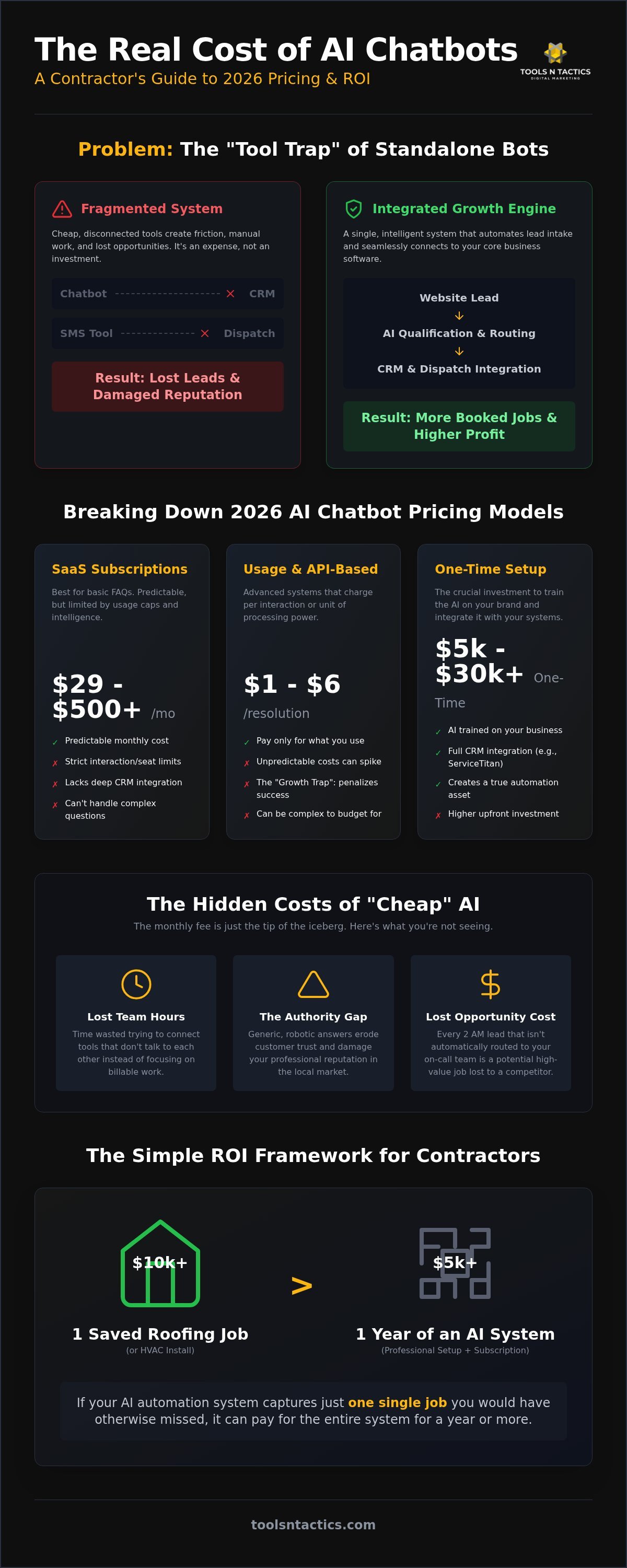
Many contractors see a $20 monthly price tag and think they’ve solved their lead intake problem. This is the “Tool Trap.” Software companies sell features, but business owners need outcomes. When researching ai chatbot pricing for business, looking at the monthly subscription fee alone is like looking at the cost of a spark plug instead of the whole truck. It’s a small part of a much larger machine.
In North Texas, we see roofing and HVAC companies buying tools in isolation. They have a chat widget from one vendor, an SMS tool from another, and a CRM that doesn’t talk to either. These fragmented systems create friction. If a lead from Plano hits your site at 2:00 AM, a standalone bot might say “hello,” but if it doesn’t trigger your Automation Engine to alert your team, that lead is as good as gone.
A bot is a script; an engine is a process. Most ai chatbot pricing for business models focus on the script. They charge you for the ability to send messages back and forth. However, a message is not a booked appointment. A true system connects that conversation to your dispatch software, sends a confirmation SMS to the homeowner, and updates your lead tracker. If your bot doesn’t move the needle on your bottom line, it’s just an expense, not an investment.
The Fragmented Tech Tax
Hidden costs pile up when you try to DIY your AI setup. You spend hours trying to make software work together; that’s time you should spend on job sites. Chatbot technology requires constant tuning to stay relevant. If you buy a “set it and forget it” tool, you’ll eventually forget why you bought it because it isn’t producing revenue. Managing three tools that don’t communicate costs more in lost opportunities than a professional, integrated system.
The Authority Gap
Cheap AI can damage your local Dallas reputation. If a potential customer asks about your specific emergency repair rates and the bot gives a generic, robotic answer, you’ve lost their trust. High-performance businesses use a Conversion Engine to ensure every automated interaction sounds like their brand. Custom-trained AI is no longer an optional luxury in 2026; it’s the baseline for looking professional. A generic response tells the customer you don’t care about the details, which is the last thing they want from a contractor.
Breaking Down 2026 AI Chatbot Pricing Models
The market for ai chatbot pricing for business has shifted from simple monthly fees to complex, hybrid models. In 2026, you’ll likely encounter three main ways to pay. Choosing the wrong one doesn’t just hurt your wallet; it can stall your lead flow. You need to align your costs with your specific business volume to ensure the system remains profitable as you scale.
SaaS Subscriptions for Local Businesses
Standard SaaS platforms typically range from $29 to over $500 per month. These plans are often best for basic FAQ handling or simple lead capture. However, they come with strict limits. At the $29 level, you might only get a few hundred “seats” or interactions. If your roofing company runs a heavy local promotion and traffic spikes, a basic plan might cut off right when the leads start pouring in. These templates lack the deep intelligence needed to handle complex scheduling or specific service questions.
Usage and API Token Costs
Many advanced systems now use usage-based pricing. You might pay between $0.99 and $6.00 per “resolution,” which is an interaction where the AI successfully answers a question or captures a lead. While this sounds fair, it can become a “growth trap.” As your AI becomes more efficient and handles more customers, your monthly bill climbs. This effectively penalizes you for being successful.
A token is the basic unit of AI processing cost. These costs are tied to the underlying model, such as GPT-4o. High-traffic sites can see sudden price spikes if the AI isn’t optimized to be concise. Professional systems balance this by using “RAG” (Retrieval-Augmented Generation) to pull from your own data efficiently, keeping token waste to a minimum.
- Flat-rate models: Predictable costs but often limited “brain power.”
- Usage-based models: Low entry cost but can scale unpredictably.
- Performance-based models: Costs are tied directly to the number of qualified leads generated.
Quality AI requires a one-time setup investment. Research shows that professional implementation and integration fees can range from $5,000 to $30,000. This covers the “blueprint” phase where the AI is trained on your specific brand voice and connected to your CRM. Skipping this step is why many contractors end up with a bot that gives generic, useless answers. If you aren’t sure which model fits your current call volume, you can request a custom ROI map to see the numbers for your specific service area.
The Hidden Costs of Cheap AI Chatbots for Service Companies
Many contractors get lured in by a low monthly fee only to realize the software is a hollow shell. When evaluating ai chatbot pricing for business, the real cost often lies in what the software doesn’t do right out of the box. A standalone bot is an isolated island; it doesn’t know your schedule, it doesn’t know your specific service areas, and it certainly doesn’t know how to talk to your CRM. Cheap software often leads to expensive failures that drain your time and frustrate your potential customers.
CRM and Lead Routing Integration
Building a high-performance Conversion Engine requires a seamless flow of data between your website and your field software. If you use ServiceTitan or Jobber, your AI needs a custom API bridge to push lead data directly into your dispatch queue. Without this integration, your office staff still has to manually copy and paste info from an email into your system. This manual work is a hidden labor tax that eats your margins and slows down your response time.
Speed to lead is the most critical metric for North Texas service companies. A bot that captures a name but doesn’t trigger an immediate SMS follow-up is a wasted investment. If a homeowner in Plano is looking for a roofer after a hail storm, they aren’t waiting for an email. They want a text confirmation that a pro is on the way. The true cost of a cheap bot is the loss of a high-value job because your competitor’s system responded in seconds while yours waited for a manual check.
Ongoing Content and Training Updates
AI isn’t a tool you can set and forget. Your business evolves; you add new services, change your pricing, or expand your service area further into Dallas. If your bot is left on autopilot, it will eventually provide outdated information. This leads to hallucinations where the AI makes up answers to fill gaps in its knowledge, which can lead to legal or reputational headaches.
- Quarterly Refreshes: Your knowledge base needs a technical tune-up every three months to stay accurate and relevant.
- Security and Compliance: Ensuring your AI handles customer data safely in North Texas is a requirement for building long-term trust.
- Expert Management: Budgeting for a partner to manage the technical heavy lifting ensures your AI remains a revenue-generating asset.
A professional partner handles the structural integrity of your AI systems. This allows you to focus on the structural integrity of your clients’ homes while your automation handles the intake. Don’t let a low-cost tool become a high-cost distraction for your operations team.
Calculating the ROI of Your AI Automation Budget
Measuring the return on investment for AI isn’t about counting how many people click a chat bubble. It’s about calculating the revenue captured that would have otherwise vanished. When you analyze ai chatbot pricing for business, you must view it through the lens of labor replacement and lead preservation. For a professional contractor, an AI system isn’t a line-item expense; it is a safeguard for your marketing budget.
Compare the cost of a high-performance AI system to a full-time office admin in North Texas. A reliable receptionist in Dallas or Plano typically requires a salary between $40,000 and $50,000, plus taxes and benefits. An AI system performs the initial intake and lead qualification for a small fraction of that cost. It doesn’t take sick days, it doesn’t miss calls during the lunch rush, and it never forgets to ask for a customer’s phone number.
The math of missed leads is even more compelling. In the roofing and HVAC industries, a single job can be worth $10,000 to $20,000 in revenue. If your AI captures just one emergency repair lead at 9:00 PM on a Tuesday while your competitors are asleep, it has paid for its entire annual operation. You aren’t just buying software; you’re buying a 24/7 net that catches the high-value jobs your team is too busy to grab.
Lead Capture vs. Lead Conversion
True ROI comes from moving a lead into your CRM, not just starting a conversation. By deploying the Automation Engine, you ensure that every chat interaction triggers a specific business outcome. Speed to lead is the most important metric for Plano contractors. If you don’t respond to a digital inquiry within five minutes, your chances of converting that lead drop significantly. AI ensures that response is instantaneous, maintaining the momentum of the sale until your team can step in.
Operational Efficiency Gains
Your dispatchers and sales reps should focus on high-value tasks, not answering repetitive questions about your service area or warranty details. AI chatbots reduce cost-per-lead by capturing traffic that usually bounces. By automating FAQ handling, you reduce the administrative burden on your staff. This allows your business to scale its lead volume and revenue without the immediate need to hire more office personnel. If you want to see exactly how these numbers look for your specific trade, request a custom ROI blueprint for your business today.
Beyond the Bot: Pricing AI as a Total Growth Engine
The most successful contractors in Dallas and Plano don’t view AI as a digital accessory. They don’t buy “just a chatbot” to sit on a website like a lonely sign in a dark alley. Instead, they treat AI as a mechanical component within a larger machine. When you evaluate ai chatbot pricing for business, you must decide if you’re buying a tool or an entire engine. A tool requires your constant attention; an engine provides the power to scale your revenue without more manual labor.
Standalone bots fail because they lack visibility and authority. If your bot isn’t integrated with your Visibility Engine, you’re paying for a conversion tool that never sees any traffic. High-performance businesses use our Growth Partner Program to ensure their AI and SEO work together. This unified approach prevents the “fragmented tech tax” where you pay for multiple services that don’t communicate. It’s about building structural integrity into your digital presence.
The Power of an Integrated System
An AI Chatbot for Local Business Website only works if it’s backed by data. It needs to be powered by a strong Authority Engine to answer specific questions about your trade with professional accuracy. If a customer asks about a specific roof material or HVAC brand, the AI must respond as an expert. This level of sophistication is the baseline for 2026. Moving from fragmented tools to a steady growth hand ensures your brand remains the top choice in North Texas.
Your 2026 Budgeting Checklist
Before you commit to ai chatbot pricing for business, you need to audit the provider’s claims. Many vendors sell basic templates at custom prices. Use this checklist to verify the value of the system they are proposing:
- Does the AI integrate directly with my specific CRM (ServiceTitan, Jobber, etc.)?
- Is the knowledge base updated quarterly to reflect my current services and prices?
- Does the pricing model penalize my success through high usage-based fees?
- How does the system handle lead routing when a high-value job is identified after hours?
- Can the provider show a clear ROI map based on local North Texas lead costs?
Audit your current lead flow before you spend a single dime on new software. You likely have leaks in your intake process that AI can fix, but you need a blueprint first. You can contact Tools N Tactics for a custom automation audit to see exactly where your system needs reinforcement. Stop buying software in isolation and start building a repeatable system for long-term stability.
Securing Your Lead Flow for Long-Term Stability
Stop looking at AI as a simple monthly subscription and start seeing it as a mechanical asset for your business. We’ve explored how ai chatbot pricing for business in 2026 is less about the sticker price and more about the structural integrity of your lead routing. A cheap bot that doesn’t talk to your CRM is a liability that costs you jobs; a professional engine is an investment that pays for itself by capturing high-value leads at all hours of the night.
You now have the blueprint to avoid the “tool trap” and the fragmented systems that plague so many North Texas contractors. By focusing on speed to lead and seamless integration, you can scale your operations without increasing your office overhead. Our integrated Automation Engine provides the stability you need with zero reliance on expensive paid ads. It’s time to move past digital toys and invest in high-performance functionality.
You don’t have to navigate this digital landscape alone. With our local expertise and proven systems, we’re ready to help you build a repeatable path to growth. Apply for the Growth Partner Program to Scale Your Business and turn your intake process into a revenue-driving machine. Your future growth starts with a solid foundation.
Frequently Asked Questions
Is a custom AI chatbot worth the price for a small service business?
A custom AI chatbot is worth the investment if it prevents missed leads after hours. For a roofing company in Dallas, missing a single $15,000 job because the office was closed is a major loss. Custom AI functions as a 24/7 intake specialist. It qualifies leads and books appointments while you sleep. This ensures your marketing budget isn’t wasted on traffic that hits your site but never converts into a phone call.
What is the average monthly cost for a business-grade AI chatbot in 2026?
Business-grade ai chatbot pricing for business typically ranges from $29 to over $500 per month for SaaS platforms. However, advanced systems often use usage-based models where you pay per resolution. These costs can range from $0.99 to $6.00 per successful interaction. For North Texas contractors with high lead volume, a hybrid model that combines a flat fee with usage often provides the most predictable budgeting for long-term growth.
Do AI chatbots have hidden fees for API usage?
Yes, many platforms pass through API token costs from providers like OpenAI. These additional fees depend on how much the AI has to process during a conversation. A token is the basic unit of processing cost. If your bot isn’t optimized to be concise, your monthly bill can spike during busy seasons. It’s essential to work with a partner who monitors these technical expenses to prevent unexpected budget overruns.
Can an AI chatbot integrate with my existing CRM like Jobber or ServiceTitan?
Seamless integration with Jobber or ServiceTitan is a core requirement for a high-performance system. A bot that just sends an email is a digital toy. A professional AI chatbot pushes customer data directly into your dispatch software. This triggers your Automation Engine to alert your team via SMS or email immediately. This connection eliminates manual data entry and ensures your Plano business responds faster than the competition.
How much does it cost to train an AI chatbot on my specific business data?
Implementation and training fees typically range from $5,000 to $30,000 in 2026. This one-time cost covers the technical architecture required to build your specific knowledge base. The AI must learn your service area, warranty details, and brand voice. While DIY templates are cheaper, they often lack the structural integrity needed to represent a professional North Texas contractor. Custom training ensures the AI provides accurate, brand-specific answers to every homeowner.
What happens if the AI chatbot gives a customer the wrong price?
Incorrect pricing can occur if the AI isn’t properly grounded in your data. High-quality systems use Retrieval-Augmented Generation to pull answers only from your approved documents. If an error happens, the system should have a clear protocol to flag the conversation for a manager. Regular quarterly updates to your knowledge base are necessary to keep the AI aligned with your current Dallas service rates and offers to prevent these hallucinations.
Is there a difference in pricing between AI voice agents and text chatbots?
AI voice agents are generally more expensive than text-based chatbots. This is due to the extra compute power needed for real-time speech processing and telephony costs. While a text bot might cost a few cents per interaction, a voice agent involves per-minute fees for the phone line and the AI listening time. For many North Texas service businesses, a text-based chatbot is the most cost-effective starting point for capturing website traffic.
How long does it take to see an ROI after installing a custom AI chatbot?
Most service companies see a return on investment within 30 to 90 days. The ROI math is simple; if the AI captures just one high-value roofing or HVAC job that would have bounced, the system has paid for itself. By reducing the burden on your office staff and improving speed to lead, you gain operational efficiency immediately. This allows your team in Plano or Dallas to focus on closing jobs instead of chasing data.